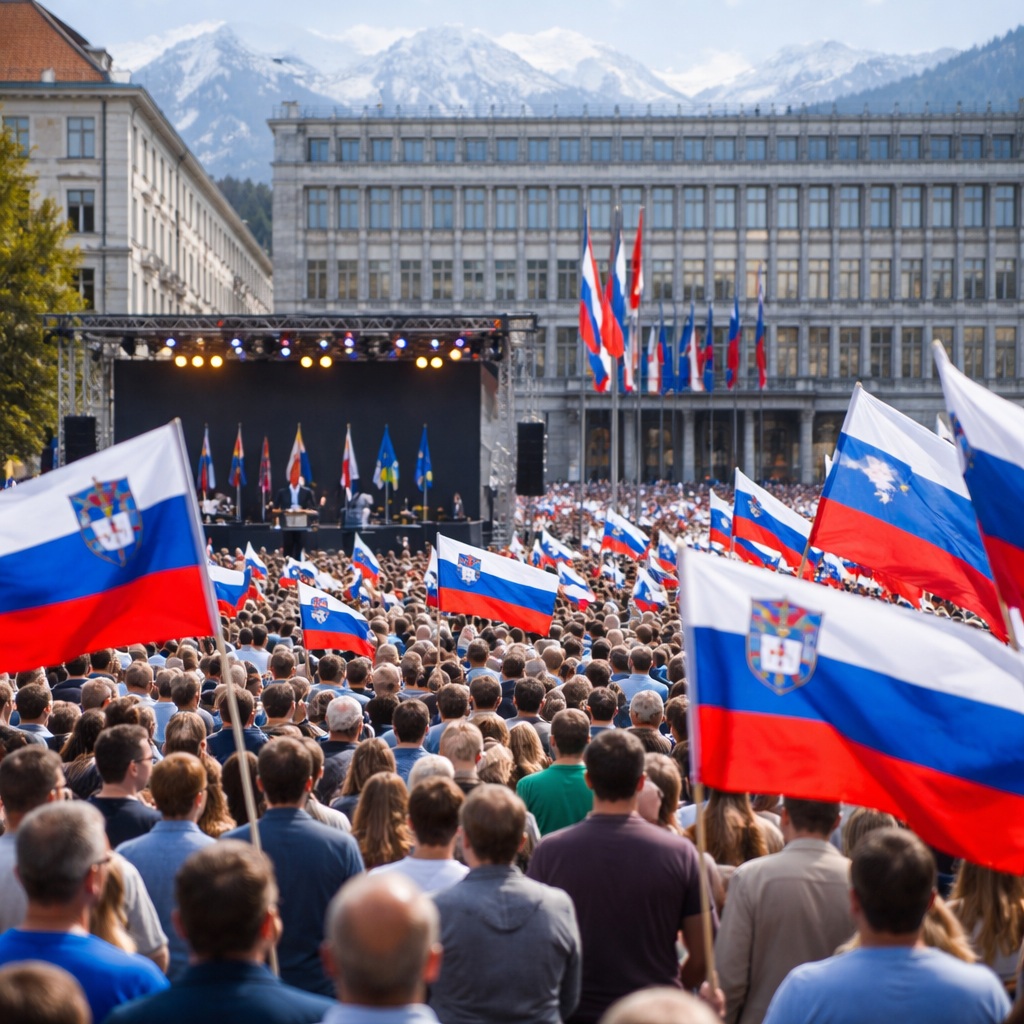
Campaign season opens as liberal coalition faces a more confident and organised opposition

Slovenia has formally entered election mode after the country’s president set the date for the next parliamentary vote in March, triggering the official start of the campaign period. The announcement marks a pivotal moment for the Alpine European Union member state, where shifting political dynamics and growing voter uncertainty are expected to shape the weeks ahead.
The election will determine the composition of Slovenia’s National Assembly and, ultimately, the direction of the next government. While elections are a regular feature of democratic life, the coming contest carries particular weight. It arrives at a time of heightened political fragmentation, rising public scrutiny of governing institutions, and renewed debate over Slovenia’s economic and social trajectory within the EU.
At the centre of the contest stands the current liberal-led governing coalition, which came to power on a promise of political renewal, institutional reform, and a more values-driven foreign policy. Since taking office, the coalition has pursued changes in healthcare management, climate and energy policy, and public administration. Supporters credit it with stabilising Slovenia’s international standing and restoring predictability after years of political turbulence. Critics, however, argue that reforms have been uneven and that everyday concerns such as cost of living pressures and administrative efficiency remain unresolved.
The opposition, sensing an opening, has become more vocal and more coordinated. Conservative and populist forces have stepped up their criticism of the government’s record, focusing on inflation, public sector performance, and what they describe as an overly ideological approach to governance. Smaller parties, meanwhile, are seeking to position themselves as pragmatic alternatives, appealing to voters fatigued by polarisation and repeated snap elections over the past decade.
With the election date now set, the technical machinery of the vote is moving into high gear. Candidate registration is under way, party lists are being finalised, and early campaign activities are already visible across the country. Billboards, town hall meetings, and social media outreach are beginning to signal the themes that will dominate the campaign: economic security, trust in public institutions, and Slovenia’s role in a rapidly changing Europe.
Political analysts note that voter turnout and coalition arithmetic may prove decisive. Slovenia’s proportional representation system often produces fragmented parliaments, making post-election negotiations as important as the campaign itself. Even a clear lead for one political bloc may not translate into an easy path to government, especially if smaller parties hold the balance of power.
Internationally, the election is being closely watched in Brussels and neighbouring capitals. Slovenia has generally been seen as a constructive EU partner, and the outcome of the vote could influence its stance on issues ranging from enlargement and migration to fiscal coordination and climate policy. While foreign policy rarely dominates domestic campaigns, it remains an undercurrent in debates about national interest and sovereignty.
As the campaign unfolds, much will depend on whether the governing coalition can defend its record convincingly and whether the opposition can translate dissatisfaction into a coherent alternative. For voters, the weeks ahead offer a chance to weigh competing visions for Slovenia’s future and to decide whether continuity or change best serves the country at this juncture.
What is clear is that the starting gun has been fired. With the election date confirmed, Slovenia’s political actors are moving from preparation to confrontation, setting the stage for a closely watched parliamentary race that will shape the country’s course in the years to come.



 The Tower Post