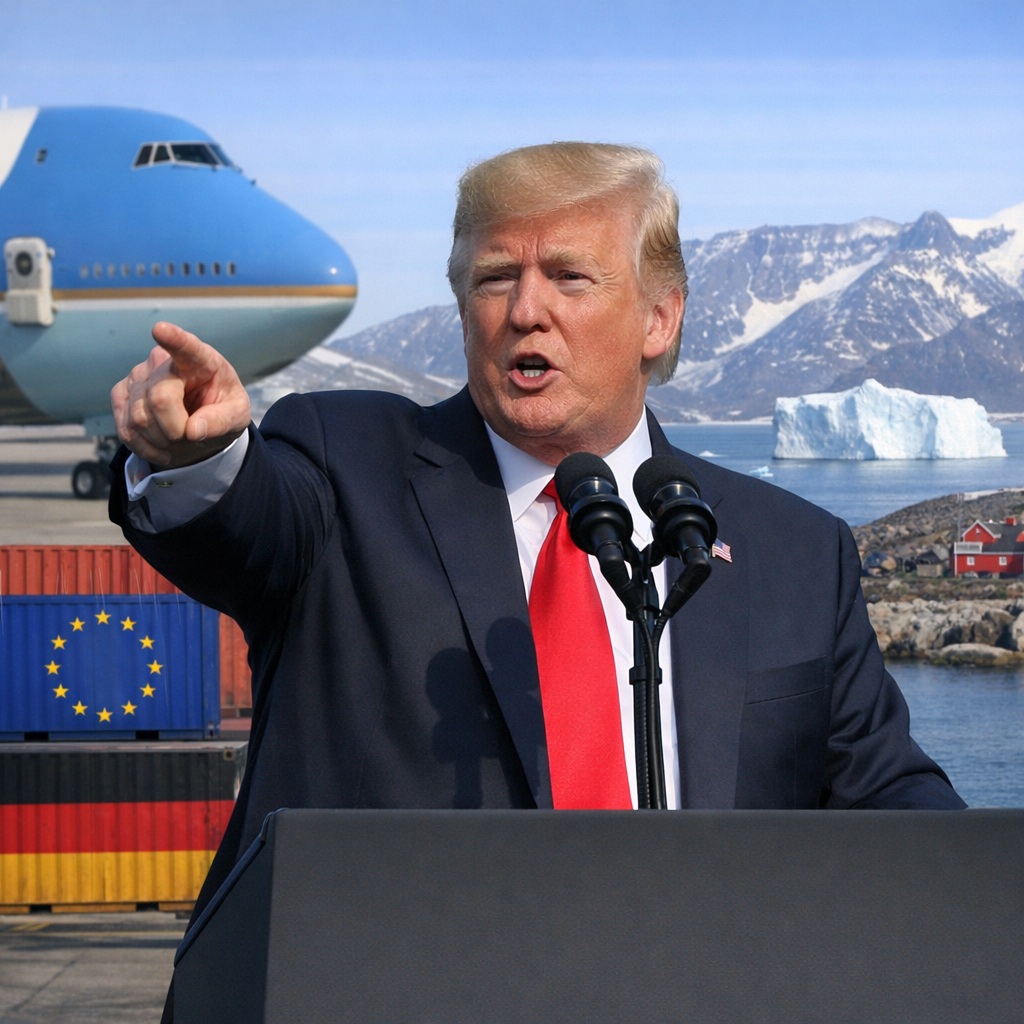
By tying renewed interest in Greenland to tariff threats against European partners, President Trump has reignited a transatlantic crisis that tests EU unity and exposes new fractures within NATO.
Washington’s long-running fascination with Greenland has returned to the center of global diplomacy, this time carrying a sharper economic edge. President Donald Trump has publicly linked American ambitions toward the Arctic island with the possibility of new tariffs on European nations, a move that European officials describe as coercive and destabilizing. The rhetoric has pushed relations between Washington and Brussels into their most volatile phase in years, reopening old wounds about trade, security, and sovereignty at a moment of strategic uncertainty.
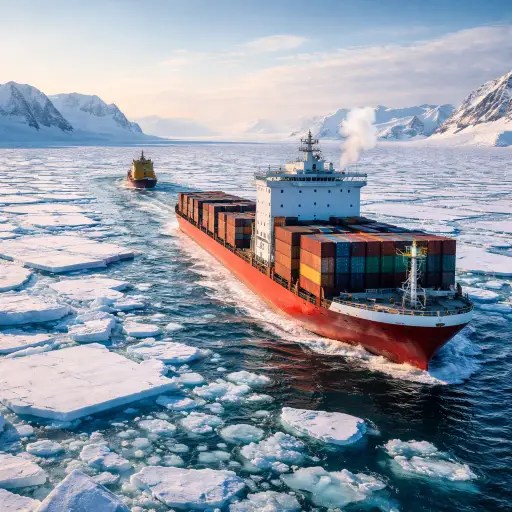
At the heart of the dispute lies Greenland’s growing geopolitical value. As Arctic ice continues to recede, the island’s location has become critical for transatlantic security, satellite monitoring, and access to emerging shipping routes. Its mineral potential, including rare earth elements essential for advanced technologies, has only intensified global interest. For the Trump administration, Greenland represents both a strategic asset and a symbol of renewed American assertiveness on the world stage.
European leaders, however, see a different picture. By tying Greenland to tariff threats, they argue, Washington is blurring the line between security cooperation and economic punishment. Several EU officials have warned that using trade measures to pressure allies undermines the spirit of partnership that has defined the postwar Atlantic order. The message from Brussels has been blunt: Greenland is not a bargaining chip, and Europe will not negotiate its sovereignty under threat.
The tariff dimension has proven especially inflammatory. President Trump has repeatedly portrayed tariffs as a legitimate tool to correct what he views as unfair European trade practices. This time, the implication that economic penalties could be applied in response to resistance over Greenland has alarmed European capitals. Diplomats fear a spiral in which trade disputes bleed into security cooperation, weakening the trust that NATO depends upon.
Within NATO, the tension has been palpable. While the alliance has weathered disagreements before, the current dispute cuts closer to its core. Greenland hosts critical infrastructure tied to North American and European defense, making cooperation essential. Any perception that one ally might leverage economic pressure to extract strategic concessions raises uncomfortable questions about collective defense and mutual respect.
Denmark, which retains responsibility for Greenland’s foreign and security policy, has found itself in a particularly delicate position. Danish officials have emphasized that Greenland’s future must be decided by its own people, not negotiated in foreign capitals. At the same time, Copenhagen is acutely aware of its reliance on NATO solidarity and the risks of a prolonged standoff with Washington.
Greenlandic leaders have also sought to assert their voice amid the escalating rhetoric. While welcoming investment and international engagement, they have stressed their right to self-determination. For many in Nuuk, the renewed attention from global powers is a double-edged sword, promising economic opportunity while threatening to turn the island into a pawn in a larger power struggle.
The crisis has exposed broader anxieties within the European Union about strategic autonomy. Calls have grown louder for Europe to reduce its vulnerability to U.S. trade pressure and to strengthen its own defense capabilities. Some officials argue that the Greenland episode illustrates the need for a more unified European response to external pressure, both economic and military.
In Washington, supporters of the president frame the approach as pragmatic realism. They argue that the United States is merely defending its interests in an increasingly competitive world and that Europe must adapt to a less sentimental, more transactional partnership. Critics, however, warn that this strategy risks alienating allies at a time when coordination is essential to manage global challenges from climate change to great-power rivalry.
As the standoff continues, the Greenland tariff threat has become more than a bilateral dispute. It is a stress test for the transatlantic relationship itself. Whether the crisis leads to renewed dialogue or deeper division will shape the future of NATO and the balance of power in the Arctic for years to come. What is clear is that trust, once strained, is not easily repaired, and the cost of this confrontation may extend far beyond trade or territory.

 The Tower Post