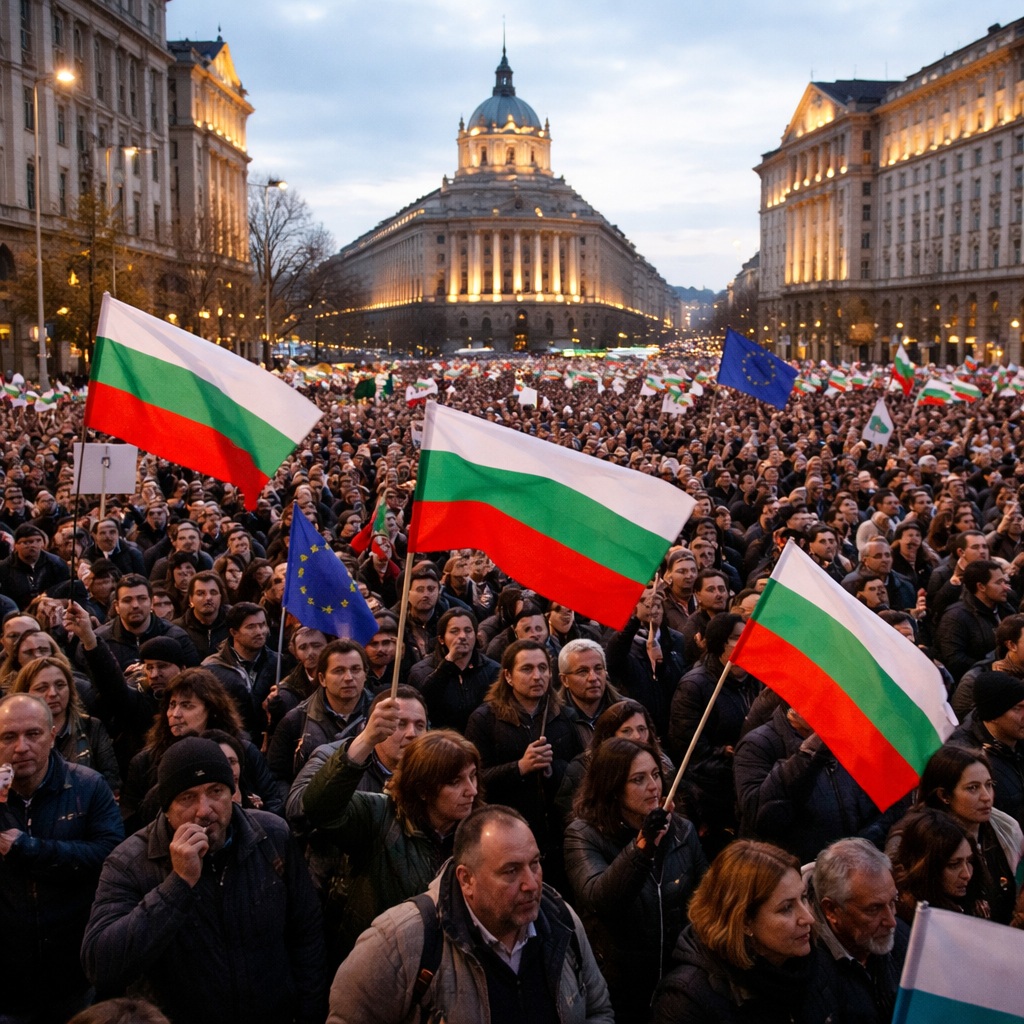
Crowds in Sofia demand transparent voting rules as political deadlock deepens and trust in institutions erodes.
Thousands of demonstrators filled the streets of Bulgaria’s capital this week, transforming central Sofia into a sea of flags, banners, and chants calling for fair and transparent elections. The protests, among the largest seen in recent months, reflect mounting public frustration with a political system trapped in prolonged instability and repeated votes that have failed to produce a lasting government.
From early afternoon into the evening, people gathered around key landmarks and government buildings, accusing authorities of undermining electoral integrity by refusing to fully implement machine voting and by maintaining procedures that critics say leave too much room for manipulation. Protesters from different age groups and political backgrounds shared a common message: confidence in elections has been steadily eroded, and without credible reforms, any new vote risks deepening the crisis rather than resolving it.
“Elections are supposed to be the foundation of democracy, not a source of suspicion,” said one demonstrator, holding a Bulgarian flag wrapped around their shoulders. Similar sentiments echoed through the crowd, where chants calling for transparency and accountability rang out across the city center.
At the heart of the protests is the government’s decision to limit or roll back the use of voting machines, a system introduced in recent years to reduce errors and prevent fraud. Supporters of machine voting argue that electronic systems provide clearer audit trails and reduce opportunities for ballot stuffing or miscounting. Critics within the government, however, have raised concerns about technical failures, security risks, and voter confusion, insisting that paper ballots remain more reliable.
For many Bulgarians on the streets of Sofia, those arguments ring hollow. Protest organizers claim that the refusal to expand machine voting is politically motivated, designed to preserve opaque practices that benefit entrenched interests. They warn that without meaningful safeguards, the legitimacy of the next election could be questioned from the outset.
The demonstrations come at a delicate moment for Bulgaria, which is once again preparing for a national election after a fragmented parliament failed to form a stable governing coalition. Successive votes have produced divided legislatures, short-lived administrations, and caretaker governments with limited mandates. Each new election has promised a breakthrough, only to deliver another stalemate.
Political analysts say the repeated cycles of voting and deadlock have taken a toll on public trust. Voter turnout has shown signs of fatigue, while skepticism toward political parties and institutions has grown. “When citizens feel their vote does not lead to meaningful change, they begin to disengage,” said one Sofia-based political observer. “That is why the integrity of the process itself has become such a powerful rallying point.”
The protests have drawn support from civil society groups, activists, and some opposition figures, though organizers insist the movement is not aligned with any single party. Their demands focus on clear rules for voting, transparent counting procedures, and independent oversight capable of reassuring the public that results reflect the will of the electorate.
Government officials have responded cautiously, emphasizing the need for stability and adherence to existing laws. Some have accused protest leaders of spreading fear and misinformation, arguing that Bulgaria’s electoral system already meets democratic standards. Others have signaled openness to dialogue, though concrete commitments remain limited.
International observers are watching developments closely. Bulgaria, as a member of the European Union, is expected to uphold high democratic standards, and concerns over election credibility could have broader implications for its standing within the bloc. Past elections have generally been deemed competitive, but recurring disputes over rules and procedures have kept the issue alive both domestically and abroad.
As night fell in Sofia, protesters vowed to continue their demonstrations in the days ahead, insisting that fair elections are not a technical detail but a democratic necessity. Candles were lit, speeches delivered, and calls for vigilance repeated, underscoring a determination to keep pressure on those in power.
Whether the protests will lead to concrete changes remains uncertain. What is clear is that a significant portion of Bulgarian society is no longer willing to accept electoral processes it does not trust. As the country approaches yet another vote, the demand echoing through the streets is simple but profound: without transparency and fairness, democracy itself is at risk.



 The Tower Post