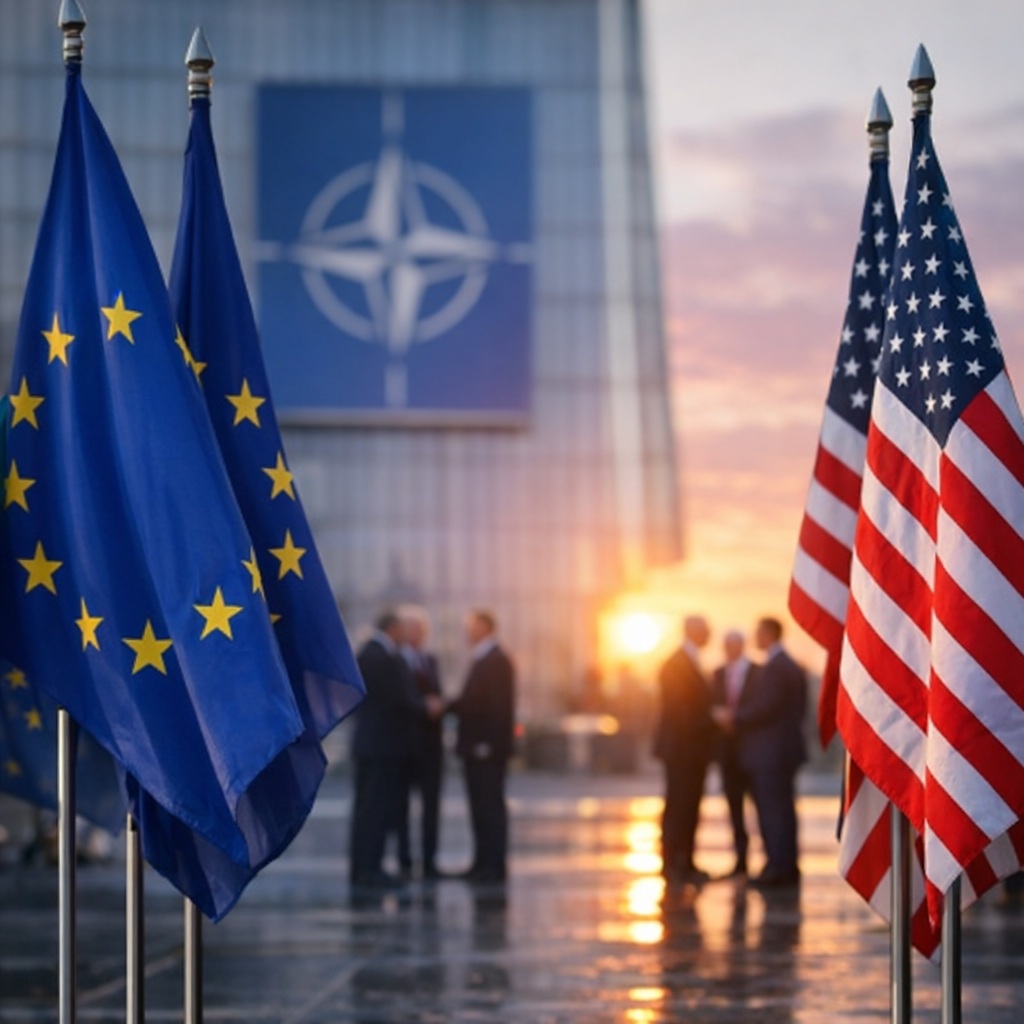
As transatlantic ties strain, Europe debates whether its future security lies in deeper EU integration or in preserving the long-standing U.S. alliance.
Europe is once again confronting an old question with new urgency: where does its security ultimately come from? As political signals across the Atlantic grow more uncertain, European capitals are reassessing assumptions that have underpinned the continent’s stability for decades. The debate is no longer theoretical. It cuts to the core of Europe’s strategic identity and its role in a rapidly fragmenting world.
For generations, the transatlantic alliance anchored European security. The United States provided military muscle, nuclear deterrence, and strategic leadership, while Europe focused on economic integration and internal reconciliation. That division of labor, once seen as efficient and mutually beneficial, is now increasingly questioned. Shifting U.S. priorities, domestic polarization in Washington, and an evolving global balance of power have forced Europe to ask whether reliance on America remains sustainable.
At the same time, Europe faces a harsher security environment. War on the continent’s eastern flank, persistent cyber threats, and instability to the south have exposed vulnerabilities that years of underinvestment left unresolved. The assumption that Washington would always be both willing and able to respond decisively is no longer taken for granted in European policy circles.
This uncertainty has reignited a long-simmering argument within the European Union: should Europe move toward deeper defense integration, or should it double down on the traditional U.S.-led alliance framework? The answer is far from settled, and the divide runs through governments, institutions, and public opinion alike.
Proponents of deeper EU integration argue that Europe must finally take responsibility for its own security. They point to the bloc’s economic weight, technological capacity, and population size as evidence that strategic autonomy is achievable. From joint procurement programs to coordinated defense planning, the EU has already taken steps that would have seemed politically impossible a decade ago.
Supporters of this path argue that autonomy does not mean isolation. Rather, it would allow Europe to act when U.S. attention is elsewhere, strengthening the alliance by making it more balanced. A Europe capable of defending itself, they contend, would be a more credible partner for Washington, not a weaker one.
Yet skeptics remain unconvinced. They warn that EU defense integration risks duplicating existing structures while delivering less deterrence than NATO. For them, the U.S. security guarantee, underpinned by American military power and nuclear deterrence, remains irreplaceable. Any move that could weaken NATO’s cohesion is viewed as strategically reckless.
This camp also highlights Europe’s internal divisions. Defense policy touches on sovereignty in ways that economic integration never did. Differing threat perceptions between eastern and western member states, as well as between northern and southern ones, complicate any attempt at a unified strategy. Without political unity, critics argue, military integration could become an expensive illusion.
The United States, for its part, sends mixed signals. On one hand, Washington has long urged Europe to spend more on defense and shoulder a greater share of the burden. On the other, it remains wary of initiatives that might reduce American influence within NATO. This ambiguity feeds European anxiety, reinforcing doubts about long-term U.S. reliability while offering no clear alternative.
Public opinion adds another layer of complexity. While many Europeans support stronger EU cooperation, trust in the United States remains relatively high in several countries, particularly those closest to perceived external threats. For these societies, the American presence is not an abstract geopolitical concept but a tangible reassurance.
What is emerging, then, is not a clean choice but a strategic dilemma. Europe’s challenge is to enhance its capacity to act independently without undermining the alliance that still underpins its security. Achieving that balance will require political leadership, sustained investment, and a willingness to confront uncomfortable trade-offs.
The stakes extend beyond Europe itself. How the EU resolves this debate will shape global perceptions of Western cohesion. A fragmented or indecisive Europe risks emboldening adversaries and unsettling partners. Conversely, a more capable and confident Europe could help stabilize an increasingly volatile international system.
Ultimately, the question is less about choosing between Washington and Brussels than about redefining the relationship between them. The transatlantic bond has always evolved in response to changing realities. Today’s strain may yet become the catalyst for a more mature, balanced partnership—if Europe can decide what kind of strategic actor it wants to be.



 The Tower Post