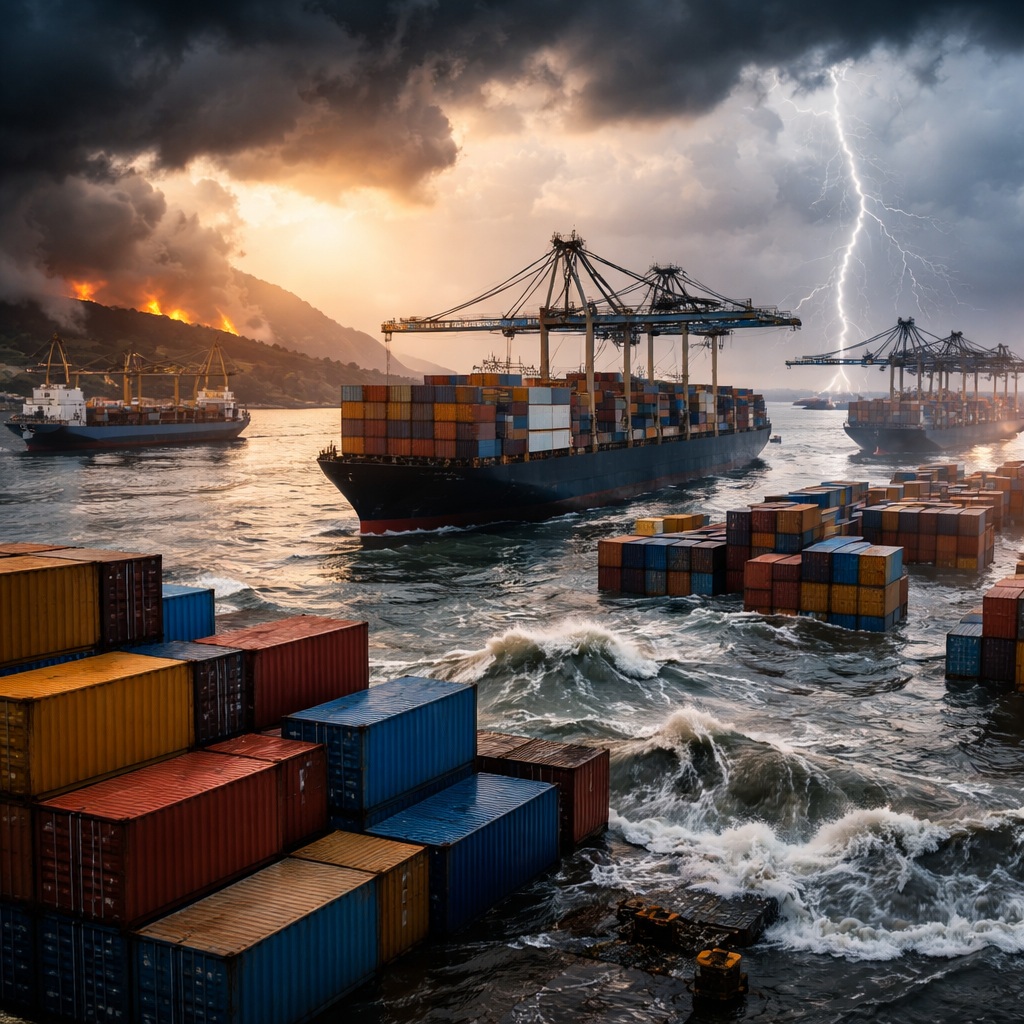
As extreme weather and environmental volatility intensify, insurers and logistics firms overhaul risk models, coverage terms, and resilience strategies to keep goods moving.
By mid-winter, cargo terminals from the Gulf Coast to Southeast Asia have become testing grounds for a new era of risk. Storm surges, prolonged heat waves, flooding rivers, and wildfire smoke are no longer episodic disruptions to global trade; they are persistent features of the operating environment. For insurers underwriting the arteries of the world economy—ports, rail corridors, highways, warehouses, and shipping lanes—the implications are profound.
Climate-related hazards are increasingly reshaping how supply chain insurance is priced, structured, and even justified. Traditional actuarial models, long reliant on historical loss data and relatively stable weather patterns, are struggling to keep pace with the volatility now affecting transportation and logistics networks. The result is a rapid reassessment of coverage limits, exclusions, and the very definition of insurable risk.
Across the insurance market, underwriters report a steady rise in claims tied to climate stressors. Flooded distribution centers interrupt inventory flows for weeks. Heat extremes warp rail lines and degrade cold-chain reliability. Intensifying storms strand vessels offshore, delay deliveries, and trigger cascading penalties throughout just-in-time supply systems. Each incident may be localized, but the financial consequences reverberate globally.
What distinguishes the current moment is not a single catastrophic event, but the accumulation of smaller, more frequent losses. Insurers say this “attritional risk” is proving harder to manage than headline-grabbing disasters. When disruptions occur simultaneously across multiple regions, diversification—the bedrock of insurance—offers less protection. Loss correlations are rising, and margins are thinning.
In response, insurers are revising how they assess exposure along supply chains. Rather than focusing solely on individual assets, underwriters are mapping network dependencies: where a single port, canal, or inland hub represents a chokepoint for multiple industries. Climate vulnerability is being layered onto these maps, incorporating projections for sea-level rise, heat stress, water scarcity, and extreme precipitation.
This shift is pushing insurance deeper into the realm of forward-looking analytics. Satellite data, sensor networks, and climate modeling are increasingly embedded in underwriting decisions. Some carriers now require logistics clients to share real-time operational data as a condition of coverage, blurring the line between insurer and risk manager. Premiums, in turn, are being adjusted dynamically to reflect evolving conditions rather than fixed annual assumptions.
The changes are not limited to pricing. Coverage terms are tightening, with higher deductibles for climate-related perils and narrower definitions of business interruption. In some high-risk corridors, insurers are declining coverage altogether unless firms invest in resilience measures such as elevated facilities, redundant routing, or hardened infrastructure. The message from the market is clear: risk transfer alone is no longer sufficient.
For logistics companies and manufacturers, this recalibration presents both challenges and opportunities. Insurance costs are rising, particularly for firms with concentrated supply chains or limited visibility beyond their tier-one suppliers. At the same time, those that can demonstrate robust climate adaptation strategies are finding more favorable terms. Resilience is becoming a competitive differentiator, not just an operational goal.
Governments are also being drawn into the equation. Public infrastructure—from ports to rail networks—often sits at the intersection of private supply chains and public responsibility. As insurers reassess their appetite for climate-exposed assets, pressure is mounting on authorities to invest in adaptation or provide backstops for essential trade routes. Without such interventions, some risks may become effectively uninsurable.
Policy discussions increasingly frame supply chain insurance as a matter of economic security. Disruptions to food, energy, and medical supply lines carry social and political consequences that extend beyond corporate balance sheets. In this context, insurance is being asked to play a stabilizing role even as the underlying risks escalate.
Industry leaders acknowledge that the sector itself must adapt structurally. This includes rethinking capital allocation, reinsurance arrangements, and the time horizons used to evaluate risk. Climate change challenges the assumption that tomorrow will resemble yesterday, an assumption embedded in many legacy insurance practices. The transition is uneven, but momentum is building.
There is also a growing recognition that technology introduces new vulnerabilities alongside solutions. Automated warehouses, digital freight platforms, and interconnected logistics systems can amplify the impact of physical disruptions through cyber and operational failures. Insurers are increasingly assessing climate risk and technological exposure together, reflecting the complex reality of modern supply chains.
As winter disruptions continue to ripple through global trade, the insurance industry finds itself at a crossroads. Adaptation is no longer optional, and neither is collaboration among insurers, clients, and governments. The reshaping of supply chain insurance is still underway, but its direction is clear: toward a model that rewards resilience, demands transparency, and acknowledges that climate risk is now a central feature of global commerce.



 The Tower Post