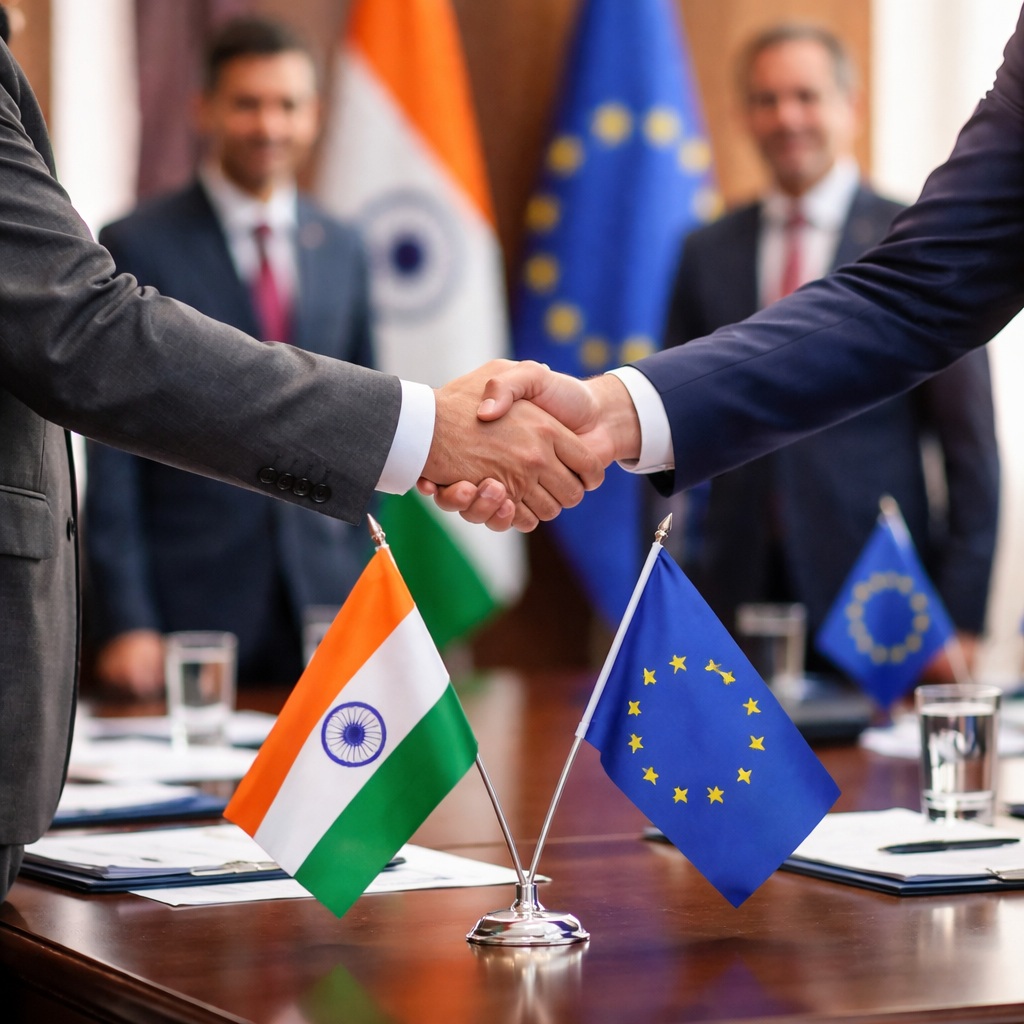
A long-awaited pact promises to redraw trade ties between Europe and Asia as legal texts move toward clearance
As winter advances across Europe and India’s financial year approaches its closing stretch, negotiators on both sides are preparing for what could be a watershed moment in global trade. The European Union and India are poised to conclude a long-anticipated Free Trade Agreement, a deal years in the making that aims to unlock new momentum in bilateral commerce and deepen strategic ties between two of the world’s largest economic blocs.
Officials familiar with the talks say the agreement is entering its final phase, with political alignment largely achieved and legal scrubbing under way. While formal ratification will still be required, the sense in Brussels and New Delhi is that the finish line is finally in sight. For businesses that have waited through multiple negotiation rounds, pauses, and restarts, the prospect of closure marks a turning point.
The EU–India trade relationship has long been substantial but under-realized. Europe is among India’s largest trading partners, and India represents one of the EU’s most important gateways to Asia’s fast-growing markets. Yet tariffs, regulatory divergence, and market access barriers have constrained the full potential of this exchange. The forthcoming agreement seeks to address these frictions through phased tariff reductions, improved access for services, and clearer rules for investment and public procurement.
At the heart of the pact is an ambition to boost bilateral trade flows by making it easier and more predictable for companies to operate across borders. European exporters are expected to gain improved access to India’s vast consumer market, particularly in sectors such as machinery, automobiles, chemicals, and agri-food products. Indian firms, in turn, are likely to benefit from enhanced entry into the EU for textiles, pharmaceuticals, information technology services, and a growing range of manufactured goods.
Beyond tariffs, negotiators have focused on non-tariff barriers that often weigh more heavily on trade than customs duties. Regulatory cooperation, standards alignment, and transparent dispute resolution mechanisms are intended to reduce compliance costs and uncertainty. For small and medium-sized enterprises, which often lack the resources to navigate complex regulatory landscapes, these provisions could prove especially significant.
The agreement also reflects a broader strategic convergence. In recent years, the EU has sought to diversify its trade partnerships and reduce overdependence on a narrow set of suppliers. India, positioning itself as a reliable and rules-based economic partner, fits squarely within that strategy. For New Delhi, closer economic integration with Europe supports its own objectives of attracting investment, upgrading industrial capacity, and embedding itself more firmly in global value chains.
Sustainability and values have featured prominently in the negotiations, mirroring the EU’s approach to recent trade deals. Commitments related to labor standards, environmental protection, and responsible business conduct are expected to be part of the final text. While such provisions have at times been sensitive, they underscore a shared recognition that trade growth must be aligned with social and environmental goals to be politically durable.
Still, challenges remain before the agreement can take full effect. Once the legal texts are finalized, the pact will need to navigate the EU’s ratification process, including approval by member states and the European Parliament, as well as India’s domestic procedures. Past experience suggests that this phase can be lengthy and politically complex. Stakeholders on both sides are therefore cautious, balancing optimism with realism.
If ratified, the EU–India Free Trade Agreement could have ripple effects beyond the bilateral relationship. By linking two major markets with complementary strengths, the pact has the potential to reshape trade patterns between Europe and Asia more broadly. It may encourage supply chain diversification, stimulate new investment corridors, and set benchmarks for future agreements involving emerging economies.
For now, attention is fixed on the final steps of negotiation and legal clearance. The coming days are expected to clarify whether the long wait is indeed coming to an end. Should the agreement be sealed as anticipated, it would stand as one of the most consequential trade developments of the year, signaling renewed confidence in open markets at a time of global economic uncertainty.


 The Tower Post