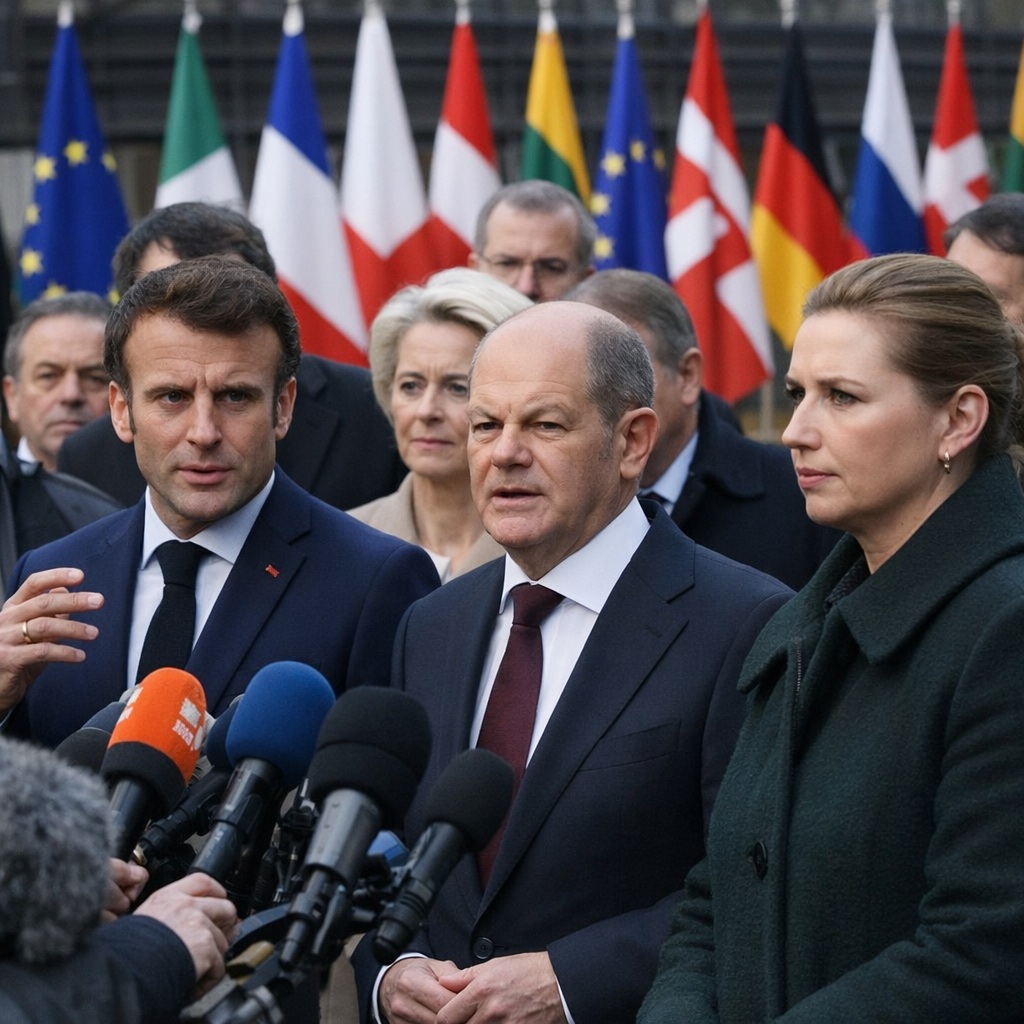
EU nations targeted by U.S. tariff warnings denounce them and reaffirm sovereignty, seeking unified political pushback.
European leaders closed ranks this week in an unusually sharp rebuke of Washington after U.S. President Donald Trump revived the idea of imposing punitive tariffs linked to Greenland, reigniting a debate that many in Europe thought had been laid to rest. The warnings, framed by the White House as a matter of “strategic balance and fair trade,” were met with swift denunciations from across the European Union, where officials described the move as an unacceptable challenge to sovereignty and international norms.
At the center of the dispute is Greenland, the vast Arctic territory that remains an autonomous part of the Kingdom of Denmark. While Trump has long expressed interest in Greenland’s strategic location and mineral potential, European leaders say the latest tariff threats cross a new line by explicitly tying trade measures to territorial and geopolitical pressure.
“This is not how partners speak to one another,” a senior EU diplomat said. “Trade policy cannot be weaponized to question the sovereignty of a European territory.”
The remarks followed comments from Trump suggesting that European exports could face new duties if Denmark and the EU failed to engage more “constructively” with Washington over Arctic security and resource access. Though no formal measures were announced, the language alone was enough to trigger alarm in Brussels and several European capitals.
Denmark reacted first and forcefully. The Danish prime minister dismissed the idea that Greenland’s status could be negotiated through economic pressure, reaffirming that the island’s future lies in the hands of its own population. “Greenland is not for sale, not for barter, and not subject to threats,” she said, echoing a phrase that has become a refrain in Copenhagen whenever the issue resurfaces.
Officials in Nuuk, Greenland’s capital, also responded, stressing that while the island seeks greater economic independence and welcomes investment, decisions about its resources and security will be made on its own terms. Greenlandic leaders emphasized cooperation with both Europe and the United States but rejected what they described as a “coercive tone” from Washington.
Across the EU, reactions quickly coalesced into a broader political stance. France and Germany called for unity, warning that any unilateral U.S. tariffs aimed at pressuring a member state would provoke a coordinated response. “The European Union will defend its interests and its values,” a spokesperson for the European Commission said, adding that the bloc was prepared to use all available trade instruments if necessary.
The Commission confirmed that it is assessing potential countermeasures, though officials stressed that de-escalation remains the preferred outcome. Behind closed doors, however, diplomats acknowledged that patience with Washington is wearing thin after years of unpredictable trade policy and confrontational rhetoric.
“This is not just about Greenland,” said an EU official involved in the discussions. “It’s about the principle that borders and sovereignty are not bargaining chips in trade disputes.”
Analysts note that the Arctic has become an increasingly strategic theater, as melting ice opens new shipping routes and access to rare earth minerals critical for green technologies and defense industries. The United States, China, and Russia have all stepped up their presence in the region, and Europe has sought to balance cooperation with deterrence.
Trump’s renewed focus on Greenland taps into these dynamics but also revives memories of his earlier attempts to assert U.S. influence in unconventional ways. For many European leaders, the concern is less about immediate economic damage and more about setting a precedent that trade sanctions can be used to exert geopolitical pressure within allied relationships.
Business groups in Europe expressed unease at the uncertainty created by the threats. Exporters in sectors ranging from automotive manufacturing to renewable energy warned that even the hint of new tariffs could disrupt supply chains and investment decisions. “Markets react to signals,” said the head of a major European industry association. “And this signal is not reassuring.”
In Washington, administration officials sought to downplay the backlash, insisting that the president was merely advocating for stronger U.S. interests in the Arctic and fairer trade terms. Yet the lack of clarity over what Washington actually wants from Denmark and the EU has only deepened frustration in Europe.
Some observers see the episode as a test of the EU’s ability to act cohesively on foreign policy. While unity has often proven elusive, the Greenland issue appears to have galvanized a shared response, at least rhetorically. Smaller member states, often cautious about confronting the United States, lined up alongside larger powers in defense of Denmark.
“There is a sense that if this can happen to one, it can happen to all,” said a diplomat from a northern European country. “That changes the calculation.”
The dispute also carries implications for NATO, where Arctic security has become an increasingly prominent topic. European officials were careful to separate the trade confrontation from military cooperation, emphasizing that transatlantic security ties remain vital. Still, several warned privately that trust is harder to maintain when economic pressure is used in political disputes.
For now, both sides appear to be calibrating their next moves. European leaders hope that a united front will deter Washington from following through on its threats, while leaving room for dialogue on Arctic cooperation. Whether that balance can be maintained remains uncertain.
What is clear is that Greenland has once again become a flashpoint far beyond its icy shores. In challenging U.S. tariff threats, European leaders are not only defending a territory but also asserting a vision of partnership based on mutual respect rather than coercion. As one EU official put it, “The message is simple: sovereignty is not negotiable, and neither is our unity.”


 The Tower Post