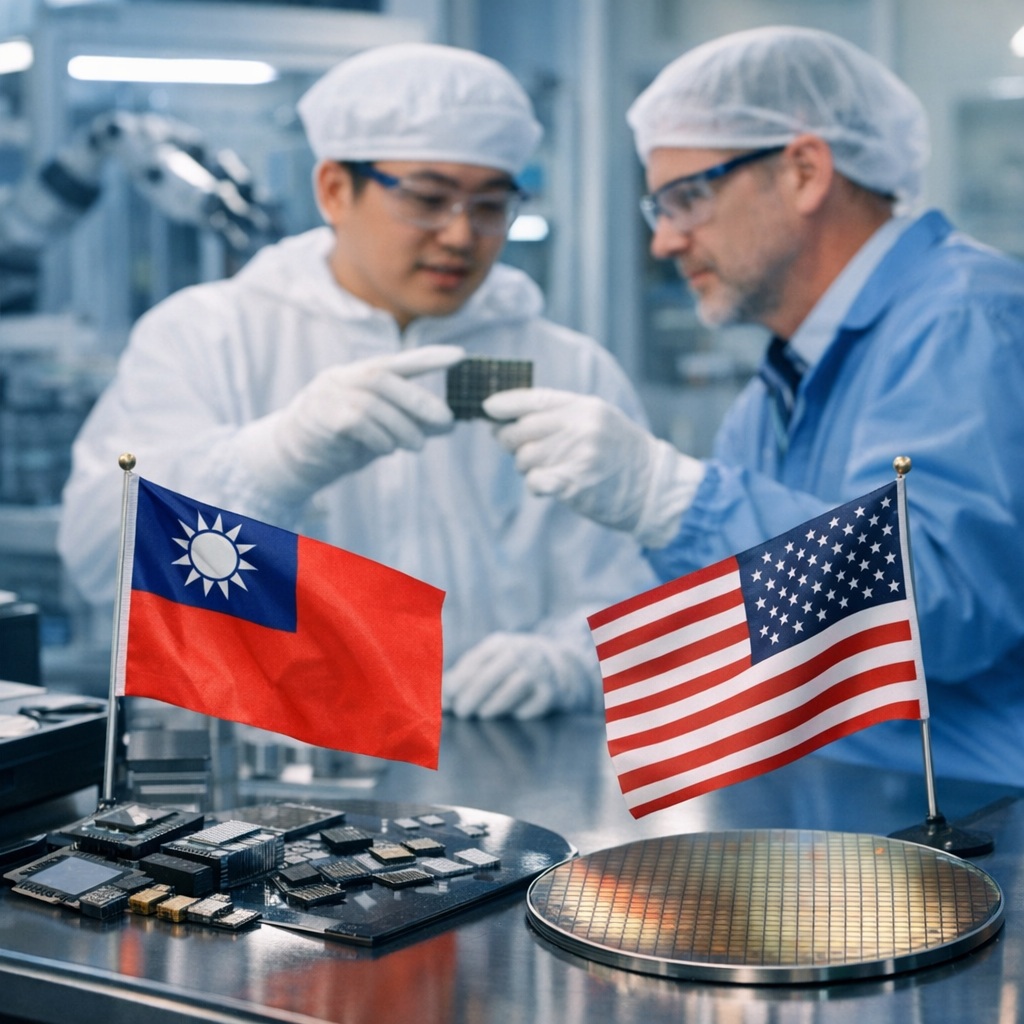
A new framework between Taipei and Washington aims to deepen semiconductor investment and jointly shape strategic AI supply chains, blending economic security with shared political values.
Taiwan and the United States have taken a decisive step toward reshaping the global technology landscape, unveiling a framework to build what officials describe as a “democratic” high-tech supply chain. The initiative, centered on advanced semiconductors and strategic artificial intelligence infrastructure, reflects growing urgency in both capitals to secure critical technologies amid intensifying geopolitical competition.
The agreement, announced following high-level consultations between Taipei and Washington, signals a deepening of an already close economic partnership. At its core is a shared ambition: to ensure that the most sensitive and consequential technologies of the coming decade are developed, manufactured, and governed within systems that prioritize transparency, rule of law, and political accountability.
Semiconductors sit at the heart of the effort. Taiwan’s chip industry, led by world-class foundries, remains indispensable to the global economy, powering everything from smartphones and data centers to advanced defense systems. The new framework aims to expand Taiwanese semiconductor investment in the United States while reinforcing Taiwan’s own manufacturing base, creating what officials describe as a resilient, two-way industrial ecosystem.
For Washington, the deal builds on a broader push to reduce strategic vulnerabilities exposed by recent supply chain disruptions. For Taipei, it represents both an economic opportunity and a political statement: a demonstration that Taiwan is not only a critical supplier, but also a trusted partner in shaping the norms and governance of next-generation technologies.
Beyond chips, artificial intelligence has emerged as the second pillar of the partnership. As AI systems become more powerful and more deeply embedded in societies, both sides see supply chain control as inseparable from questions of ethics, security, and democratic oversight. The framework envisions co-leadership in AI hardware supply chains, from advanced processors to the specialized components required for large-scale data centers.
Officials familiar with the talks say the initiative goes beyond manufacturing footprints. It includes coordination on standards, export controls, and research collaboration, with an emphasis on preventing advanced technologies from being diverted to uses that could undermine human rights or regional stability. In this sense, the “democratic” label is not merely rhetorical; it reflects an attempt to align economic policy with political values.
The timing of the announcement is notable. As global technology markets begin the year under pressure from slowing growth and rising strategic fragmentation, the Taipei-Washington accord sends a signal of continuity and resolve. It reassures investors that, despite political uncertainty elsewhere, the U.S.–Taiwan technology axis remains a cornerstone of the global innovation economy.
Industry leaders have welcomed the move with cautious optimism. Semiconductor executives note that diversifying production geographically can enhance resilience, but warn that advanced manufacturing requires sustained investment, skilled labor, and long-term policy stability. The success of the initiative, they argue, will depend on whether governments can translate strategic intent into predictable regulatory environments.
In Taiwan, the agreement has also sparked domestic discussion about balancing international engagement with local capacity. Policymakers emphasize that overseas expansion will be paired with continued investment at home, ensuring that Taiwan retains its technological edge. The government has framed the deal as a way to “extend” Taiwan’s industrial strengths, not hollow them out.
From a strategic perspective, the partnership carries implications that extend well beyond economics. By tying semiconductor and AI supply chains more closely to democratic allies, Taiwan and the United States are implicitly drawing lines in an increasingly polarized global tech order. Analysts say this could accelerate the emergence of parallel technology ecosystems, differentiated not only by standards and suppliers, but by political alignment.
At the same time, officials on both sides stress that the initiative is not designed to exclude, but to set benchmarks. The hope, they say, is that a transparent, secure supply chain can become a model that others choose to join. Whether that vision proves realistic will depend on how global partners, particularly in Europe and the Indo-Pacific, respond.
As the framework moves from announcement to implementation, attention will turn to concrete projects: new fabrication plants, joint research centers, and mechanisms for AI governance. While many details remain to be negotiated, the direction is clear. Taipei and Washington are betting that in an era where technology and geopolitics are inseparable, shared values can be a strategic asset.
For Taiwan, the initiative underscores its evolving role on the world stage—not just as a manufacturing powerhouse, but as a co-architect of the digital future. For the United States, it reinforces a strategy of working with trusted partners to secure the foundations of economic and national security. Together, they are attempting to redefine what resilience means in the high-tech age.




 The Tower Post