
As the Winter Games approach in the Italian Alps, Austria’s new generation of sliders is challenging decades of German dominance on the ice.
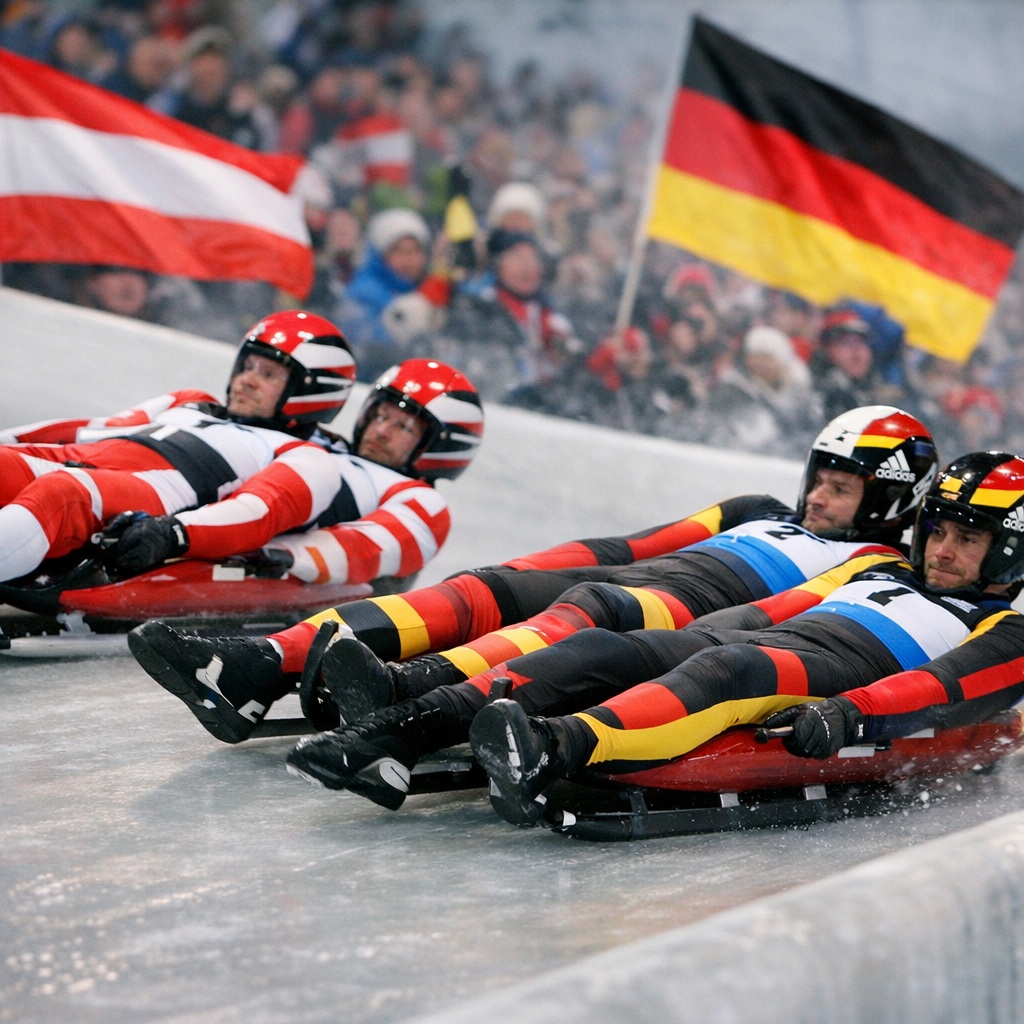
In the cold, echoing tunnels of Europe’s most famous luge tracks, a familiar sound has long prevailed: the low hum of German efficiency, precision-engineered sleds slicing through ice, and athletes raised within a system that has dominated the sport for generations. For decades, luge has been Germany’s domain, a near-monopoly built on infrastructure, science, and an unmatched conveyor belt of talent. Now, as the Winter Olympics draw closer, Austria is positioning itself as the most credible challenger to that hegemony.
Germany’s record in Olympic luge is staggering. No other nation comes close to its haul of gold medals, a dominance that has shaped expectations at every major international competition. Yet beneath that imposing historical weight, subtle but significant shifts are taking place. Austrian athletes, coaches, and federations believe the gap is no longer unbridgeable. On the contrary, they sense an opportunity—one forged through technical innovation, targeted investment, and a new competitive mindset.
At recent World Cup stops and continental championships, Austrian sliders have consistently featured on the podium. In men’s and women’s singles, doubles, and team relays, red-and-white suits are increasingly interspersed among the traditional black, red, and gold. While Germany remains the benchmark, Austria’s presence is no longer an exception; it is becoming a pattern.
“We are not chasing Germany blindly anymore,” said one senior Austrian coach during a recent training block. “We are building our own identity, our own solutions. That takes time, but the results are starting to show.”
Central to Austria’s rise is a renewed focus on athlete development. While Germany benefits from a dense network of artificial tracks and regional training centers, Austria has concentrated its resources on fewer hubs, emphasizing quality over quantity. Young athletes are identified early, but just as crucially, they are encouraged to remain in the sport through a more holistic approach that balances education, physical preparation, and mental resilience.
Technological progress has also played a decisive role. Luge is a sport of margins measured in hundredths of a second, where sled setup, runner geometry, and ice-reading skills can decide medals. Austrian engineers, often working in close collaboration with athletes, have refined sled designs to better suit the demanding profiles of modern tracks. Data analysis, once an area where Germany enjoyed a clear advantage, has become a shared battleground.
The rivalry is intensifying as attention turns toward the upcoming Olympic competitions in Cortina d’Ampezzo. The historic Italian venue promises a track that rewards adaptability and nerve as much as raw speed. For Austrian athletes, Cortina represents more than another Olympic stage—it is a chance to disrupt a narrative that has endured for generations.
German teams, for their part, are not underestimating the challenge. Officials and athletes alike have acknowledged Austria’s progress, while publicly reaffirming confidence in their own systems. “Competition makes everyone better,” one German slider noted. “Austria pushing us means we have to push ourselves harder.”
That mutual pressure is reshaping the competitive landscape. Where once luge events often felt like internal German contests for medal order, they are now genuine international battles. Austria is joined by other nations eager to close the gap, but it is Vienna’s program that appears most capable of sustaining a long-term challenge.
For Austrian fans, the moment carries emotional weight. Luge has always been popular in alpine regions, but sustained Olympic success has often felt just out of reach. Now, with athletes regularly threatening German supremacy, expectations are rising. The challenge will be managing those expectations while maintaining the steady progress that has brought Austria this far.
Whether Austria can truly dent Germany’s dominance remains to be seen. History, depth, and experience still favor the Germans. But in the lead-up to the Games, the tone has shifted. The question is no longer whether Germany will win everything, but how hard it will have to fight—and whether Austria is ready to seize the moment when it counts most.
As sleds thunder down the ice and the world watches once again, luge’s long-standing hierarchy faces its most serious test in years. For Austria, that alone marks a victory of sorts. The rest will be decided in silence, speed, and the unforgiving curves of an Olympic track.




 The Tower Post