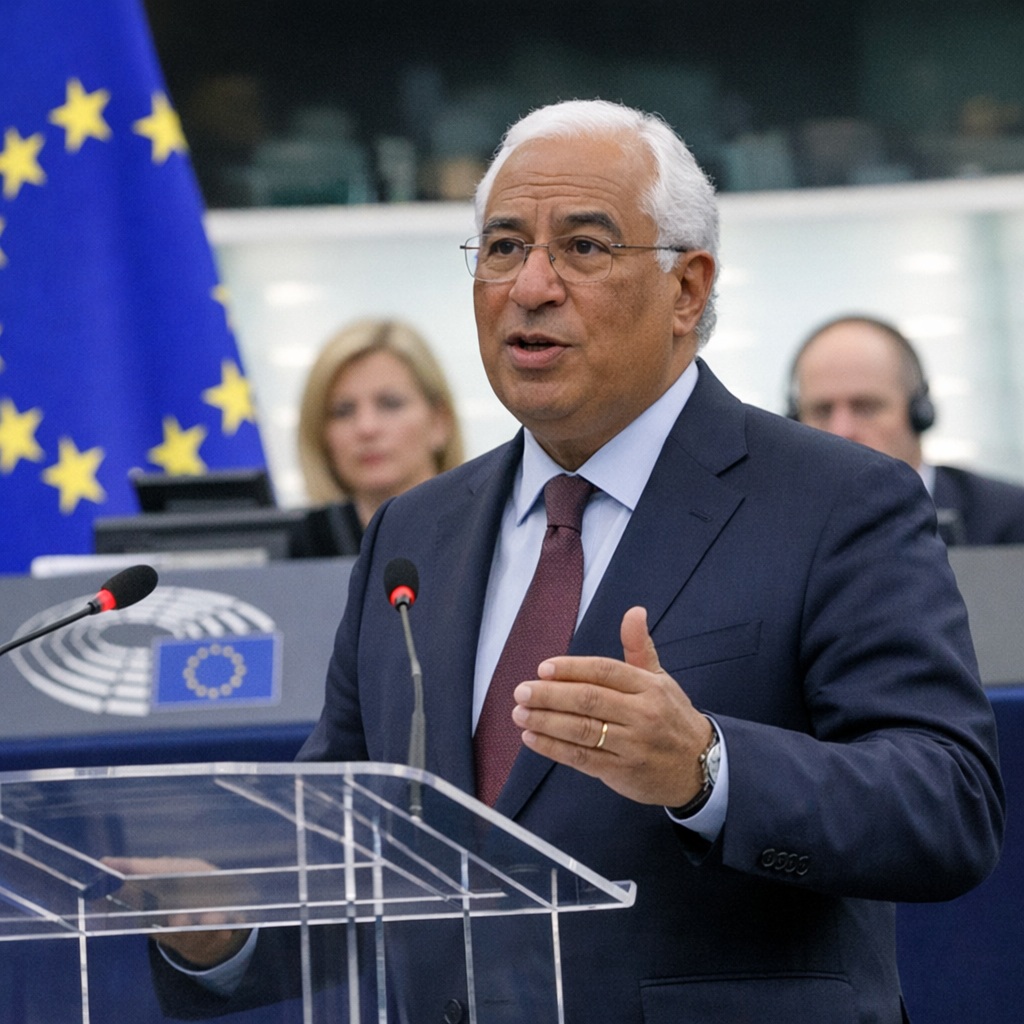
EU Council President António Costa tells lawmakers the Union is prepared to defend itself against coercion while reaffirming commitment to international law and a rules-based order
By any measure, the tone in Brussels this week was one of vigilance rather than alarm. Addressing the European Parliament, EU Council President António Costa said the European Union stands ready to defend itself against coercion, sending a clear message that economic, political, and strategic pressure will not go unanswered.
Speaking before lawmakers from across the political spectrum, Costa framed the Union’s position as both defensive and principled. The EU, he said, seeks cooperation over confrontation, but it will not hesitate to protect its interests, values, and autonomy when faced with attempts to force its hand. The remarks reflected a broader shift in European foreign policy thinking, shaped by years of geopolitical turbulence and growing awareness of the vulnerabilities that accompany openness.
At the heart of Costa’s message was a firm attachment to international law and the rules-based global order. These principles, he argued, are not abstract ideals but practical safeguards for stability and prosperity. “When rules are ignored or selectively applied,” he warned, “the consequences are felt far beyond borders.” For the EU, defending itself against coercion is inseparable from defending the system of rules that governs global trade, security, and diplomacy.
The speech came at a moment when European policymakers are increasingly candid about the pressures facing the bloc. From trade disputes and supply-chain disruptions to political interference and strategic dependencies, coercion has become a recurring concern in Brussels. While Costa avoided naming specific countries or incidents, his remarks were widely interpreted as a response to a global environment in which economic leverage and political pressure are used more openly as tools of statecraft.
Members of the European Parliament welcomed the clarity of the message, even as debates continue over how far the Union should go in translating words into action. Over recent years, the EU has developed instruments designed to counter coercive practices, including measures aimed at protecting the single market and ensuring fair competition. Costa’s intervention suggested that these tools are no longer theoretical safeguards but central elements of Europe’s strategic posture.
In his address, the Council President emphasized unity as the EU’s most effective defense. The strength of the Union, he said, lies in its ability to act collectively, drawing on the economic weight and political legitimacy of its member states. Fragmentation, by contrast, would only invite further pressure. This call for cohesion resonated with lawmakers who have long argued that Europe’s credibility abroad depends on solidarity at home.
Costa also sought to balance firmness with openness. The EU, he stressed, remains committed to dialogue and cooperation with partners around the world. Defending against coercion does not mean retreating into protectionism or abandoning multilateral engagement. On the contrary, he argued, a confident and resilient Europe is better positioned to support global cooperation and peaceful dispute resolution.
The emphasis on a rules-based order echoed long-standing EU rhetoric but carried renewed urgency. International institutions and norms, Costa noted, are under strain as power politics resurfaces. For Europe, whose integration project is built on law and compromise, this trend poses both a challenge and a call to action. Upholding rules abroad reinforces them at home, he suggested, creating a virtuous circle of stability.
Analysts see the speech as part of a broader effort to articulate Europe’s role in a more contested world. The EU has traditionally relied on its economic attractiveness and regulatory power to shape outcomes. Today, that approach is being complemented by a greater willingness to acknowledge risks and prepare countermeasures. Costa’s words signaled continuity with this evolution rather than a dramatic departure.
Within the Parliament chamber, reactions reflected the complexity of the issue. Some lawmakers urged swift and decisive action whenever coercion is identified, warning that hesitation can undermine credibility. Others cautioned against escalating tensions or undermining the EU’s reputation as a champion of openness and free trade. Costa appeared to address both camps, insisting that preparedness and restraint are not mutually exclusive.
The speech also touched on the internal dimension of resilience. Protecting Europe from coercion, Costa said, requires investment in strategic sectors, diversification of supply chains, and support for innovation. Economic strength and social cohesion, in this view, are as important as diplomatic tools. By reducing vulnerabilities, the Union reduces the leverage others might seek to exploit.
As the session drew to a close, the message was unmistakable: the EU intends to remain an actor, not a bystander, in global affairs. Costa’s declaration of readiness was less about projecting power than about asserting agency. Europe, he implied, will not allow its openness to be turned against it.
Whether this resolve will translate into concrete policy decisions remains a subject of debate in Brussels. Yet for many observers, the significance of the moment lay in its symbolism. By publicly affirming the Union’s willingness to defend itself against coercion, the EU Council President set a tone of confidence and responsibility that is likely to shape discussions in the months ahead.
In an era marked by uncertainty and shifting alliances, Costa’s intervention served as a reminder of the principles the Union seeks to uphold. Commitment to international law, belief in a rules-based order, and readiness to protect its interests form the backbone of Europe’s response to a changing world. The challenge now is to ensure that this resolve is matched by unity and action, preserving the EU’s role as a stabilizing force on the global stage.



 The Tower Post