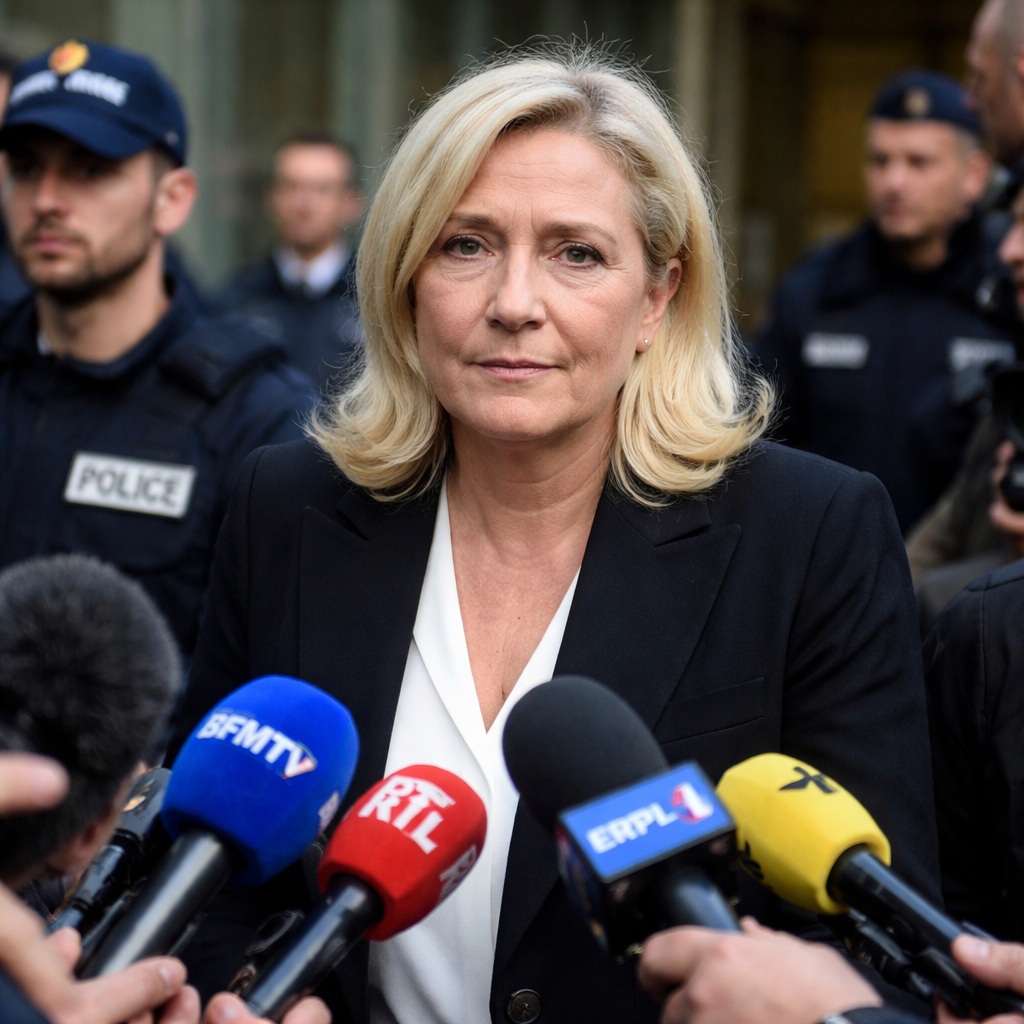
Acknowledgment in court revives scrutiny over party finances and casts a shadow over the far right leader’s political future
In a carefully calibrated appearance before a French court, Marine Le Pen acknowledged what she described as a “mistake” in the long-running trial over the alleged misuse of European Union funds, a moment that reverberated well beyond the courtroom and into the heart of French politics.
The far-right leader, who has spent years seeking to rebrand both herself and her party as a credible governing force, broke with her earlier strategy of outright denial by conceding that errors had been made in the management of European Parliament resources. While maintaining that there was no personal enrichment and no deliberate attempt to defraud the EU, Le Pen’s admission marked a notable shift in tone in a case that has followed her for much of her national career.
At the center of the proceedings is the accusation that funds intended to pay parliamentary assistants in Brussels and Strasbourg were instead used to finance party work in France. Prosecutors argue that a system was put in place to blur the line between European parliamentary duties and domestic political activity, effectively channeling EU money toward party operations. Le Pen and several associates have consistently rejected the charge of organized embezzlement, framing the case as a politically motivated attack.
Her acknowledgment of a “mistake” was presented as an administrative failing rather than a criminal act. According to her defense, the overlap between European parliamentary work and national political coordination was misunderstood or poorly regulated at the time, leading to practices that, in hindsight, did not meet the strict requirements of EU rules. “There was no intention to cheat,” her lawyers insisted, portraying the episode as symptomatic of broader ambiguities in the assistant system that have since been clarified.
The admission nonetheless represents a delicate moment for a politician who has long built her narrative around personal integrity and opposition to what she calls the corruption of traditional elites. For supporters, the statement was framed as an act of transparency and responsibility, contrasting her conduct with that of rivals accused of clinging to denial. For critics, it was seen as a tacit confirmation of wrongdoing that undermines years of rhetorical attacks on the political establishment.
The trial has unfolded against a backdrop of heightened political tension in France and across Europe, where questions of sovereignty, public spending, and trust in institutions remain potent. Le Pen’s party has repeatedly denounced the European Union as distant and unaccountable, making the allegations of misused EU funds particularly damaging symbolically. Even a limited concession risks reinforcing the perception of double standards: condemning Brussels while benefiting from its resources.
Legal experts caution that the word “mistake,” while powerful in the public arena, does not in itself determine the court’s judgment. The judges will weigh whether the actions described amount to negligence, systemic abuse, or criminal intent. Possible outcomes range from acquittal to financial penalties or, in the most serious scenario, restrictions that could affect Le Pen’s eligibility to hold public office.
Such stakes explain the intense attention surrounding the case. Le Pen remains one of the most recognizable figures in French politics, with a loyal electoral base and a proven ability to reach the final stages of major national contests. Any ruling that weakens her leadership or complicates her candidacy would reverberate through the far-right movement and reshape internal dynamics within her party.
Inside that movement, reactions have been mixed but disciplined. Senior figures closed ranks after the hearing, emphasizing unity and accusing opponents of exploiting a technical dispute for political gain. Privately, however, some strategists acknowledge that the admission could complicate efforts to present the party as fully “normalized” and ready to govern. Years of image-polishing risk being overshadowed by courtroom headlines.
Beyond partisan calculations, the trial has reopened broader questions about how European parliamentary funds are monitored and used. Similar cases involving lawmakers from different countries and political families have highlighted systemic weaknesses in oversight mechanisms. For advocates of reform, Le Pen’s case illustrates the need for clearer rules and stronger enforcement to prevent abuses, whether intentional or not.
Public opinion appears divided. Polling and street interviews suggest that many voters see the affair as emblematic of a political class disconnected from everyday concerns, while others view it as a technical issue inflated by media attention. For some of Le Pen’s supporters, the case reinforces a sense of persecution by institutions hostile to her ideology. For undecided voters, it adds another layer of doubt at a time when trust in leaders is already fragile.
As the trial moves toward its conclusion, Le Pen faces a familiar challenge: balancing defiance with responsibility, and populist rhetoric with institutional accountability. Her admission of a “mistake” may be intended to close one chapter of the affair, but it has also opened a new phase of scrutiny—one that could prove decisive for her ambitions.
Whatever the verdict, the proceedings underscore how legal battles can intersect with political destinies in modern France. For Marine Le Pen, the courtroom has once again become a stage where personal strategy, party identity, and the broader debate over Europe collide, with consequences that will extend far beyond the immediate case.




 The Tower Post