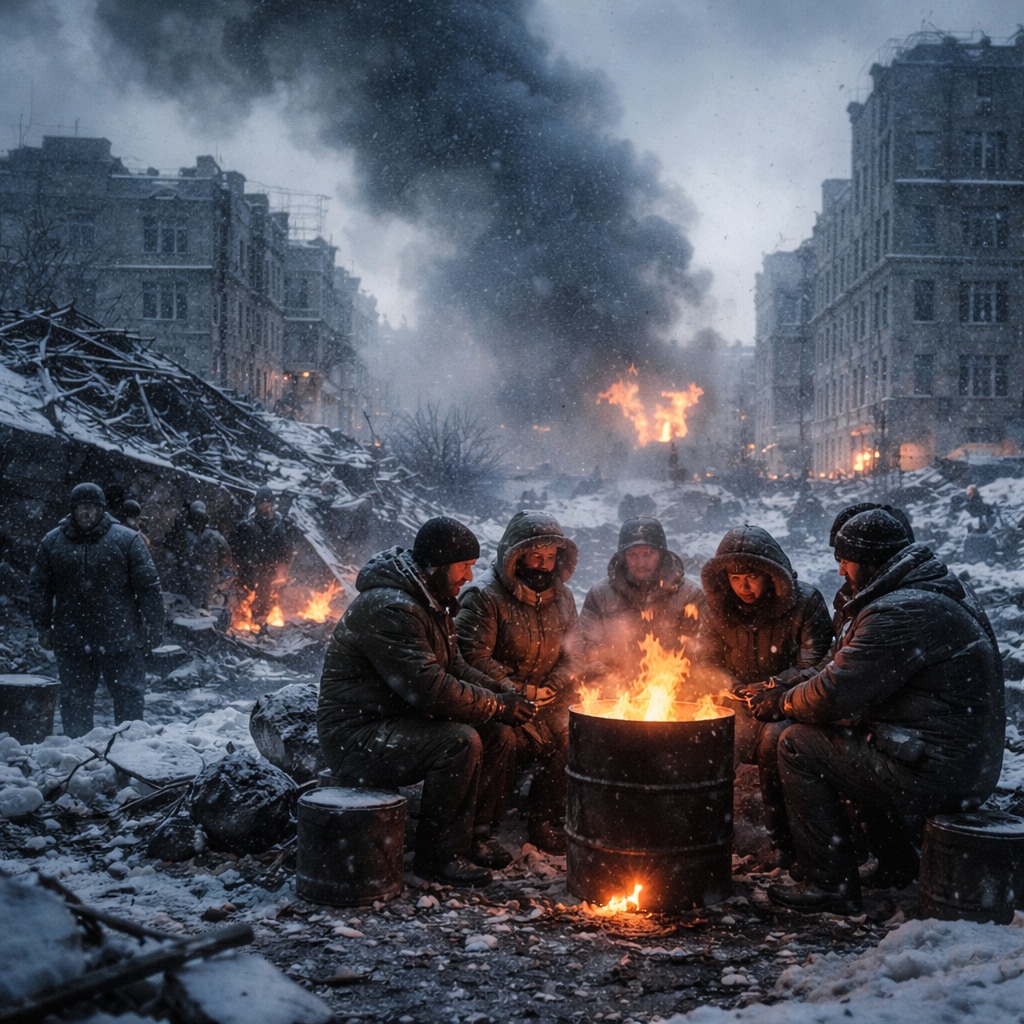
Relentless Russian strikes target heating and energy infrastructure, plunging millions into darkness as civilians struggle to endure another brutal phase of war.
Winter has tightened its grip on Ukraine, and with it has come a renewed wave of Russian strikes aimed squarely at the country’s energy lifelines. As icy winds sweep across cities and villages, missiles and drones have battered power stations, substations, and heating facilities, leaving large parts of the population struggling to stay warm. The attacks have underscored a grim reality: as the war drags on, civilians remain on the front line, especially during the coldest months of the year.
In the capital, Kyiv, the consequences have been stark. Entire neighborhoods have been plunged into darkness following sustained overnight attacks on electrical infrastructure. City officials say that close to three-fifths of the capital has faced power disruptions at various points, forcing rolling blackouts and emergency shutdowns to prevent total system collapse. Elevators have stalled, water pumps have faltered, and households have huddled around candles and battery-powered lamps as temperatures dip well below freezing.
Across the country, the pattern is painfully familiar. Waves of drones precede missile barrages, overwhelming air defenses and striking targets designed not for military advantage alone, but for maximum civilian impact. Heating plants in eastern and central regions have been hit repeatedly, while high-voltage substations—difficult to repair and essential for long-distance power transmission—remain prime targets. Engineers race to restore connections even as repair crews are forced to work under the constant threat of renewed attacks.
For many Ukrainians, winter has become a season of endurance. In apartment blocks, residents layer clothing indoors, sleep in coats and hats, and share generators when they can. In rural areas, where infrastructure is more fragile, families rely on wood stoves and improvised heating, rationing fuel to last through long nights. Schools have shifted between in-person and remote learning depending on power availability, while hospitals prioritize electricity for critical wards, often relying on backup generators to keep life-saving equipment running.
Humanitarian organizations warn that the cumulative effect of these strikes is pushing vulnerable groups to the brink. Elderly residents, people with disabilities, and families with young children are particularly at risk as prolonged exposure to cold compounds existing health problems. Aid groups have stepped up the distribution of thermal blankets, portable heaters, and insulation materials, but access remains uneven, especially in areas closer to the front lines.
Ukrainian authorities accuse Moscow of waging an energy war designed to break civilian morale. Officials say the strategy mirrors previous winters, when infrastructure attacks peaked during the coldest periods. This season, however, comes after years of sustained damage, leaving the grid more fragile despite extensive fortification and decentralization efforts. While Ukraine has invested in air defense systems and dispersed energy assets, the sheer scale and persistence of the strikes continue to test those defenses.
On the streets of Kyiv, resilience is visible alongside fatigue. Cafés run on generators, offering warmth and charging stations to residents. Volunteers coordinate online to share information about blackout schedules and warming centers. Public shelters and metro stations serve as refuges during air raid alerts, doubling as places where people can briefly escape the cold. Yet beneath the determination lies a sense of exhaustion, as another winter of uncertainty unfolds.
International partners have condemned the attacks and pledged continued support, including equipment to repair energy systems and bolster air defenses. Energy experts abroad work with Ukrainian counterparts to source transformers and components that are in short supply globally. Still, repairs often amount to temporary fixes, buying time until the next strike. Each restoration is a race against both the weather and the enemy.
As the war enters yet another harsh phase, winter has become a weapon as potent as any missile. The cold amplifies the impact of every blackout, turning hours without power into a test of survival. For Ukrainians, the struggle is not only to defend territory, but to keep the lights on, the heaters running, and daily life going against the odds.
Despite the darkness, there are moments of light. Communities band together, sharing heat, food, and information. Utility workers, many of whom have not had a full night’s rest in weeks, continue to climb poles and repair lines under dangerous conditions. Their efforts, like those of countless civilians, reflect a determination to endure—through winter, through war, and through whatever comes next.




 The Tower Post