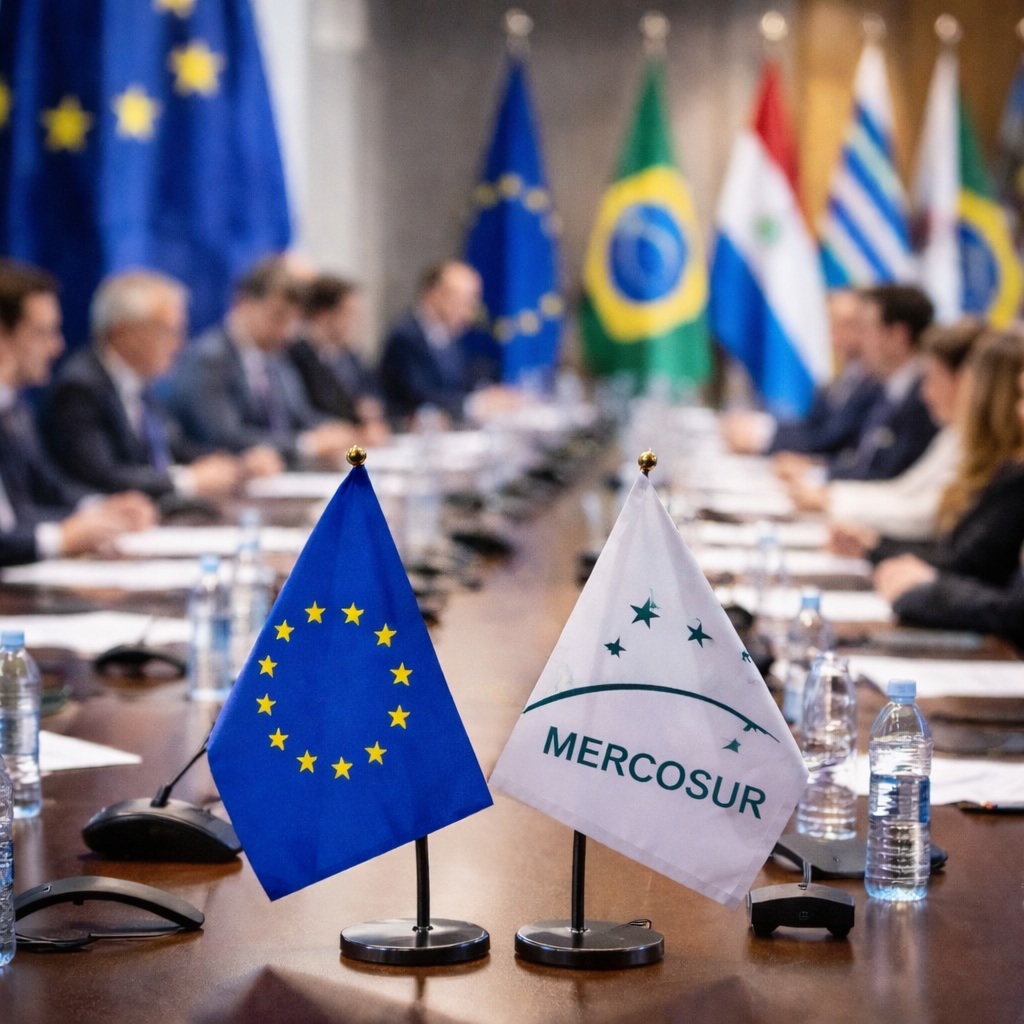
A narrow parliamentary vote to consult Europe’s top court highlights deep divisions over trade, climate commitments, and the balance of power between EU institutions.
EU lawmakers have moved to escalate scrutiny of the long-negotiated trade agreement between the European Union and the Mercosur bloc, voting to request a legal opinion from the European Court of Justice. The decision, taken after a heated debate in the European Parliament, reflects intensifying political resistance to the pact and signals a broader struggle over the future direction of EU trade policy.
The agreement, concluded in principle after decades of negotiations with Argentina, Brazil, Paraguay, and Uruguay, has long been promoted by the European Commission as a cornerstone of the EU’s global trade strategy. Supporters argue it would open markets, secure supply chains, and strengthen the Union’s geopolitical presence in Latin America. Yet within Parliament, concerns over environmental protection, agricultural standards, and democratic oversight have continued to mount.
By opting to refer the agreement to the Court for a legal assessment, lawmakers are seeking clarity on whether the pact aligns with EU treaties, climate obligations, and internal regulatory standards. While the move does not block ratification outright, it introduces a potentially significant delay and places legal scrutiny at the center of an already polarized debate.
At the heart of the controversy lies the tension between trade liberalization and environmental commitments. Critics of the deal warn that increased agricultural exports from Mercosur countries could exacerbate deforestation and undermine global climate efforts. They argue that existing sustainability chapters lack enforceable mechanisms and rely too heavily on political goodwill rather than binding sanctions.
These concerns resonate strongly at a time when the EU is positioning itself as a global leader on climate action. For many lawmakers, approving a trade agreement perceived as weak on environmental safeguards risks eroding the credibility of the Union’s Green Deal and broader sustainability agenda. The Court’s opinion is therefore seen as a way to test whether the agreement’s legal structure genuinely supports those ambitions.
Economic anxieties have also fueled opposition. European farmers, particularly in beef-producing regions, fear being undercut by imports from Mercosur countries where production costs are lower and standards differ. Several parliamentary groups have echoed these worries, arguing that the agreement could place disproportionate pressure on rural economies already struggling with inflation, energy costs, and regulatory change.
Supporters of the pact counter that the deal includes quotas and safeguards designed to protect sensitive sectors. They also stress that rejecting or indefinitely delaying the agreement could weaken the EU’s standing as a reliable trading partner. In a world marked by trade fragmentation and strategic rivalry, they argue, disengagement carries its own risks.
The parliamentary vote underscores a deeper institutional friction between lawmakers and the European Commission. While the Commission retains the formal mandate to negotiate trade agreements, Parliament’s consent is required for ratification. Increasingly, MEPs are asserting their role not merely as endorsers but as active shapers of trade policy, demanding stronger guarantees on labor rights, environmental protection, and legal accountability.
Requesting a Court opinion is a powerful, if infrequently used, tool in that effort. It allows Parliament to frame its objections in legal terms, potentially compelling the Commission to revisit aspects of the agreement if incompatibilities are identified. Even a broadly favorable opinion could come with caveats that reshape the political debate.
For Mercosur countries, the development adds another layer of uncertainty. Governments in the bloc have repeatedly emphasized the strategic importance of the agreement, both economically and symbolically. Delays risk cooling political momentum and may prompt questions about the EU’s ability to deliver on negotiated outcomes.
The timing of the parliamentary move is also significant. As the new political season gathers pace in Brussels, trade policy is becoming increasingly entangled with debates over strategic autonomy, climate leadership, and industrial resilience. The Mercosur agreement has emerged as a litmus test for how the EU reconciles these sometimes competing priorities.
Observers note that the Court’s involvement could ultimately provide a clearer framework for future trade deals. A detailed legal opinion may set precedents on how sustainability commitments are integrated into international agreements and how they interact with EU law. In that sense, the current dispute extends beyond Mercosur itself.
Still, the immediate effect is to prolong uncertainty. Businesses on both sides of the Atlantic, which have long awaited clarity on the agreement’s fate, now face a longer horizon before any benefits materialize. Political trust, both internally within the EU and externally with partners, hangs in the balance.
As lawmakers await the Court’s assessment, the debate is unlikely to cool. Instead, it is set to intensify, reflecting a broader rethinking of what trade agreements should deliver in an era defined as much by environmental urgency and social expectations as by economic growth.


 The Tower Post