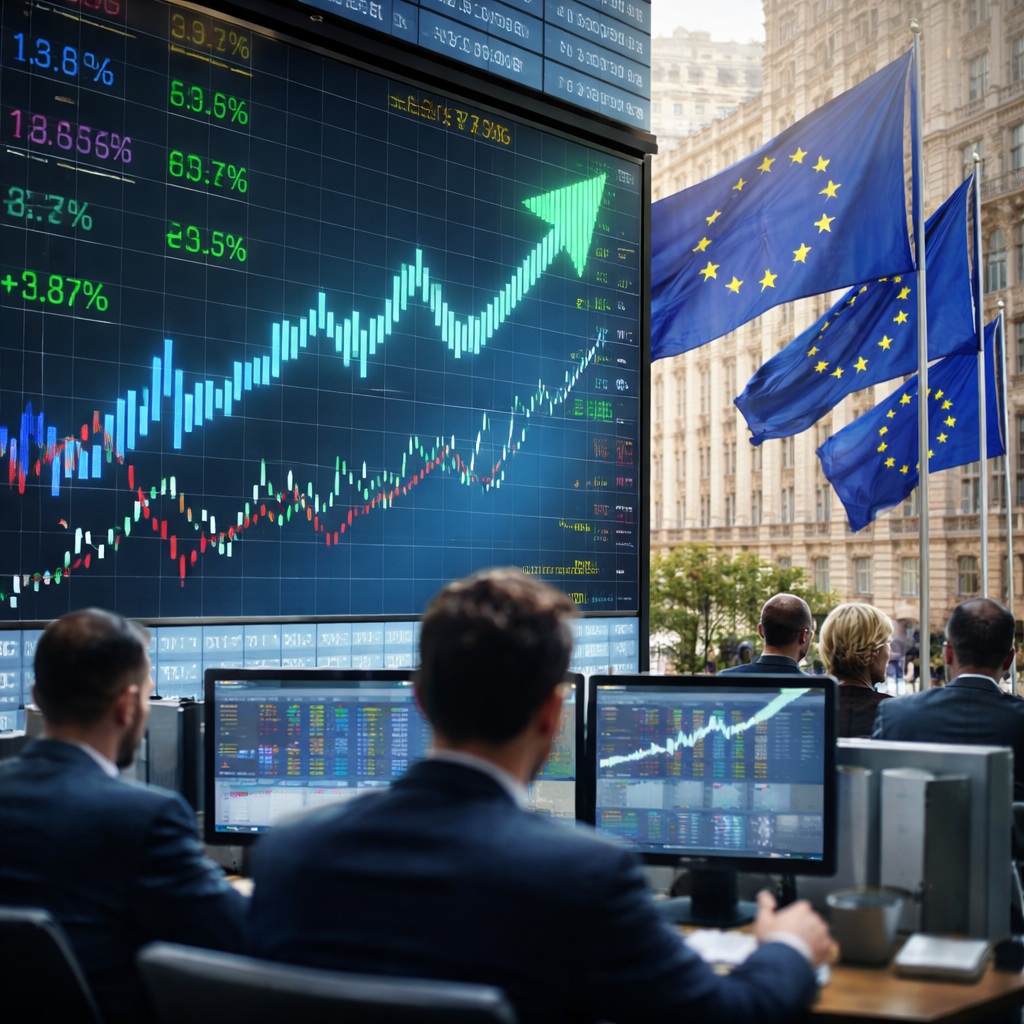
Relief spreads across trading floors as softened rhetoric over Greenland-linked tariffs steadies investor confidence and lifts European equities.
European stock markets staged a broad rebound at the end of the week, as investors reacted to signs that the United States was stepping back from a renewed wave of tariff threats. The shift in tone, linked to earlier warnings involving Greenland and strategic trade routes, helped calm nerves that had been rattled by days of political brinkmanship and revived fears of transatlantic trade friction.
From Frankfurt to Paris and Milan, equity markets moved higher in a synchronized response that reflected more than simple bargain-hunting. For many investors, the easing of tariff rhetoric represented a pause in a narrative that had begun to feel uncomfortably familiar: sudden policy signals, rapid market sell-offs, and the re-emergence of protectionism as a dominant economic risk.
In recent sessions, European assets had come under pressure as comments from Washington hinted at possible trade measures tied to Arctic resources and shipping access. Greenland, while geographically distant from the continent’s financial centers, occupies a sensitive position in global trade discussions due to its strategic location and growing importance in critical raw materials. Any suggestion of tariffs connected to this region was quickly interpreted by markets as a potential escalation with knock-on effects for Europe’s export-driven economies.
The change in mood came after U.S. President Donald Trump appeared to soften his stance, signaling that immediate tariff action was no longer on the table. While the remarks stopped short of a formal policy reversal, they were enough to trigger a relief rally across European exchanges. Traders described the move as a “de-escalation bounce,” driven by the perception that worst-case scenarios were being deferred, if not abandoned entirely.
Market participants emphasized that the rebound was rooted in psychology as much as fundamentals. Uncertainty, rather than tariffs themselves, had been the primary drag on sentiment. With global supply chains already adjusting to slower growth and geopolitical fragmentation, the prospect of fresh trade barriers had threatened to undermine corporate earnings forecasts for the year ahead.
Industrial and export-oriented sectors led the recovery, reflecting their sensitivity to trade policy signals. Automakers, engineering firms, and logistics companies all benefited from the improved outlook, while banks also advanced as calmer markets reduced fears of volatility-driven losses. Defensive stocks, which had attracted inflows during the period of uncertainty, lagged slightly as investors rotated back into riskier assets.
Despite the upbeat tone, analysts cautioned against reading the rebound as a definitive turning point. The underlying issues that sparked the tariff debate—competition over strategic resources, control of trade routes, and broader geopolitical rivalry—remain unresolved. For European policymakers and businesses, the episode served as another reminder of how exposed the region remains to shifts in U.S. trade policy, particularly under an administration known for its unpredictable communication style.
Currency markets echoed the cautious optimism seen in equities. The euro steadied after recent weakness, supported by improved risk appetite, while safe-haven assets saw reduced demand. Bond yields edged higher as investors moved away from defensive positioning, though moves remained contained, signaling that confidence had not fully returned.
Economists noted that Europe’s economic backdrop remains fragile, with growth subdued and manufacturing activity still uneven across member states. In this context, any reduction in external pressure is likely to be welcomed by markets. However, they warned that relief rallies can fade quickly if political tensions resurface or if rhetoric hardens once again.
For now, the pullback from tariff threats has given investors breathing room. Trading desks reported lighter volumes and a more orderly market environment, suggesting that participants were reassessing positions rather than rushing to exit or enter. The episode underscored the extent to which markets have become conditioned to respond instantly to political signals, particularly those originating from Washington.
As the week drew to a close, the prevailing mood in European markets was one of cautious relief rather than celebration. The rebound reflected a hope that dialogue might replace confrontation, at least temporarily. Yet few were willing to assume that the risk had disappeared entirely. In a global economy shaped by strategic competition and fragile alliances, today’s reassurance can quickly give way to tomorrow’s uncertainty.
For investors, the lesson was clear: political headlines remain a powerful market force. While Europe’s stock markets have shown resilience in the face of shifting narratives, their direction continues to hinge on decisions made far beyond the continent’s borders. The latest rally may have restored some confidence, but it also reinforced how quickly that confidence can be tested.


 The Tower Post