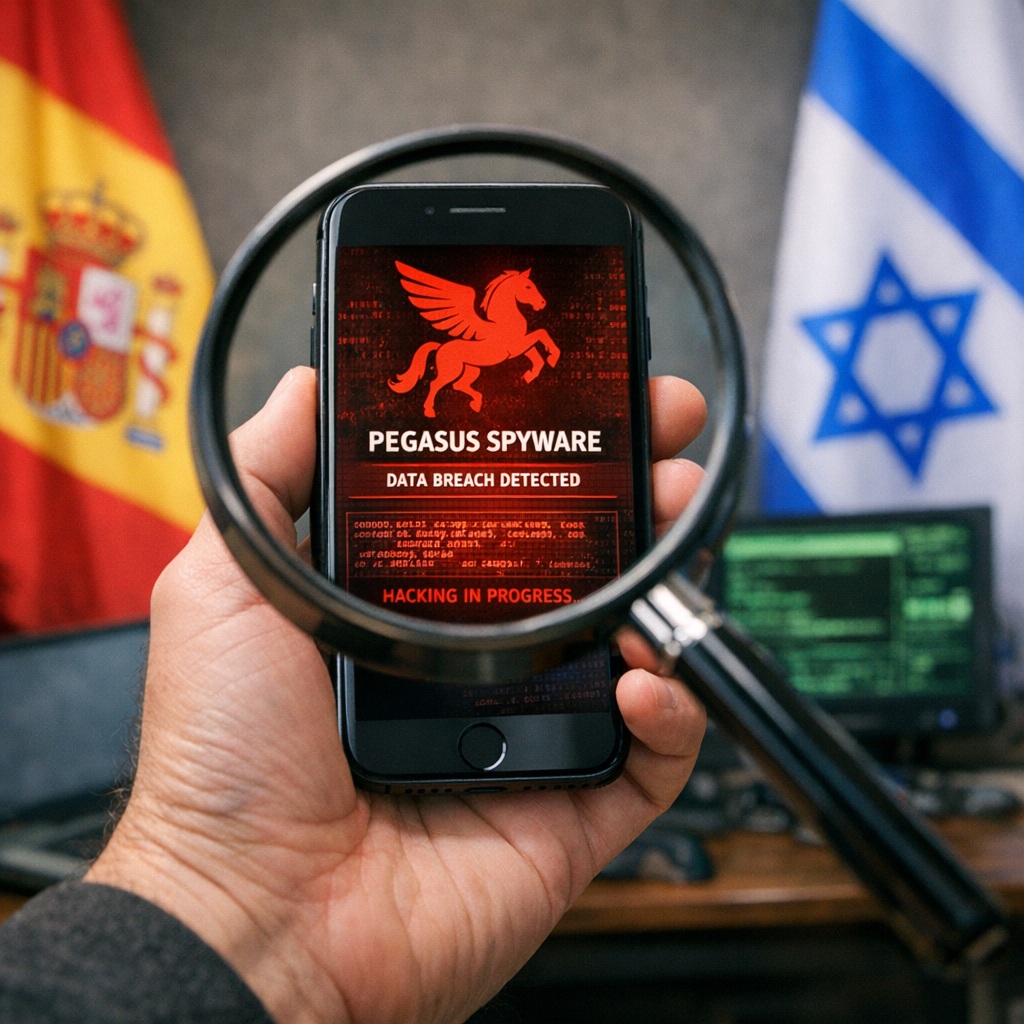
Madrid’s High Court ends a politically explosive investigation into alleged surveillance of senior officials, underscoring the limits of judicial cooperation in an era of global cyber-espionage.
Spain’s High Court has formally closed its investigation into the alleged use of Pegasus spyware against Spanish political leaders, bringing a quiet but consequential end to one of the most sensitive intelligence scandals to shake Madrid in recent years. The decision, taken this week, cites a persistent lack of cooperation from Israeli authorities, whose assistance was deemed essential to advance the case.
The probe centered on Pegasus, a powerful surveillance tool developed by Israel-based cyber-intelligence firm NSO Group. Designed to infiltrate smartphones without user interaction, the software can access messages, emails, microphones, and cameras, effectively turning personal devices into real-time intelligence assets. While NSO Group has long argued that Pegasus is sold exclusively to governments for use against terrorism and serious crime, multiple investigations worldwide have linked the technology to abuses against journalists, activists, and political figures.
In Spain, the controversy erupted when forensic analysis revealed that the phones of several senior officials, including members of Prime Minister Pedro Sánchez’s cabinet, had been infected. The revelations triggered a political storm, prompting parliamentary inquiries, public protests, and a broader reckoning over the country’s cyber-defense capabilities and internal oversight of intelligence services.
The High Court launched its investigation with the aim of determining who authorized or executed the surveillance and whether foreign entities were involved. From the outset, magistrates signaled that cooperation from Israel would be critical, given NSO Group’s location and the strict export controls governing Israeli cyber-surveillance technology. Formal requests for judicial assistance were sent through diplomatic and legal channels, seeking technical information and testimony that could help identify the operators behind the spyware attacks.
Those requests, according to court officials, went largely unanswered.
In its closing statement, the court acknowledged the gravity of the allegations but concluded that, without substantive input from Israeli authorities, the investigation could not meet the evidentiary standards required to proceed. The decision effectively shelves the case, though it leaves open the possibility of reopening the probe should new evidence emerge or cooperation improve.
For the Spanish government, the closure is a double-edged sword. On one hand, it brings procedural closure to a case that had become a persistent source of political tension. On the other, it reinforces a sense of unresolved vulnerability at the highest levels of the state.
At the height of the scandal, the discovery that the prime minister and defense officials had themselves been targeted raised uncomfortable questions about Spain’s ability to protect its own leadership from advanced cyber threats. It also fueled suspicions across the political spectrum, with opposition parties demanding clarity on whether domestic intelligence agencies had any role in the surveillance, and regional leaders pointing to a broader pattern of digital monitoring.
The Pegasus affair in Spain unfolded against a wider international backdrop. Similar allegations have surfaced in multiple countries, prompting lawsuits, sanctions, and export restrictions. Several governments have moved to tighten oversight of surveillance technologies, while international organizations and rights groups have called for clearer global norms governing their use.
Israel, for its part, has faced growing scrutiny over its role as a leading exporter of cyber-intelligence tools. While Israeli officials have consistently maintained that such technologies are subject to rigorous licensing and oversight, critics argue that enforcement remains opaque and accountability limited once tools are deployed abroad.
The lack of response cited by Spain’s High Court highlights a structural challenge in confronting transnational cyber-espionage: legal systems remain largely national, while digital surveillance operates seamlessly across borders. When cooperation falters, even well-resourced investigations can grind to a halt.
Legal experts note that the Spanish case may set a sobering precedent. This decision underscores the dependency of national courts on international goodwill when dealing with cyber tools that are tightly controlled by foreign states. Without binding mechanisms for cooperation, accountability becomes elusive.
NSO Group has repeatedly denied any direct involvement in targeting Spanish officials, stating that it does not operate Pegasus systems itself and cannot access client data. The company has also emphasized that it investigates credible allegations of misuse. However, critics argue that such internal reviews fall short of independent scrutiny.
As the case closes, political debate in Spain is shifting from blame to prevention. Government officials have signaled renewed investment in cybersecurity, encryption standards, and device protection for senior figures. There is also growing momentum for European-level initiatives aimed at regulating surveillance technologies and strengthening collective defenses against digital intrusion.
For now, the end of the High Court probe leaves more questions than answers. Who ultimately authorized the surveillance of Spain’s leadership remains unknown, and the full scope of the intrusion may never be publicly established. What is clear is that the Pegasus scandal has left a lasting imprint on Spain’s political consciousness, serving as a reminder that power in the digital age is as much about invisible code as it is about visible institutions.
As Europe grapples with the balance between security and rights, Spain’s unresolved spyware saga stands as a cautionary tale—one where judicial limits, diplomatic silence, and cutting-edge technology converge, leaving accountability just out of reach.




 The Tower Post