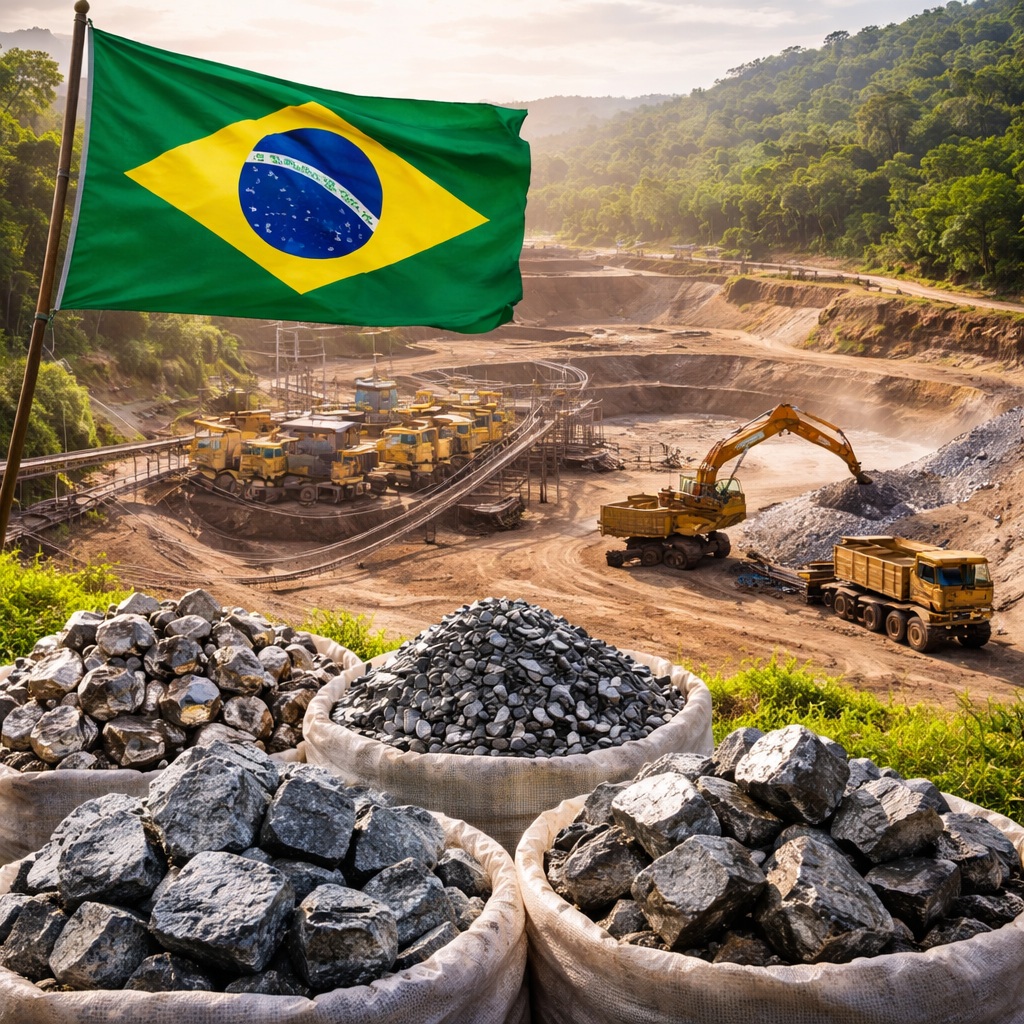
Washington and Brussels deepen engagement with Brasília to secure graphite, niobium and nickel vital for green technologies and industrial resilience.
By late January, the global race for critical minerals has entered a more overt diplomatic phase, and Brazil has emerged as one of its most sought-after partners. The European Union and the United States are both intensifying engagement with Brasília to secure long-term access to strategic resources such as graphite, niobium and nickel—materials that underpin everything from electric vehicle batteries to advanced aerospace alloys.
The courtship reflects a broader recalibration of industrial policy on both sides of the Atlantic. As governments seek to reduce dependency on single suppliers and to insulate clean-energy transitions from geopolitical shocks, attention has turned to resource-rich democracies with established mining sectors. Brazil, with vast geological reserves, a diversified economy and an increasingly assertive foreign policy, fits that profile.
For Washington, Brazil represents a potential anchor in the Western Hemisphere supply chain. U.S. officials have framed cooperation around critical minerals as part of a wider strategy to “friend-shore” production, pairing climate goals with national security considerations. Graphite, essential for lithium-ion battery anodes, and nickel, a key input for high-density batteries, are central to this approach. American automakers and technology firms are pressing for predictable access as domestic demand accelerates.
The European Union’s interest is equally strategic but shaped by its own regulatory landscape. Brussels is moving to implement frameworks designed to secure stable supplies of raw materials necessary for its Green Deal and industrial competitiveness. Niobium—a metal where Brazil already dominates global production—is particularly important for lightweight steel used in wind turbines, rail infrastructure and energy-efficient buildings. European policymakers see Brazil not only as a supplier, but as a partner in building value-added processing capacity.
Brazilian officials, for their part, are signaling openness while carefully managing expectations. The government has emphasized that any deepened cooperation must align with national development goals, environmental standards and local industrialization. Rather than simply exporting raw ore, Brasília is promoting downstream investments that would allow Brazil to capture more value within its borders.
This stance reflects lessons learned from previous commodity booms. While Brazil has long been a mining powerhouse, from iron ore to bauxite, policymakers are wary of repeating cycles in which global demand surges without delivering durable domestic benefits. Critical minerals, they argue, offer an opportunity to reshape the sector through technology transfer, skilled employment and stricter environmental oversight.
Environmental considerations loom large in the discussions. Mining projects, particularly for nickel and graphite, can carry significant ecological and social impacts if poorly managed. Both the EU and the U.S. are under pressure from voters and regulators to ensure that imported materials meet high sustainability standards. As a result, diplomatic talks increasingly include provisions on traceability, community consultation and deforestation safeguards.
Industry players are watching closely. European battery manufacturers and U.S. defense contractors alike see Brazil as a potential stabilizing force in volatile markets. At the same time, Chinese firms—already deeply embedded in global mineral supply chains—remain active investors in Brazil’s mining sector. This adds a competitive dimension to Western engagement, even as officials insist the goal is diversification rather than exclusion.
Analysts note that Brazil’s leverage is growing. With demand for critical minerals set to expand rapidly over the coming years, Brasília can afford to be selective, balancing partnerships across regions. The country’s diplomatic tradition of non-alignment and multilateralism gives it room to negotiate terms that reflect its interests, rather than aligning exclusively with any single bloc.
There are also domestic political dynamics at play. Mining expansion can generate revenue and jobs, but it can also provoke resistance from indigenous communities and environmental groups. The government must navigate these tensions carefully, particularly as global scrutiny intensifies. International partners, aware of these sensitivities, are framing cooperation as support for responsible development rather than extractive expansion.
For the EU and the U.S., success will depend on translating diplomatic intent into concrete projects. This includes financing infrastructure, supporting research into cleaner extraction methods, and aligning standards so that Brazilian minerals can flow seamlessly into transatlantic supply chains. The challenge lies not only in securing supply, but in doing so in a way that is resilient, ethical and politically sustainable.
As the new year unfolds, Brazil stands at the intersection of climate ambition and industrial competition. The simultaneous courtship by Washington and Brussels underscores how central critical minerals have become to global power dynamics. Whether Brazil can leverage this moment to redefine its role—from raw material exporter to strategic industrial partner—will shape not only its own economic future, but the trajectory of the green transition across the Atlantic.


 The Tower Post