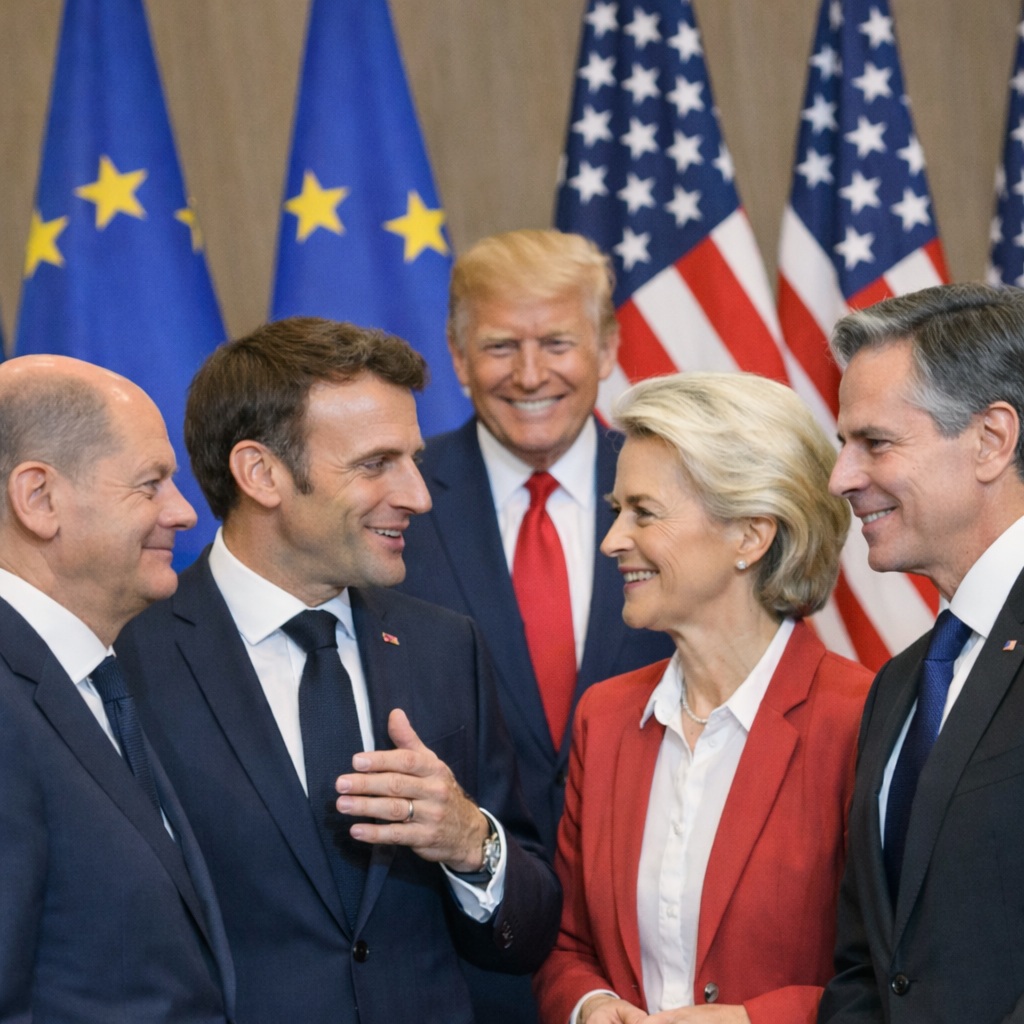
After tariff tensions ease, European officials stress unity, pragmatism, and renewed cooperation with Washington
At a time when global alliances are being tested by economic pressure, geopolitical uncertainty, and domestic political shifts, European Union leaders have moved to underscore the resilience of the transatlantic relationship. Meeting at a recent summit marked by unusually candid exchanges, heads of state and government welcomed Washington’s decision to step back from threatened tariffs linked to Greenland, framing the moment as a reminder of the strategic depth binding Europe and the United States.
The atmosphere at the gathering was notably calmer than in the days leading up to it, when the prospect of new trade measures had raised concerns across European capitals. Several leaders privately described the tariff rhetoric as destabilising, particularly given the fragile state of the global economy and ongoing efforts to coordinate on security and climate policy. The subsequent reversal by the United States was therefore received not as a victory, but as a necessary correction.
“This was about restoring trust and predictability,” one senior EU diplomat said on the sidelines. “Disagreements will happen, but how we manage them defines the partnership.”
Greenland, a strategically significant territory due to its location and resources, had become an unexpected flashpoint. European officials were wary that economic pressure connected to the island could spill into broader trade relations, potentially reopening wounds from past tariff disputes. The decision to de-escalate was widely interpreted in Brussels as a signal that Washington is once again prioritising consultation over confrontation with its European allies.
Publicly, EU leaders struck a careful tone. Rather than dwelling on the episode itself, they emphasised shared values and mutual interests. The language of unity, cooperation, and long-term alignment dominated the summit’s conclusions, reflecting a desire to move beyond reactive diplomacy toward a more structured partnership.
The episode also served as a reminder of Europe’s evolving posture on the global stage. While the EU remains committed to close ties with the United States, there is growing consensus that Europe must also strengthen its own economic and strategic autonomy. For many leaders, these two objectives are not contradictory but complementary.
“We want a strong Europe and a strong transatlantic bond,” said one head of government. “One reinforces the other.”
Trade remains at the heart of this relationship. EU officials have long argued that transatlantic commerce is too deeply integrated to be subjected to abrupt political shocks. Supply chains, investment flows, and regulatory cooperation bind both sides in ways that make escalation costly for all involved. The Greenland tariff threat, though limited in scope, was seen as a test of whether lessons from earlier trade conflicts had truly been learned.
According to officials familiar with the discussions, the summit included a renewed commitment to early warning mechanisms on trade disputes. The goal is to identify potential points of friction before they escalate into public standoffs. While such mechanisms are not new, leaders acknowledged that they have not always been used effectively.
Beyond trade, security considerations loomed large. With ongoing instability in Europe’s neighbourhood and continued concern over great-power competition, transatlantic coordination on defence remains a cornerstone of EU strategy. Several leaders stressed that economic disagreements should never undermine collective security commitments.
In this context, the easing of tariff tensions was portrayed as a positive signal ahead of upcoming discussions on defence spending, military mobility, and joint capabilities. “Strategic trust is indivisible,” said another senior official. “If it weakens in one area, it affects all others.”
Climate and energy policy also featured prominently. European leaders reiterated their expectation that cooperation with Washington will intensify on clean technologies, energy security, and emissions reduction. The Greenland episode, some noted, highlighted the risks of linking sensitive geopolitical issues too closely with trade measures, particularly in sectors critical to the green transition.
Despite the broadly optimistic tone, there was no sense of complacency. Several leaders acknowledged that transatlantic relations will continue to face strain, especially as both sides navigate domestic political pressures. The challenge, they said, is to prevent these pressures from translating into unilateral actions that surprise allies.
Analysts in Brussels noted that the summit’s message was as much about reassurance as it was about policy. By publicly welcoming Washington’s de-escalation, EU leaders aimed to project stability to markets, partners, and their own citizens. At the same time, they signalled that Europe expects to be treated as a strategic partner, not merely a trading counterpart.
For the United States, the decision to step back from tariff threats was seen by European officials as an acknowledgment of Europe’s growing coherence on foreign and economic policy. “The EU speaks more with one voice than it did in the past,” said a policy analyst at a European think tank. “That changes the dynamics of the relationship.”
As the summit concluded, the prevailing mood was one of cautious confidence. The Greenland tariff episode, while unsettling, ultimately reinforced the importance of dialogue and restraint. For EU leaders, the lesson was clear: the transatlantic relationship remains robust, but it requires constant attention and mutual respect to endure.
In an era defined by uncertainty, Europe’s message was simple and deliberate. Cooperation with the United States is not a given, nor is it a relic of the past. It is an active choice—one that must be reaffirmed, negotiated, and renewed whenever it is tested.


 The Tower Post