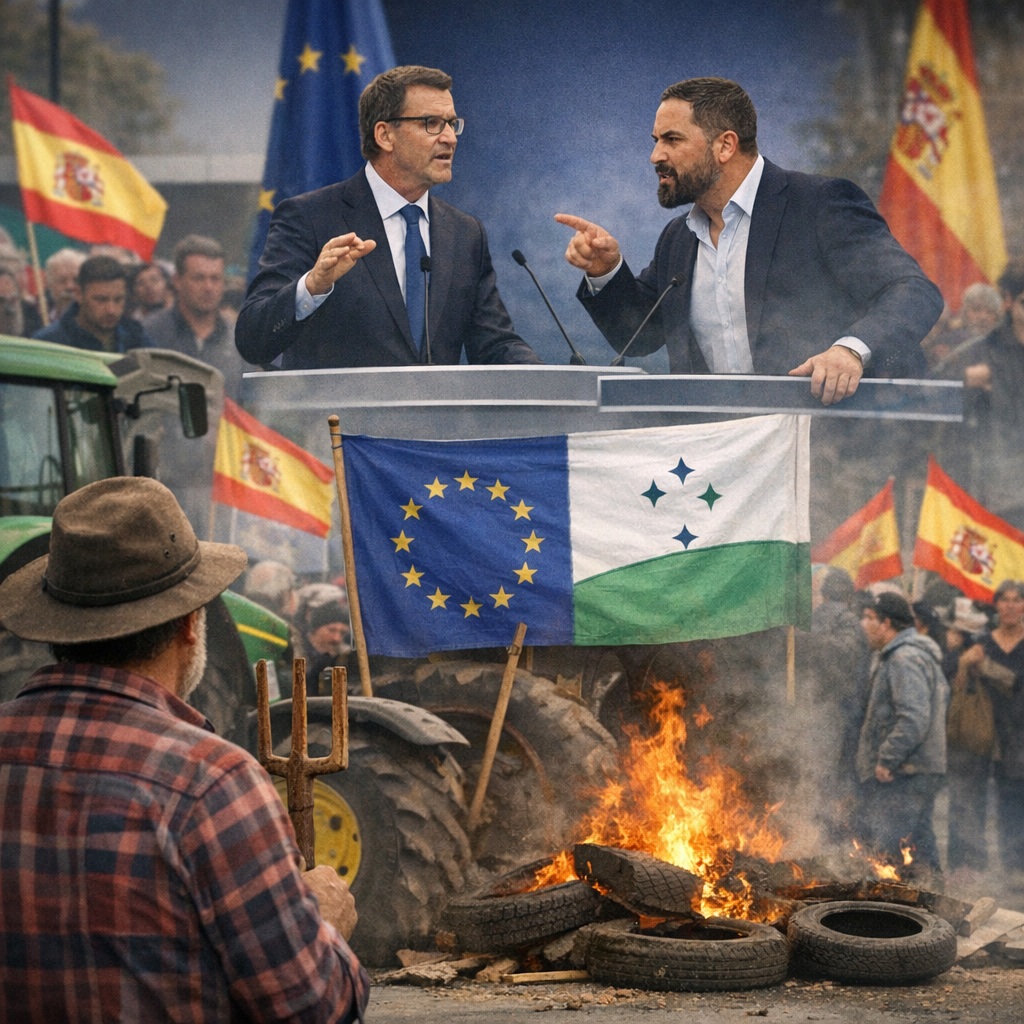
Farmers, unions and regional leaders watch closely as Spain’s right fractures over trade, sovereignty and Europe’s future
By late January 2026, Spain’s centre-right opposition finds itself publicly divided over one of the European Union’s most consequential trade agreements in decades: the long-negotiated pact between the EU and the Mercosur bloc of South American nations. The agreement, designed to create one of the world’s largest free-trade areas, has become a political stress test for Spain’s Popular Party (PP) and its uneasy relationship with the far-right Vox party.
At stake is not only Spain’s position within the European Union, but also the future of its farmers, exporters and industrial workers—groups that have taken to the streets in recent weeks, demanding clarity and protection as Brussels moves closer to ratification.
The PP, led by Alberto Núñez Feijóo, has adopted a cautious but broadly pro-European stance. Party leaders argue that Spain, as a major exporting economy, cannot afford to stand aside from a deal that promises expanded access to Latin American markets for sectors such as automotive manufacturing, chemicals, machinery and services. At the same time, they insist that the agreement must include stronger safeguards for agriculture, particularly for sensitive products such as beef, poultry, sugar and citrus fruits.
Vox, by contrast, has turned the EU–Mercosur deal into a symbol of what it calls Brussels overreach and unfair globalism. The party has rejected the agreement outright, arguing that it sacrifices Spanish farmers while imposing regulatory and environmental standards that are not equally enforced on foreign producers. Vox lawmakers have demanded that Spain veto the deal unless it is fundamentally rewritten, a stance that places them at odds not only with the governing left but also with their occasional allies on the right.
This divergence has gone beyond rhetoric. In regional parliaments and municipal councils where PP and Vox govern together, tensions have emerged over joint positions on agriculture and trade. Vox has pushed for institutional declarations opposing the agreement, while PP representatives have sought to moderate the language, wary of damaging relations with European partners and business groups.
For farmers, the debate is immediate and personal. Agricultural unions warn that increased imports of South American beef, sugar and soy—often produced under different cost structures—could undercut domestic producers already struggling with rising fuel prices, water scarcity and tighter European rules. Tractors have blocked roads, and union leaders have called for guarantees that European standards will apply equally to all imports.
Trade unions representing industrial workers are more divided. Some see opportunities in expanded exports and deeper ties with Latin America, while others fear job losses from increased competition. This split has allowed the PP to argue for a balanced position, supporting the agreement in principle while demanding safeguard clauses and compensation mechanisms.
Vox has framed the issue as part of a broader fight over national sovereignty. Its leaders link opposition to Mercosur with criticism of EU climate policy, migration rules and fiscal oversight, presenting the party as the only force willing to confront Brussels. The strategy aims to turn rural anger and scepticism toward globalisation into lasting political support.
For the PP, the challenge is strategic. It seeks to present itself as a credible, pro-European governing alternative while depending on Vox’s support in several regions. A full rupture over the EU–Mercosur deal could destabilise local alliances, but excessive compromise risks eroding the party’s European credentials.
European officials are watching Spain closely. The EU–Mercosur agreement requires broad political backing across member states, and Spain has traditionally been one of its strongest supporters due to its deep economic and cultural ties with Latin America. Visible division within Spain’s right adds uncertainty to an already fragile ratification process.
As the debate intensifies, the EU–Mercosur deal has become a proxy for larger questions about Spain’s political and economic direction. Whether the agreement moves forward or stalls, the clash between the PP and Vox has exposed fault lines that are likely to shape Spanish politics well beyond the current trade dispute.


 The Tower Post