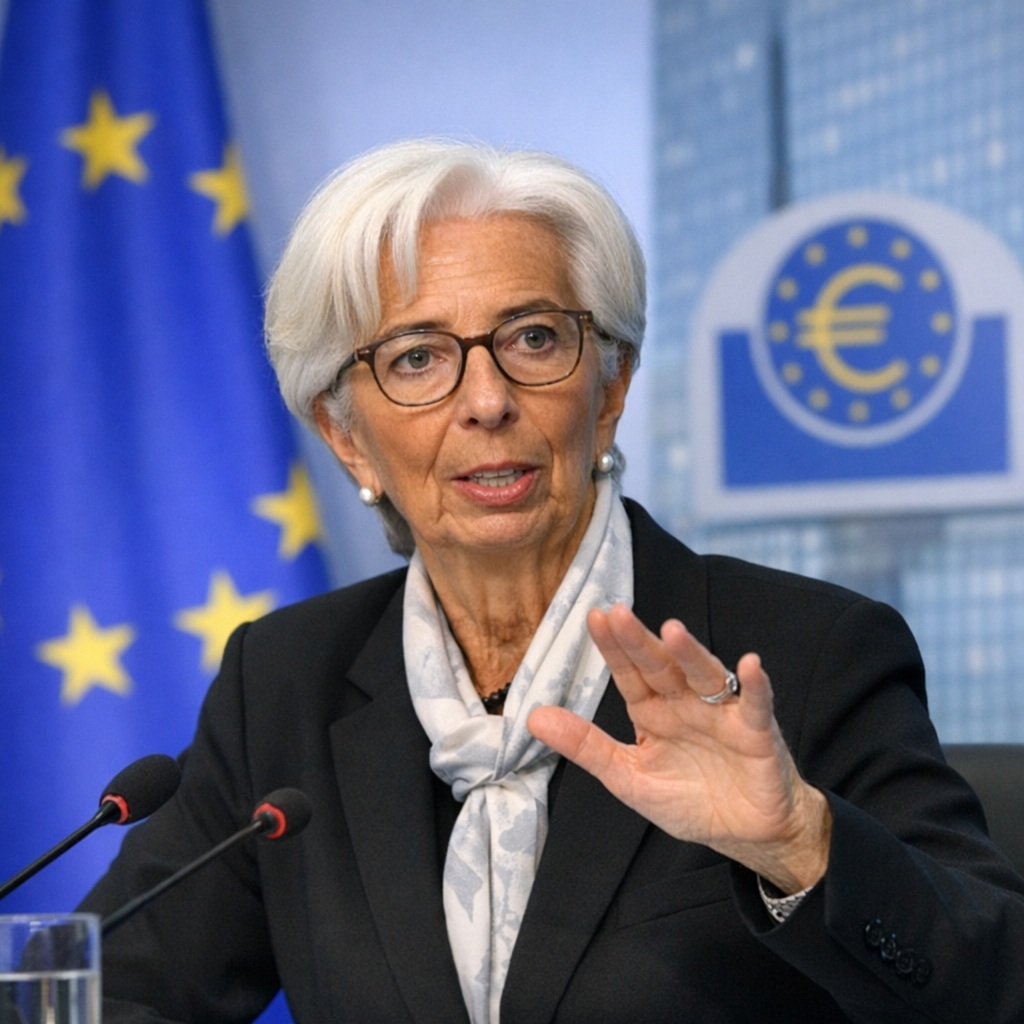
Central bank chief urges a comprehensive rethink to adapt Europe to a shifting global order
The president of the European Central Bank has issued a broad call to reassess the foundations of the euro-area economy, warning that the assumptions guiding policy for decades may no longer hold in what she described as a rapidly changing world order. Speaking in late January to policymakers, economists, and market participants, Christine Lagarde framed the challenge as both urgent and structural: Europe must adapt or risk falling behind in a more fragmented, volatile global system.
Lagarde’s intervention comes at a moment of heightened uncertainty for the euro area. The region is navigating sluggish growth, persistent geopolitical tensions, and accelerating technological change, all while attempting to maintain price stability and financial cohesion across economies with markedly different strengths and vulnerabilities. In that context, the ECB president argued that incremental adjustments are no longer sufficient. Instead, she called for a deep, comprehensive review of how the euro-area economy functions, how it is financed, and how it responds to shocks.
At the heart of her message was the idea that the global environment underpinning Europe’s economic model has shifted. Trade patterns are becoming less predictable, supply chains more regionalized, and energy markets more politicized. Meanwhile, digitalization and artificial intelligence are transforming productivity and labor markets faster than many institutions can track. “The frameworks that served us well in a more stable era must now be tested against new realities,” Lagarde said, urging European policymakers to think beyond short-term cycles.
For the ECB, the implications are significant. Monetary policy has already been stretched by years of unconventional measures, from large-scale asset purchases to negative interest rates, followed by an abrupt tightening phase aimed at curbing inflation. Lagarde acknowledged that central banks cannot solve structural problems alone, but stressed that monetary policy must be grounded in an accurate understanding of the economy it seeks to steer. A thorough review, she suggested, would help ensure that policy tools remain effective in a world marked by frequent shocks and heightened uncertainty.
Lagarde’s remarks also pointed to long-standing weaknesses within the euro area that have become more visible under stress. Investment levels lag behind those of global peers, productivity growth remains uneven, and capital markets are fragmented along national lines. These issues, she argued, limit Europe’s ability to innovate and absorb shocks. A renewed examination of the economic model could, in her view, help unlock private investment and improve the transmission of monetary policy across borders.
The call resonated with ongoing debates in Brussels and national capitals about competitiveness and strategic autonomy. European leaders have increasingly emphasized the need to strengthen domestic industrial capacity, secure access to critical raw materials, and reduce dependence on external suppliers in sensitive sectors. Lagarde’s intervention adds a monetary policy perspective to that discussion, highlighting how structural choices shape inflation dynamics, growth potential, and financial stability.
Economists note that the ECB has periodically reviewed its strategy, most notably in the wake of the global financial crisis and again more recently as inflation dynamics evolved. What distinguishes the current moment, they say, is the breadth of the challenges Lagarde is highlighting. Rather than focusing narrowly on inflation targets or policy instruments, she is pointing to the deeper economic and institutional architecture of the euro area.
Market participants reacted cautiously to the remarks, viewing them as a signal of longer-term reflection rather than an immediate shift in policy. The euro showed little reaction, and bond markets remained focused on near-term data and central bank communications. Still, analysts said the speech underscores a growing recognition among policymakers that the post-crisis playbook may not be sufficient for the years ahead.
Lagarde was careful to emphasize that a comprehensive review would require cooperation well beyond the ECB. Fiscal policy, regulatory frameworks, and national reforms all play critical roles in shaping economic outcomes. She reiterated calls for progress on long-discussed initiatives such as deeper capital markets integration and a more complete banking union, arguing that these steps would enhance resilience and support sustainable growth.
The political dimension of such reforms remains complex. Member states continue to differ over risk-sharing, fiscal rules, and the balance between national sovereignty and collective action. Lagarde’s appeal for a broad reassessment may therefore test the willingness of governments to revisit entrenched positions. Yet supporters argue that the scale of current challenges leaves little alternative.
Beyond Europe’s borders, the ECB president’s remarks reflect a wider global reassessment of economic policy. Central banks around the world are grappling with the consequences of geopolitical fragmentation, climate-related risks, and technological disruption. In that sense, Lagarde’s call positions the euro area within a broader international debate about how advanced economies can remain resilient and inclusive in an era of rapid change.
As Europe looks ahead, the question is whether this moment of reflection will translate into concrete action. A deep review of the euro-area economy, as Lagarde envisions it, would likely unfold over years rather than months. But by placing the issue squarely on the agenda, the ECB president has signaled that maintaining stability in the new world order may require more than fine-tuning existing policies. It may demand a fundamental rethinking of how Europe grows, invests, and competes in a more uncertain global landscape.


 The Tower Post