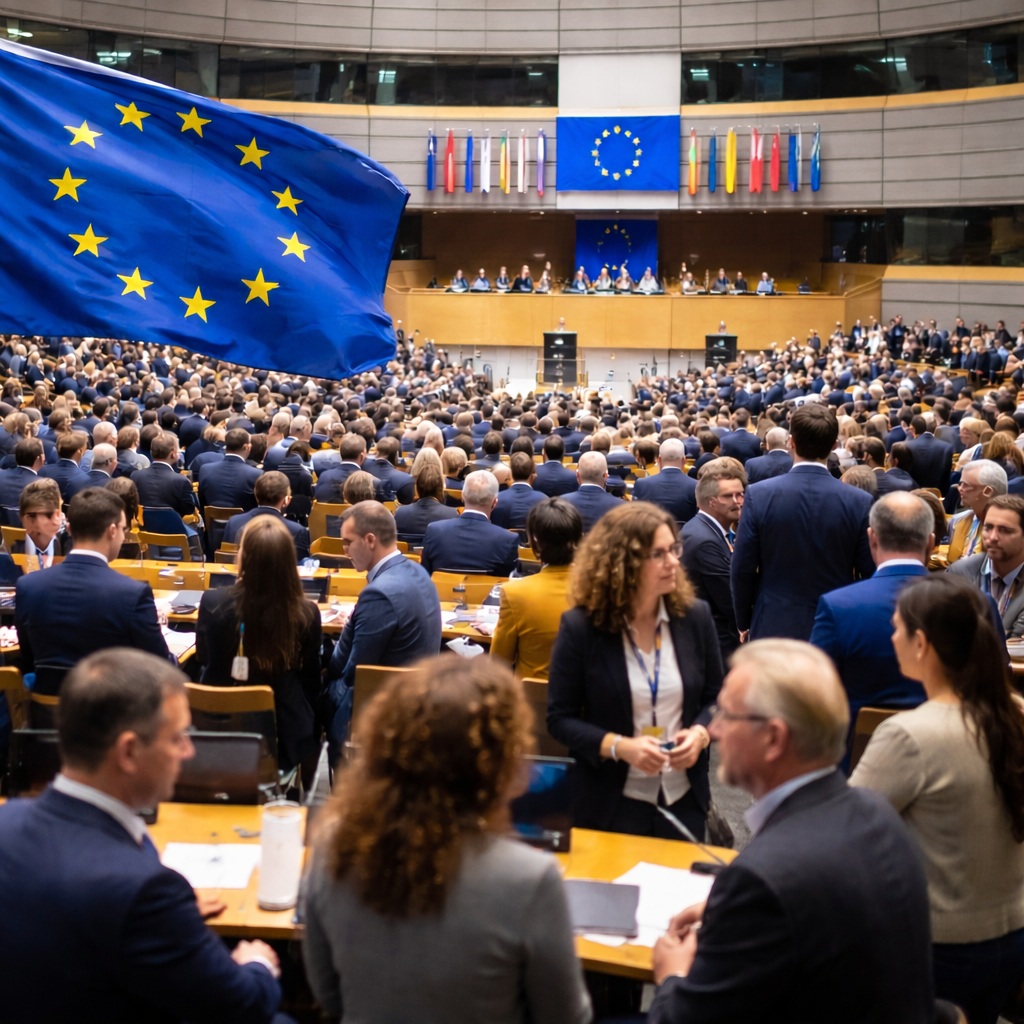
From gender equality to competitiveness, EU debates intensify as Brussels seeks renewed legitimacy at home
Europe’s political landscape is entering a phase of renewed intensity. Across institutions and member states, debates are converging around how the European Union should respond to economic pressure, social expectations, and a widening gap between policymaking and citizens’ daily realities. The result is a dense political agenda in which questions of gender equality, industrial competitiveness, and democratic engagement are no longer treated as separate files, but as interconnected tests of the EU’s relevance.
In Brussels, the emphasis is increasingly on delivery. After years marked by overlapping crises, EU officials and national leaders alike are under pressure to demonstrate that common policies can produce tangible outcomes. This urgency is shaping the tone of debates, moving them away from abstract commitments toward implementation, enforcement, and measurable impact—without necessarily relying on new treaty changes.
Gender equality remains a central reference point in this evolving agenda. While legal frameworks have expanded steadily over the years, political discussions now focus on closing persistent gaps between principle and practice. Representation in leadership, pay transparency, access to care services, and protections against gender-based violence are all framed as economic and democratic issues, not only social ones. The argument increasingly heard in Brussels is that inequality weakens Europe’s labor markets and undermines trust in institutions.
At the same time, these discussions are taking place against a backdrop of political polarization. Some national governments support a stronger EU role in setting standards, while others stress subsidiarity and cultural specificity. This tension plays out in parliamentary debates and council negotiations, where compromise is often reached through incremental steps rather than sweeping reforms. Still, the persistence of the issue on the agenda signals that gender equality has become a structural concern of European governance.
Competitiveness is the other dominant pillar of current political debate. Faced with slower growth, technological disruption, and global competition, EU policymakers are reassessing how regulation, investment, and industrial strategy interact. The traditional balance between market openness and social protection is being recalibrated, with a stronger focus on strategic sectors such as energy, digital infrastructure, and advanced manufacturing.
Business groups have intensified their calls for regulatory simplification, warning that fragmented rules and slow decision-making risk leaving Europe behind. In response, EU institutions are exploring ways to streamline procedures without dismantling environmental and social safeguards. The debate is less about deregulation than about coherence—how to ensure that rules adopted for legitimate policy goals do not collectively stifle innovation.
This discussion on competitiveness is inseparable from the green transition. Climate policy, once treated as a distinct domain, is now fully embedded in economic strategy. Political initiatives increasingly frame decarbonization as an opportunity to modernize industry and reduce external dependencies. Yet the social implications of this transition remain politically sensitive, particularly in regions dependent on traditional industries. Here again, the challenge is to align long-term objectives with short-term social stability.
Beyond policy substance, the EU is also grappling with how it communicates and engages. Brussels’ relationship with citizens has become a political issue in its own right. Low trust levels in some countries and the rise of anti-establishment narratives have pushed institutions to rethink how decisions are explained and who is involved in shaping them.
Citizen engagement initiatives are multiplying, ranging from public consultations to participatory forums. While critics question their real influence on policy outcomes, supporters argue that they represent a cultural shift within EU governance. The aim is not only to listen, but to make the policy process more legible and less technocratic. In this sense, engagement is viewed as preventive politics—a way to address discontent before it hardens into opposition.
Domestic politics in member states continue to shape these debates. Governments bring national priorities to Brussels, often influenced by electoral pressures and coalition dynamics. As a result, EU-level negotiations increasingly mirror domestic political divides, particularly on social policy and economic reform. This reinforces the perception of the EU as an extension of national politics rather than a distant authority.
The European Parliament plays a growing role in this environment. Its debates reflect a broader ideological spectrum, and its members are more assertive in linking EU initiatives to voters’ concerns. While legislative power remains shared with the Council, parliamentary scrutiny has become a key arena where issues such as equality, competitiveness, and democratic legitimacy intersect.
What emerges from this complex picture is a Union in motion rather than in crisis. Political initiatives are not always aligned, and progress is often uneven. Yet the intensity of debate itself points to an active domestic agenda at the European level. The EU is no longer only reacting to external shocks; it is negotiating its own priorities in a contested political space.
As Europe moves through this phase, the underlying question remains one of trust—trust that common action can deliver prosperity, fairness, and a sense of inclusion. The current debates do not offer simple answers, but they suggest a recognition that economic strength, social justice, and democratic engagement are mutually dependent. How convincingly this recognition is translated into policy will shape the next chapter of European politics.

 The Tower Post