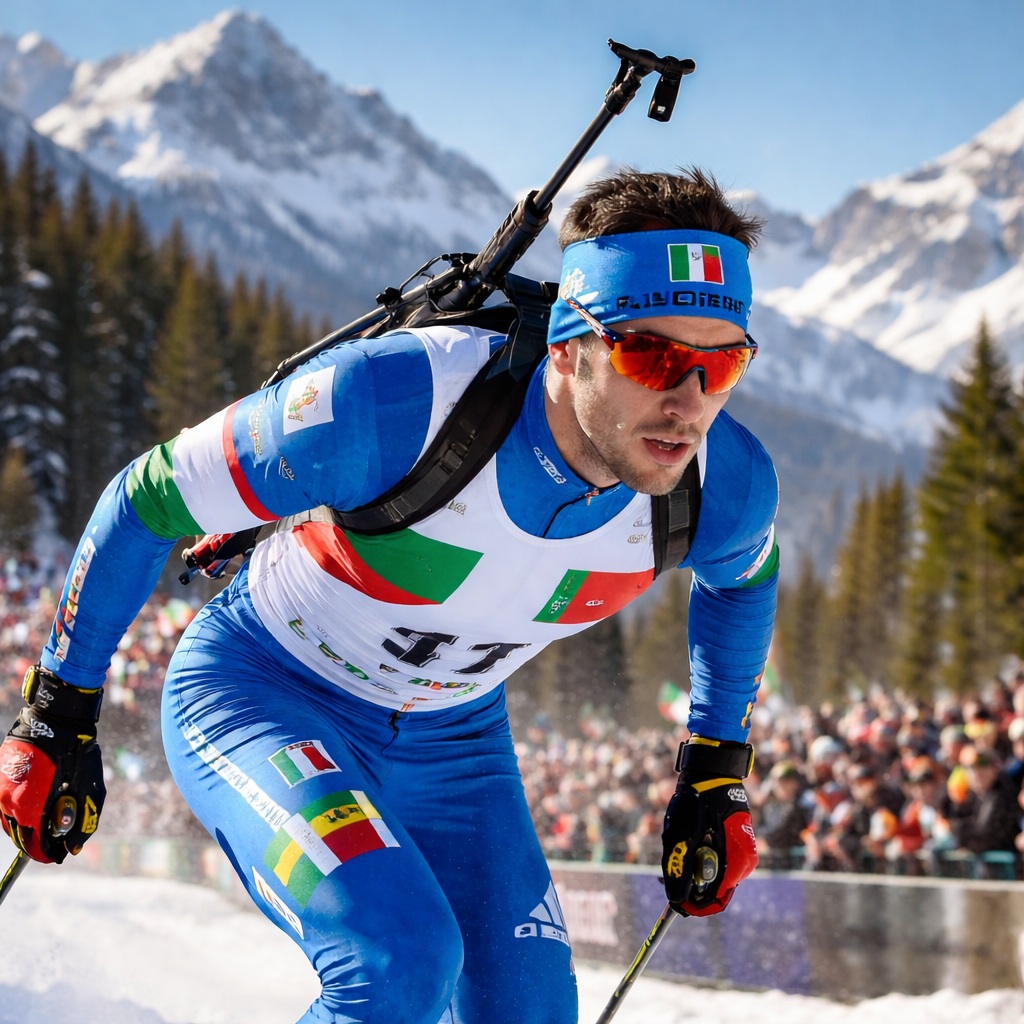
With a changing world order in men’s biathlon, Tommaso Giacomel steps into the spotlight, balancing elite form with the weight of Olympic expectations at home.
In the thin winter air of the Alps, where biathlon rifles crack and skis hiss across packed snow, Italy is daring to dream. As the Milano-Cortina Winter Olympics draw closer, the spotlight has settled on an athlete who only a few seasons ago was considered a promising outsider. Today, Tommaso Giacomel stands at the center of Italy’s Olympic ambitions, widely regarded as one of the strongest contenders for gold in men’s biathlon.
The landscape of the sport has shifted dramatically. The retirement of Norway’s Johannes Thingnes Boe has left a void at the very top, ending an era defined by relentless dominance and record-breaking consistency. In its wake, the international field looks more open than it has in years. For Giacomel, this moment represents both opportunity and challenge: a chance to seize Olympic glory, and a test of whether he can thrive when expectations are at their highest.
Giacomel’s rise has been anything but sudden. Raised in northern Italy, he grew up immersed in alpine sport, developing a blend of technical skiing ability and mental discipline that biathlon demands. Coaches who worked with him as a junior recall an athlete marked by unusual calm, particularly on the shooting range. That composure has become one of his defining traits. In recent seasons, his shooting speed has ranked among the fastest on the circuit, allowing him to gain precious seconds over rivals who hesitate under pressure.
On the tracks, Giacomel has evolved into a complete biathlete. Once considered stronger with the rifle than on skis, he has steadily closed the gap with the sport’s best pure skiers. Analysts point to improvements in his pacing and endurance, noting that he now finishes races with authority rather than merely hanging on. The result is an athlete capable of winning across formats, from individual races to mass starts where tactics and nerve play decisive roles.
The absence of Boe has altered more than medal predictions. It has changed the psychology of the sport. Where once athletes raced for second place, now a broader group senses that Olympic gold is within reach. France, Germany, and the Nordic nations will arrive with deep, experienced teams, but none carries an aura of inevitability. In this climate, Giacomel’s consistency has become a major asset. He may not win every race, but he rarely collapses, a quality that often defines Olympic champions.
Yet the promise of home Olympics brings its own complications. Competing on familiar snow should be an advantage, but performing in front of expectant crowds can weigh heavily. Italian biathlon has enjoyed success in the past, but rarely has a single athlete carried such clear gold-medal hopes. Former Olympians warn that managing emotion will be as critical as physical preparation. A missed shot in front of a roaring home crowd can feel louder than one taken abroad.
The Italian team has worked carefully to shield Giacomel from excessive pressure. Training camps have emphasized routine and stability, reinforcing habits built over years on the World Cup circuit. Team staff speak of keeping the Olympics “boring” in the best possible sense: no radical changes, no dramatic gestures, just the repetition of what has already proven effective. The message is clear—trust the process.
Technically, Giacomel enters the Olympic season with few visible weaknesses. His prone shooting has been notably reliable, while his standing series, traditionally the most fragile phase for many athletes, has improved through subtle adjustments in breathing and rifle timing. Ski technicians have also focused on optimizing equipment for the variable snow conditions typical of the Italian Alps, where weather can shift quickly and punish those unprepared.
Beyond medals, Giacomel’s role carries symbolic weight. Biathlon has long lived somewhat in the shadow of alpine skiing in Italy. A strong Olympic performance could elevate the sport’s profile, inspiring a new generation in regions where winter traditions run deep. Sponsors and broadcasters are watching closely, aware that success at home has the power to reshape national sporting narratives.
As the Olympic moment approaches, Giacomel remains characteristically measured. In interviews, he speaks less about gold and more about execution—clean shooting, smart skiing, staying present. It is a familiar refrain, but one rooted in experience. Those who know him best believe that this restraint is precisely what gives him a chance to make history.
When the starting gun finally echoes across the Olympic venue, reputations will matter less than decisions made in seconds. A steady heart rate, a smooth trigger pull, a final push on tired legs—these are the margins that decide champions. In an open field and on home snow, Tommaso Giacomel will not just be racing his rivals. He will be racing expectations, opportunity, and the rare possibility of delivering Olympic gold on Italian soil.
For Italy, that hope alone is enough to make biathlon one of the most anticipated stories of the Games.


 The Tower Post