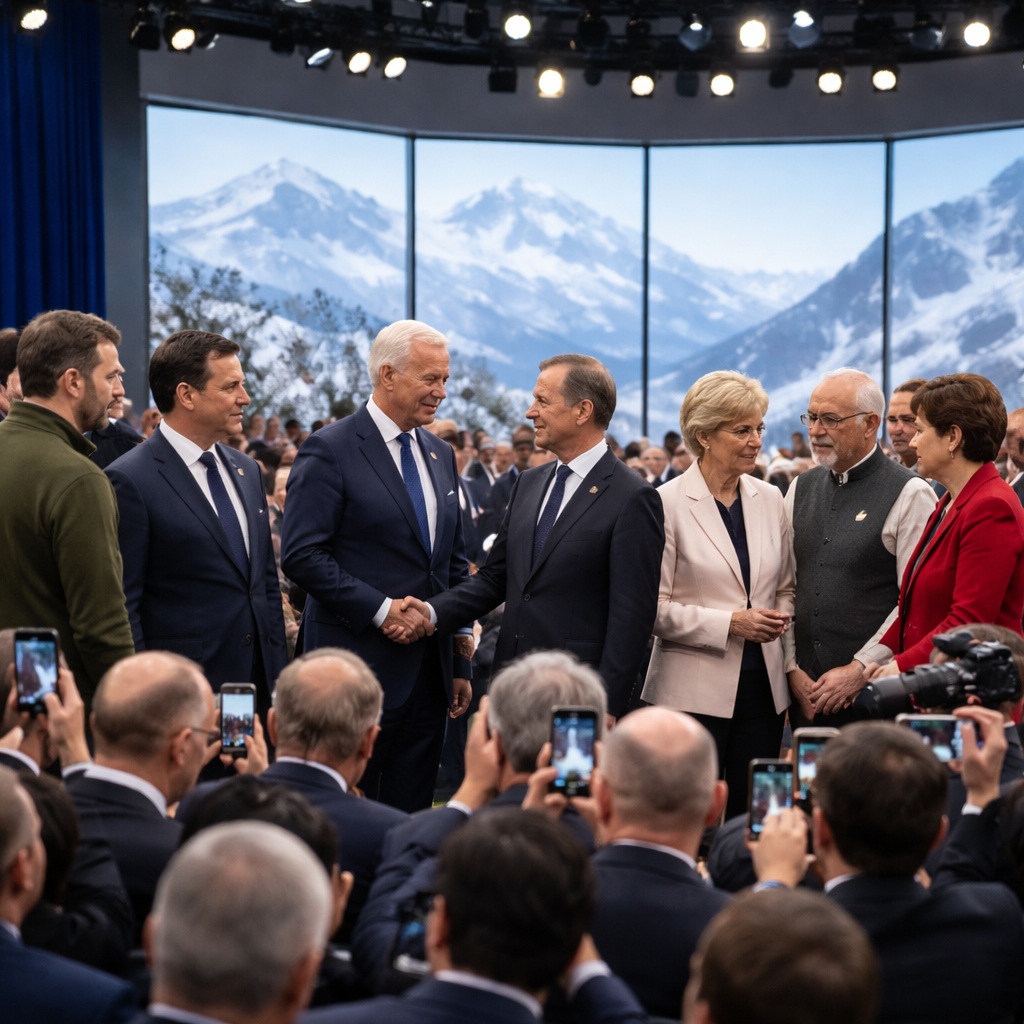
From geopolitical realignment to the reshaping of global growth, the World Economic Forum closes with a clearer sense of risk — and resolve.
As the annual gathering in the Swiss Alps draws to a close, delegations descend from Davos carrying more than briefing folders and sound bites. This year’s World Economic Forum ends with a sharper, more sober understanding of the forces reshaping the global order, and a recognition that familiar assumptions about stability, growth, and cooperation no longer hold.
Behind closed doors and on crowded panels, leaders confronted a world marked by strategic rivalry, economic fragmentation, and accelerating technological change. The tone was less celebratory than in past cycles of recovery, and more pragmatic than alarmist. The message repeated across sessions was clear: adaptation is no longer optional.
A World Reordered by Power and Proximity
Geopolitics dominated conversations in Davos, not as abstract theory but as a daily operating condition for governments and corporations alike. The era of predictable globalization has given way to a system shaped by blocs, alliances, and selective decoupling.
Leaders acknowledged that security considerations now routinely outweigh efficiency in trade, energy, and technology decisions. Supply chains are being shortened or duplicated, with “resilience” replacing “just in time” as the governing principle. While few advocated outright disengagement from global markets, many accepted that economic interdependence is increasingly managed through political filters.
At the same time, emerging and middle powers used the Davos platform to signal a more assertive stance. Rather than aligning reflexively with traditional poles, they emphasized strategic autonomy, diversified partnerships, and regional integration. The result is a multipolar landscape that is more flexible, but also more volatile.
Growth Under Pressure
Economic discussions reflected a shared concern that global growth is entering a structurally slower phase. High debt levels, demographic shifts, and persistent inflation risks are constraining policy options, particularly for advanced economies.
Finance ministers and central bank leaders stressed the need for credibility and coordination, while quietly admitting that the margin for error has narrowed. The debate has moved beyond short-term stabilization toward longer-term productivity and competitiveness — areas where progress has been uneven.
For developing economies, the challenge is more acute. Leaders warned that tighter financial conditions and reduced capital flows risk deepening inequality between and within countries. Calls for reform of international financial institutions resurfaced with urgency, framed not as ideological demands but as practical necessities for global stability.
Technology as Divider and Connector
Artificial intelligence and advanced digital systems were omnipresent in Davos discussions, seen simultaneously as engines of growth and sources of disruption. Executives showcased breakthroughs in automation, health, and climate modeling, while policymakers wrestled with governance gaps that are widening as fast as the technology itself.
There was broad agreement that innovation is outpacing regulation, but less consensus on how to respond. Some leaders pushed for global standards to prevent fragmentation and misuse, while others favored national frameworks tailored to domestic priorities. What united them was the recognition that failure to act risks both economic dislocation and public backlash.
Workforce transformation emerged as a central concern. Education, reskilling, and social protection systems are struggling to keep pace, raising questions about how societies absorb technological shocks without fueling political instability.
Climate: From Commitment to Execution
Climate discussions in Davos shifted noticeably from ambition to implementation. The focus was less on setting new targets and more on mobilizing capital, scaling infrastructure, and managing the social costs of transition.
Energy security remains a decisive factor, particularly as countries balance decarbonization with affordability and reliability. Leaders emphasized that the transition will not be linear, and that setbacks are inevitable without sustained investment and public trust.
Private-sector participation was repeatedly highlighted as essential, but executives cautioned that regulatory clarity and policy consistency are prerequisites for long-term commitments. The gap between climate pledges and real-world delivery remains a defining challenge.
A Quiet Shift in Tone
Perhaps the most striking takeaway from this year’s forum was the change in tone. The optimism that once defined Davos has given way to something more restrained but potentially more realistic. Leaders spoke less about grand visions and more about trade-offs, constraints, and sequencing.
There was no single roadmap emerging from the meeting, nor any illusion that consensus alone can solve systemic problems. Instead, Davos served as a mirror, reflecting a world in transition — unsettled, interconnected, and searching for workable paths forward.
As participants depart the Alps, the value of the forum lies less in declarations than in alignment. In a fragmented global environment, even partial understanding across borders carries weight. Whether that understanding translates into coordinated action will define the months ahead.

 The Tower Post