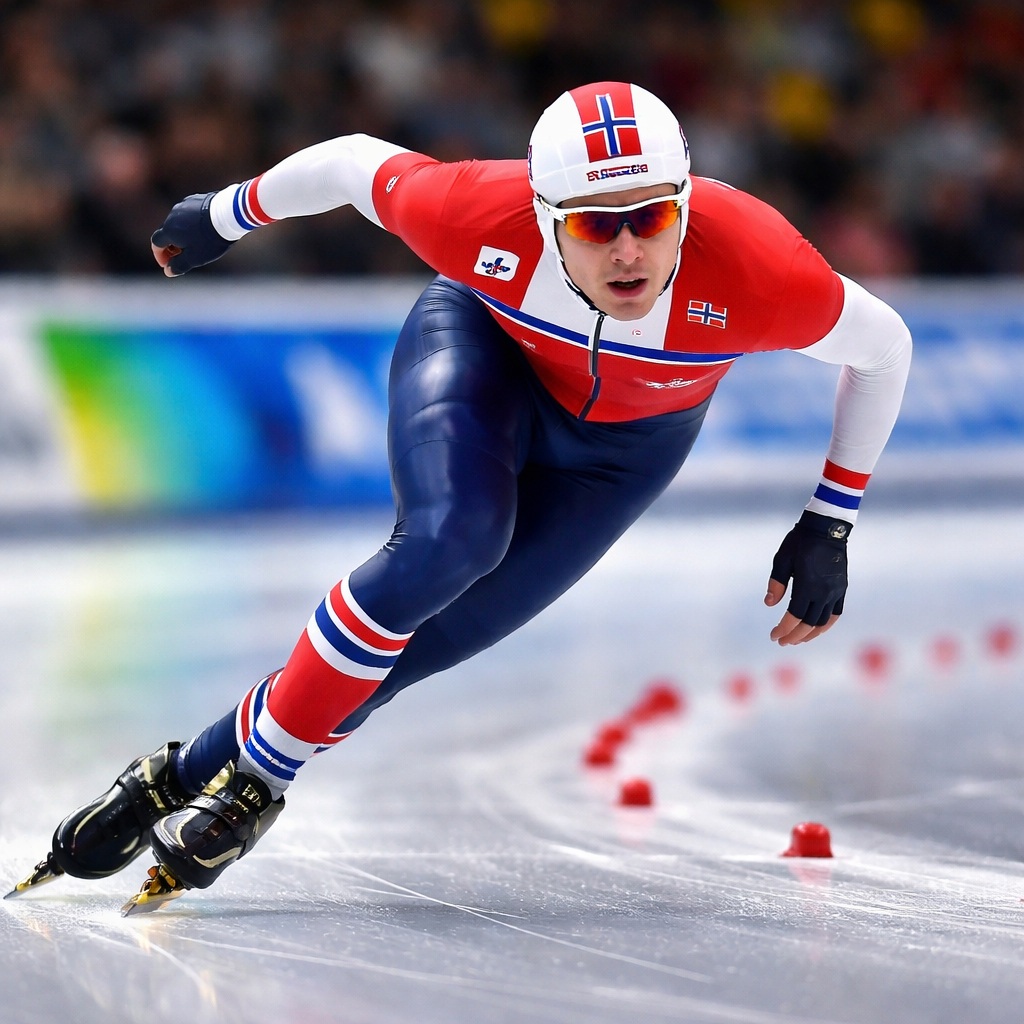
A historic sub–six-minute 5000 meters performance sends a clear message ahead of the Winter Games
By any measure, the men’s 5000 meters has long been a test of patience, power, and precision. On a cold day in Bavaria, that balance tipped decisively toward history. Norwegian speed skater Sander Eitrem delivered a performance that redefined the outer limits of endurance skating, setting a new world record at the Speed Skating World Cup in Inzell and becoming the first man ever to complete the distance in under six minutes.
The achievement resonated far beyond the alpine oval. In a discipline where world records are often shaved by tenths of a second, Eitrem’s breakthrough felt seismic. It was not only the time itself that drew gasps from competitors and coaches, but the authority with which it was achieved. From the opening laps, Eitrem skated with a controlled aggression that suggested both supreme confidence and meticulous preparation.
Inzell has long been considered fertile ground for fast times, thanks to its altitude and climate conditions, but no venue skates the race for the athlete. Eitrem’s rhythm was relentless, his technique economical. Each push appeared calibrated, conserving energy while maintaining speed, and as the laps counted down, it became evident that something extraordinary was unfolding.
For Norway, a nation with deep roots in winter sports but fewer recent headlines in long-track speed skating, the record carried symbolic weight. Eitrem’s rise has been steady rather than meteoric, marked by incremental improvements across multiple seasons. This latest performance, however, places him firmly at the center of the international conversation and restores Norway to the forefront of the endurance events.
The world record did not arrive in isolation. Throughout the current World Cup campaign, Eitrem has demonstrated remarkable consistency across long distances, frequently finishing on the podium and accumulating valuable points in the overall standings. Coaches and analysts note that this blend of peak speed and repeatability is often the hallmark of an athlete ready to contend on the biggest stage.
That stage now looms. With the Winter Olympics approaching, Eitrem’s timing could hardly be better. Olympic speed skating is as much a psychological contest as a physical one, and entering the Games as a world record holder alters the dynamics of every pairing. Rivals must respond not only to the stopwatch, but to the presence of a skater who has already crossed a threshold once considered unreachable.
Eitrem himself has struck a measured tone in post-race remarks, emphasizing process over spectacle. He credited his support team, advancements in training methodology, and careful race planning. Such restraint suggests an athlete keenly aware that Olympic medals are not awarded for records set weeks earlier, but for performances delivered on demand.
Still, momentum matters. The confidence gained from a landmark achievement can sharpen focus rather than dull it, and Norway’s coaching staff believes the record validates a long-term approach built around endurance efficiency and mental resilience. Competitors, meanwhile, are recalibrating their expectations, aware that the benchmark has shifted.
As the season moves toward its climax, the sub–six-minute barrier no longer feels theoretical. It is a proven reality, and Sander Eitrem is its author. Whether the record stands for months or years remains to be seen, but its immediate impact is undeniable. The men’s 5000 meters has entered a new era, and on the eve of the Winter Games, one skater has made clear that the future has already arrived.




 The Tower Post