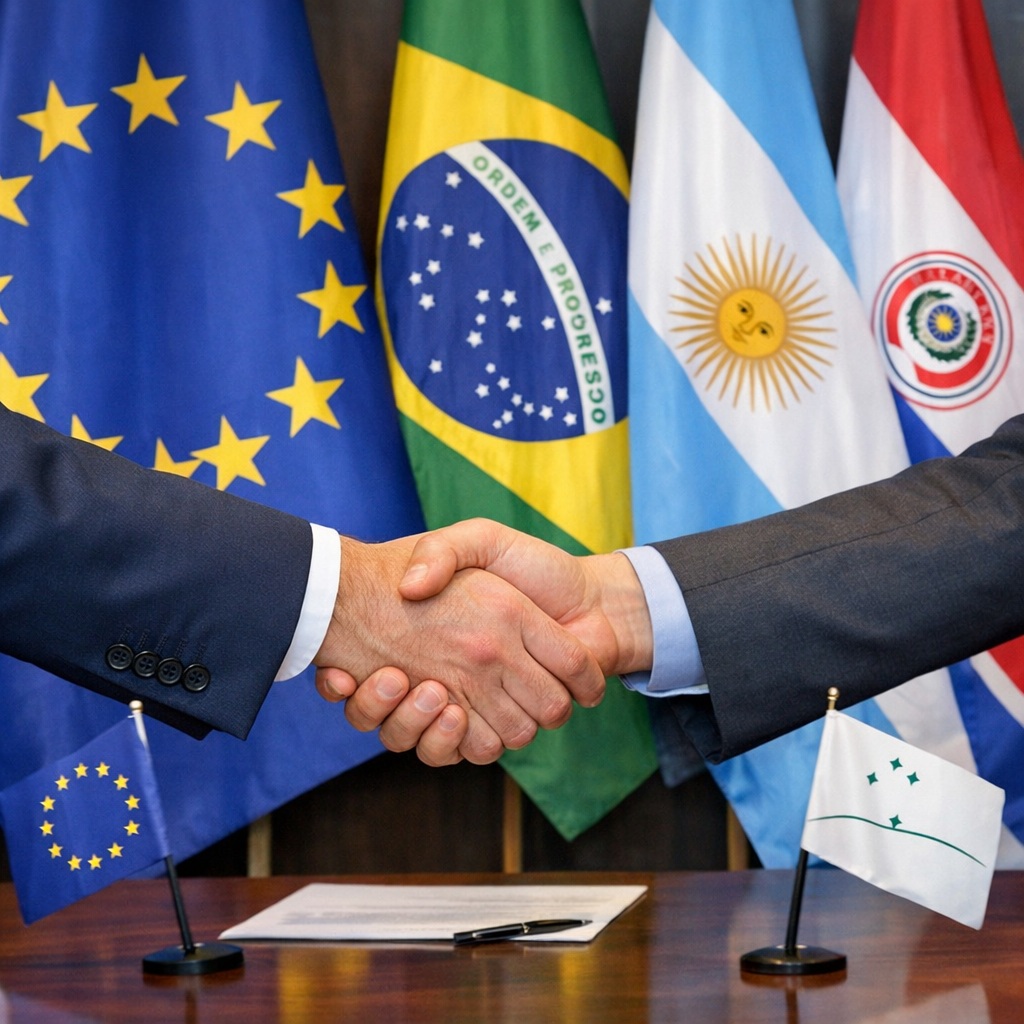
After more than a quarter-century of negotiations, political stalemates, and public protests, the European Union’s trade agreement with Mercosur is edging closer to reality.
The long-delayed deal between the EU and the South American bloc — Argentina, Brazil, Paraguay, and Uruguay — is now widely expected to enter provisional application in the near term, following final ratification steps in South America.
If confirmed, the move would mark a decisive moment for European trade policy at a time of geopolitical uncertainty, slowing growth, and renewed debates over the future of globalization.
A Deal Decades in the Making
Negotiations between the EU and Mercosur began at the turn of the millennium, stalled repeatedly, and were formally concluded only after years of technical and political wrangling. The agreement has since become one of the largest and most complex trade deals ever negotiated by the EU, covering a market of more than 700 million consumers.
The accord aims to eliminate the majority of tariffs between the two blocs, expand access for European industrial goods and services, and open South American markets to EU companies in sectors ranging from automobiles and machinery to pharmaceuticals, telecommunications, and financial services.
For Mercosur countries, the agreement promises improved access to the world’s largest single market for agricultural exports, including beef, poultry, sugar, and ethanol — products that have also made the deal controversial within Europe.
Why Provisional Application Matters
While full ratification by all EU member states remains politically sensitive and legally complex, provisional application allows key trade chapters of the agreement to take effect before the entire ratification process is completed. This mechanism has been used in previous EU trade agreements to avoid years of delay.
According to diplomats and EU officials, the final procedural hurdle lies in South America, where parliamentary approval in Paraguay is expected to unlock the path toward provisional implementation. Once this step is completed, Brussels could move swiftly to activate the commercial components of the deal.
Legal challenges remain possible, particularly in Europe, where environmental groups and farming lobbies have questioned the agreement’s compatibility with EU sustainability standards. However, EU institutions appear increasingly confident that provisional application can withstand such scrutiny.
Economic Promise Amid Sluggish Growth
Supporters of the EU-Mercosur deal argue that its timing is critical. With Europe facing weak domestic demand, high energy costs, and intensifying competition from the United States and China, expanding access to fast-growing emerging markets has become a strategic priority.
The European Commission estimates that the agreement could significantly boost EU exports, particularly for high-value manufactured goods. Tariff reductions are expected to benefit small and medium-sized enterprises that currently struggle to compete in South American markets due to high import duties.
Beyond trade volumes, advocates emphasize the geopolitical value of closer ties with Latin America. The deal is seen as a way to anchor Mercosur economies more firmly to European standards on labor rights, environmental protection, and regulatory cooperation, counterbalancing growing Chinese influence in the region.
Farmers Push Back
Despite these promises, opposition within the EU remains vocal, especially among agricultural producers. Farming unions in several member states warn that increased imports of South American meat and crops could undercut European farmers already under pressure from rising costs and stricter environmental rules.
Critics argue that enforcement of sustainability commitments in Mercosur countries will be difficult in practice, particularly when it comes to deforestation and land use. Environmental organizations have echoed these concerns, calling for stronger safeguards and clearer mechanisms to suspend benefits if standards are not met.
In response, EU officials insist that the agreement contains binding commitments on sustainable development and that new enforcement tools — strengthened in recent EU trade policy reforms — would apply. They also note that sensitive agricultural sectors are protected by quotas rather than full liberalization.
A Strategic Pivot in Trade Policy
The renewed momentum behind the EU-Mercosur deal reflects a broader shift in European trade strategy. As relations with traditional partners face increasing strain and global supply chains fragment, Brussels is seeking to diversify its economic relationships and reduce strategic dependencies.
Recent trade agreements and negotiations with partners in the Indo-Pacific, Latin America, and Africa underscore this approach. In that context, Mercosur stands out not only for its economic weight but also for its political symbolism: a demonstration that large-scale multilateral trade deals remain possible despite protectionist pressures.
What Comes Next
Provisional application would not end the debate. National ratifications within the EU could still take years, and the agreement will likely remain a focal point of political contention. Yet once businesses begin to benefit from reduced tariffs and improved market access, reversing course would become increasingly difficult.
For now, the EU-Mercosur agreement appears poised to move from diplomatic ambition to economic reality. After decades on the negotiating table, the deal may finally be preparing for takeoff — testing Europe’s ability to balance growth, sustainability, and political consensus in a rapidly changing global economy.



 The Tower Post