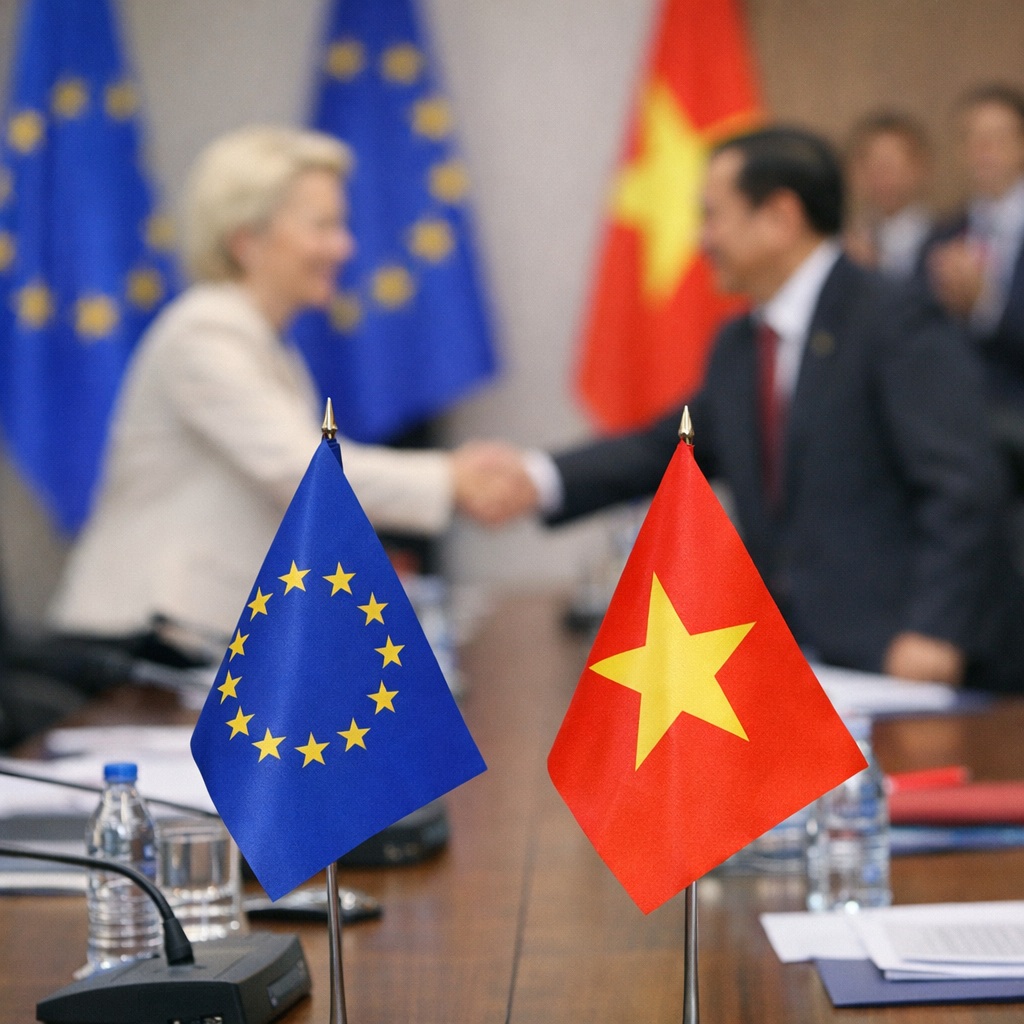
Brussels looks to Hanoi as it diversifies partnerships in a more fragmented world economy
By late January, the European Union is preparing to take a decisive step in its relationship with Vietnam, signalling an upgrade in political and economic ties at a moment when global trade patterns are under strain. The move reflects Brussels’ broader strategy to deepen partnerships beyond its traditional allies, as supply chains are reshaped by geopolitical tensions, protectionist impulses, and uncertainty in major markets.
Vietnam, one of Southeast Asia’s fastest-growing economies, has emerged as a pivotal partner in this recalibration. For the EU, closer engagement with Hanoi is not only about trade volumes, but also about resilience, strategic presence in the Indo-Pacific, and the promotion of rules-based commerce at a time when multilateral norms are under pressure.
A strategic recalibration
European officials describe the planned upgrade as part of a wider effort to “future-proof” the bloc’s external relations. With disruptions ranging from shipping bottlenecks to sudden tariff shifts and export controls elsewhere, Brussels has increasingly emphasised diversification. Vietnam stands out for its expanding manufacturing base, improving infrastructure, and relative political stability in a region marked by intense competition among global powers.
The EU and Vietnam already share a comprehensive trade framework, which has helped European companies increase their footprint in sectors such as electronics, renewable energy, pharmaceuticals, and high-end consumer goods. The envisaged elevation of ties would add a stronger political and strategic layer, covering areas such as supply-chain security, green transition cooperation, and digital standards.
For Hanoi, closer relations with the EU offer a counterbalance to overdependence on any single market. Vietnamese policymakers have consistently framed the country’s foreign economic strategy as one of “multidirectional engagement,” and Europe is seen as a partner that brings technology, regulatory expertise, and long-term investment rather than short-term volatility.
Trade in a fragmented world
The timing of the initiative is significant. Global trade flows are increasingly shaped by geopolitical alignments rather than pure economic efficiency. The EU has been vocal about the risks of excessive concentration in supply chains, particularly in critical raw materials and advanced manufacturing. Vietnam’s role as an alternative production hub has grown as companies seek to reduce exposure to geopolitical flashpoints.
European businesses operating in Vietnam point to a maturing ecosystem, with a skilled workforce and growing domestic demand complementing export-oriented production. At the same time, Brussels has signalled that any deepening of ties will continue to be linked to commitments on sustainability, labour standards, and environmental protection—areas where Vietnam has made progress but still faces scrutiny.
Beyond economics
The planned upgrade goes beyond trade and investment. Diplomats involved in the discussions underline the importance of cooperation on climate action, maritime security, and global governance. Vietnam’s vulnerability to climate change makes it a key partner for European green finance and adaptation technologies, while its position along vital sea lanes gives it strategic relevance for discussions on freedom of navigation and regional stability.
For the EU, engagement with Vietnam also fits into a broader Indo-Pacific approach that seeks to avoid binary choices between major powers. By strengthening ties with middle powers and emerging economies, Brussels aims to assert its role as an independent actor with its own interests and values.
Looking ahead
While the upgrade in relations is unlikely to grab headlines in the way major summits do, it represents a steady, deliberate shift in European foreign economic policy. In a world where trade disruptions are becoming the norm rather than the exception, the EU’s bet on Vietnam underscores a preference for pragmatic partnerships anchored in diversification and long-term cooperation.
As both sides prepare to formalise the next stage of their relationship, the message from Brussels is clear: in an era of uncertainty, expanding and elevating trusted partnerships is no longer optional—it is a strategic necessity.

 The Tower Post