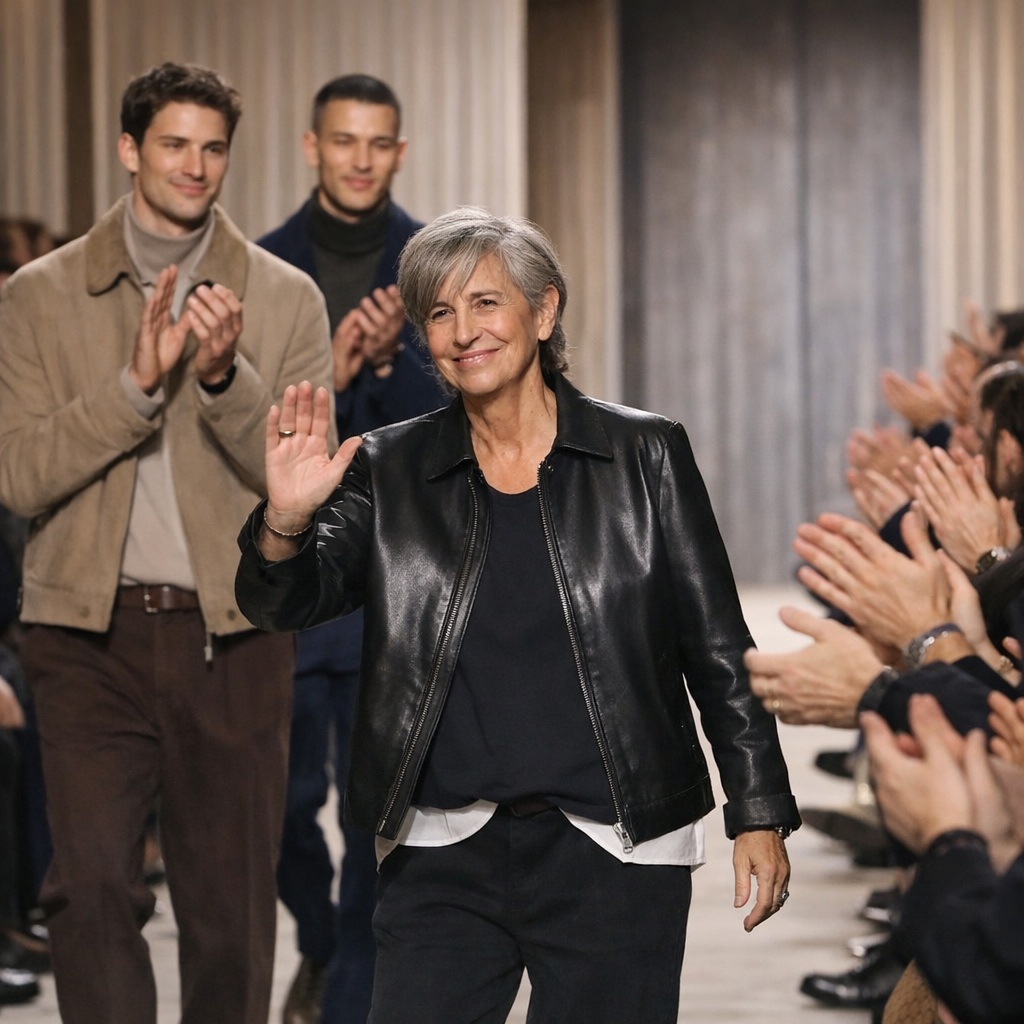
After nearly four decades shaping modern menswear, Véronique Nichanian leaves the Paris runway with a collection that reaffirmed restraint, craft, and lasting influence.
Paris awoke this season to a familiar hush as editors, buyers, and artisans filtered into a stark, sunlit venue for what would become one of the most emotionally resonant moments of the menswear calendar. Hermès, a house known for understatement rather than spectacle, presented a show that felt both resolutely forward-looking and gently retrospective. It was, as many in the room already knew, the final menswear collection by Véronique Nichanian.
Nichanian’s departure closes a chapter that has quietly shaped contemporary menswear. For decades, she has steered Hermès men with a steady hand, avoiding trends while setting standards that others would later follow. Her farewell show was not announced with grand statements or theatrical gestures. Instead, it unfolded the way her career has always progressed: through impeccable materials, humane proportions, and clothes designed for living rather than posing.
The runway opened with fluid tailoring that moved easily across the body. Jackets were relaxed yet exacting, trousers sat with natural authority, and outerwear carried the weight of craft without heaviness. Cashmere, leather, silk, and technical fabrics blended seamlessly, reflecting Hermès’ rare ability to unite heritage and innovation without friction. Colors stayed within the house’s restrained spectrum: earthy browns, softened blacks, deep blues, and muted mineral tones that caught the light rather than demanded attention.
What distinguished the collection was not novelty, but clarity. Each look seemed distilled to its essence, as if Nichanian was summarizing her philosophy in fabric. There was an emphasis on comfort and longevity, on garments that grow more expressive with wear. Coats were cut to last years, perhaps decades. Knitwear wrapped rather than constricted. Shoes grounded the looks with practicality, suggesting real streets rather than imaginary stages.
In the audience, emotion was palpable. Editors leaned forward, artisans exchanged knowing glances, and longtime collaborators watched with visible pride. Applause at the finale lingered longer than usual, not erupting into spectacle but swelling steadily, respectfully. When Nichanian emerged to acknowledge the room, the moment felt less like a farewell and more like a collective thank you.
Her influence extends far beyond Hermès. Long before “quiet luxury” became a buzzword, Nichanian was practicing it with conviction. She redefined masculinity away from rigidity and display, proposing a wardrobe built on ease, confidence, and discretion. At a time when menswear often chased provocation, her collections offered reassurance: that refinement could be modern, and that modernity did not require noise.
Colleagues often describe her as exacting yet generous, deeply involved with ateliers and unwavering in her respect for craftsmanship. Under her direction, Hermès menswear became a benchmark for material excellence, particularly in leather and knitwear. She treated luxury not as excess, but as intelligence embedded in construction and choice.
The timing of her exit resonates. The fashion industry is in a period of reassessment, questioning speed, sustainability, and meaning. Nichanian’s work stands as an implicit argument for patience and permanence. Her final show, presented amid global uncertainty, felt reassuringly human. It reminded the industry that clothes can be aspirational without being alienating, luxurious without being fragile.
Hermès has not framed this transition as an end, but as a continuation. The house is known for evolution without rupture, and insiders suggest that the foundations Nichanian built will remain intact. Still, her absence will be felt. Few designers have managed to leave such a consistent, coherent imprint over so long a period, especially in an industry defined by rapid change.
As the lights dimmed and the audience filed back into the Paris afternoon, there was a sense that something rare had just concluded. Not a dramatic era, but a quietly monumental one. Véronique Nichanian did not seek to redefine fashion with her final bow. Instead, she reaffirmed what she has always believed: that the most powerful design speaks softly, lasts long, and earns its place in everyday life.
In that sense, her farewell was perfectly Hermès. Calm. Confident. Enduring.




 The Tower Post