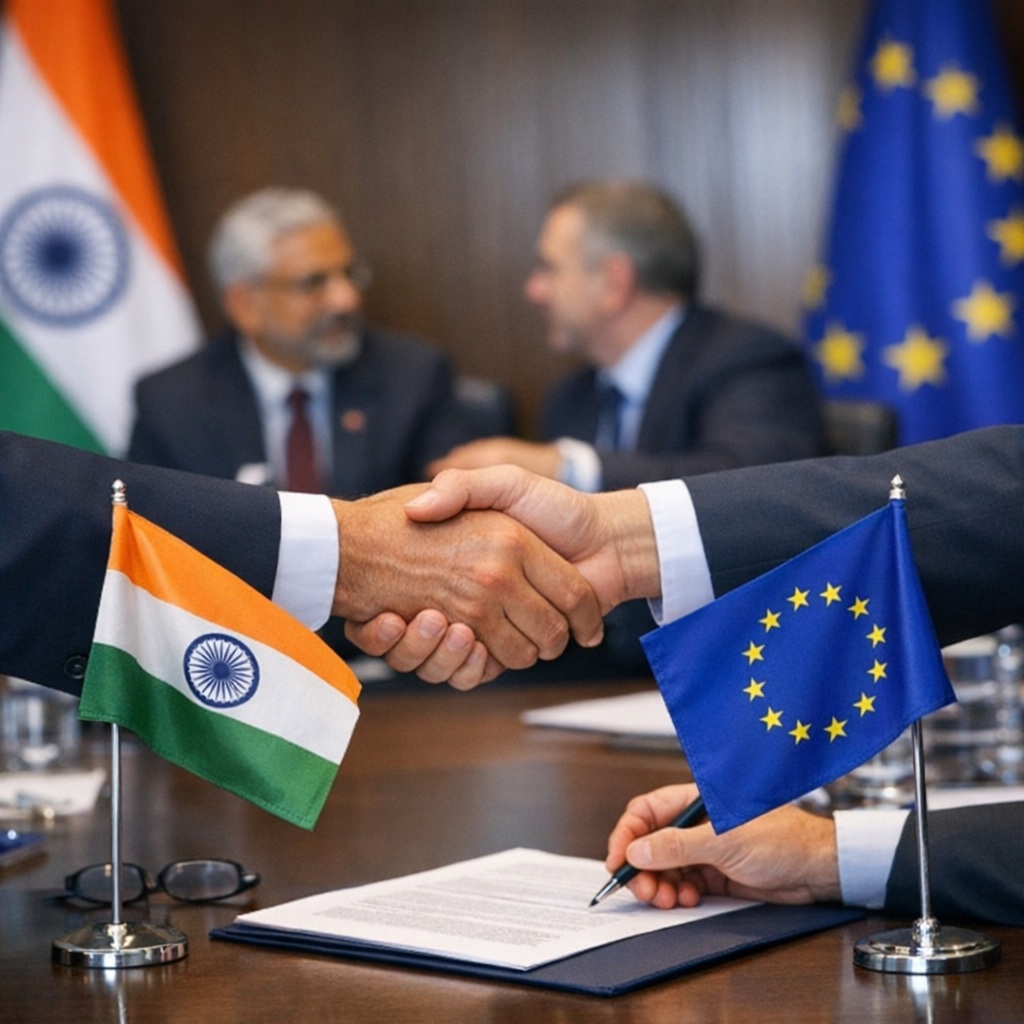
After years of stalled negotiations, New Delhi and Brussels are closer than ever to an agreement that could reshape trade flows, supply chains, and geopolitical balances between Europe and South Asia.
India and the European Union appear closer than ever to sealing a long-anticipated free trade agreement, marking a potential turning point in one of the world’s most complex and politically sensitive trade negotiations. After years of intermittent talks, pauses, and resets, diplomats and trade officials on both sides now speak with renewed confidence about bridging remaining gaps and delivering a deal that would significantly deepen economic ties.
The momentum reflects a convergence of strategic, economic, and geopolitical factors. For the EU, diversifying trade partnerships has become a priority as global supply chains are reshaped by geopolitical tensions and economic uncertainty. For India, the agreement represents a chance to anchor its growth ambitions more firmly to advanced markets while asserting itself as a central economic power in the Indo-Pacific.
Negotiations between India and the EU date back more than a decade, but progress has often been slowed by disagreements over tariffs, market access, regulatory standards, and labor and environmental provisions. Earlier rounds collapsed amid mutual frustration, particularly over India’s protection of sensitive sectors and the EU’s insistence on high regulatory and sustainability benchmarks.
This time, however, the tone is markedly different. Officials describe talks as pragmatic and results-oriented, with a clearer sense of what is politically feasible on both sides. Rather than aiming for a sweeping, idealized pact, negotiators are focusing on a balanced agreement that delivers tangible gains while leaving room for future deepening.
At the heart of the discussions is tariff reduction. India remains one of the EU’s largest trading partners with relatively high import duties, particularly on automobiles, wines and spirits, and certain manufactured goods. European exporters have long argued that these tariffs limit access to a fast-growing consumer market. In return, India is seeking greater entry for its pharmaceuticals, textiles, information technology services, and skilled professionals into the European market.
Agriculture and food standards remain sensitive issues. European policymakers face domestic pressure to protect farmers and uphold strict safety and environmental rules, while India is wary of opening sectors that support millions of livelihoods. Recent signals suggest compromise may come through phased liberalization and safeguard mechanisms designed to cushion vulnerable industries.
Beyond tariffs, the agreement is increasingly framed as a strategic partnership rather than a purely commercial one. Both sides see trade as a tool to strengthen resilience in critical sectors such as digital services, clean energy, and advanced manufacturing. Cooperation on supply chains for semiconductors, batteries, and renewable technologies has emerged as a shared priority, reflecting broader efforts to reduce overdependence on single suppliers.
Labor mobility and services are another crucial pillar. India has consistently pushed for easier movement of professionals, particularly in technology and engineering fields. While migration remains politically sensitive in Europe, negotiators are exploring targeted frameworks for short-term mobility and mutual recognition of qualifications, areas where incremental progress appears possible.
Sustainability and values are also shaping the talks. The EU is pressing for commitments aligned with its climate and human rights policies, including provisions on emissions, labor standards, and corporate responsibility. India, while cautious about binding obligations that could constrain development, has shown openness to cooperative approaches that emphasize capacity-building and technology transfer.
Business communities on both sides are watching closely. European companies view India as a long-term growth engine, especially as demographic trends and digitalization drive consumption. Indian firms, meanwhile, see the EU as a gateway to high-value markets and advanced technologies. Industry groups have urged negotiators to seize the current window of opportunity, warning that prolonged uncertainty could blunt investment decisions.
Geopolitics looms large in the background. As global trade becomes increasingly fragmented, both New Delhi and Brussels are keen to demonstrate that open, rules-based economic cooperation remains viable. A successful agreement would send a signal that large, diverse economies can still find common ground despite differing priorities and political systems.
While key issues remain unresolved, the trajectory is clear. The latest round of talks has narrowed differences and built trust, raising expectations that a deal is within reach. Even a limited initial agreement would represent a significant step forward, setting the stage for deeper integration over time.
For India and the European Union, the stakes extend well beyond trade figures. The prospective agreement is about positioning themselves in a changing global order, strengthening strategic autonomy, and forging a partnership that reflects shared interests in stability, growth, and resilience. If concluded, it would mark not just the end of a long negotiation, but the beginning of a new chapter in Europe–India relations.



 The Tower Post