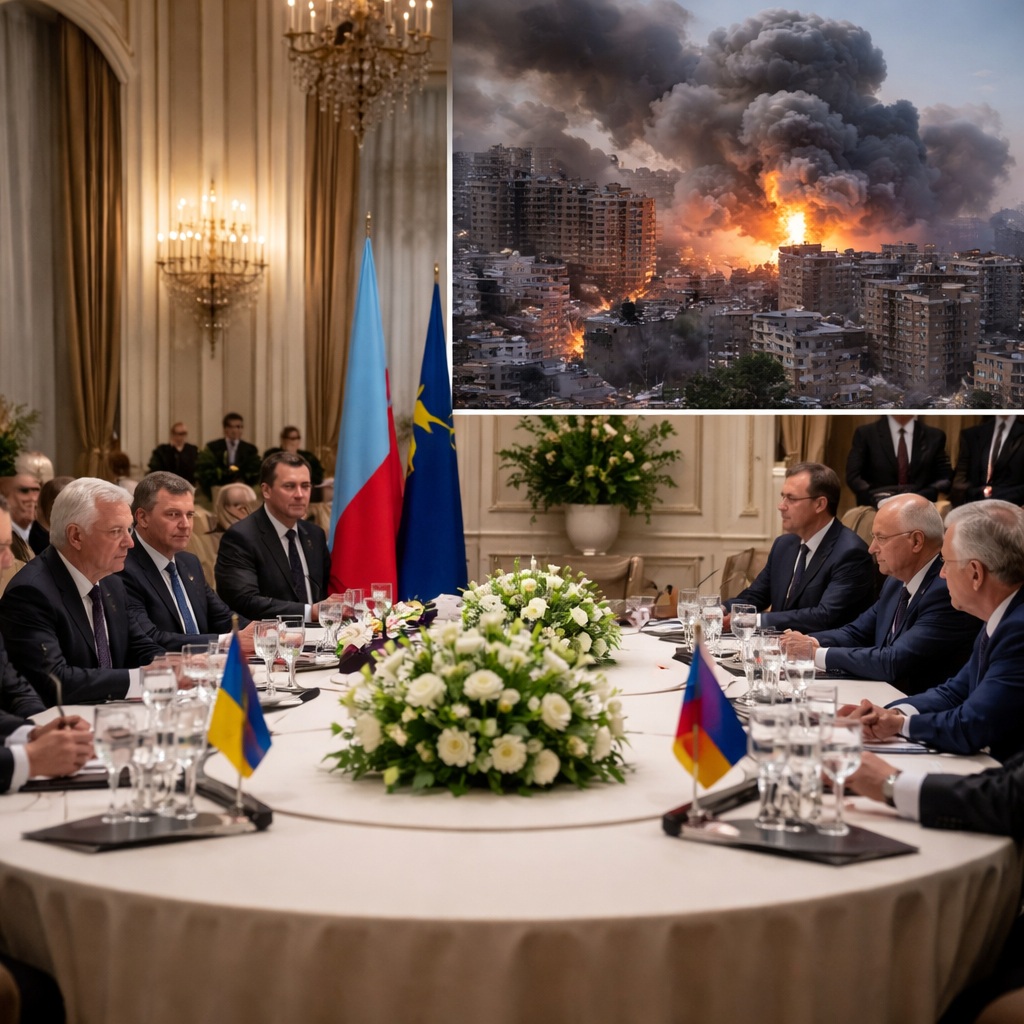
U.S.-brokered negotiations to halt the war in Ukraine close without agreement, as renewed strikes on Kyiv and other cities underscore the deep mistrust between the parties.
Peace talks hosted in Abu Dhabi concluded without a breakthrough, capping days of intense, U.S.-brokered negotiations aimed at ending the war in Ukraine. Delegations departed the Gulf capital with carefully worded statements about “continued engagement,” but no concrete steps toward a ceasefire. As talks faltered behind closed doors, Russian bombardments of Kyiv and several regional centers continued, casting a long shadow over diplomatic efforts and reinforcing doubts about the prospects for compromise.
The negotiations had been framed by organizers as a rare opportunity to test whether battlefield realities and political pressures might open space for diplomacy. Abu Dhabi was chosen for its neutral profile and logistical reach, with U.S. officials shuttling between Ukrainian and Russian representatives in an effort to narrow gaps on security guarantees, territorial control, and the sequencing of any ceasefire.
From the outset, expectations were tempered. Ukrainian officials arrived insisting that any deal must preserve sovereignty and provide enforceable security assurances. Russian representatives, according to diplomats familiar with the discussions, maintained positions that Kyiv has repeatedly rejected, including demands related to territory and limitations on Ukraine’s future security partnerships.
As the talks progressed, the atmosphere grew increasingly strained. Briefings described long pauses, parallel sessions, and repeated returns to previously debated points. “There was engagement, but not convergence,” said one Western diplomat involved in the process, speaking on condition of anonymity due to the sensitivity of the negotiations. “The gaps were structural, not technical.”
Outside the negotiating rooms, events on the ground moved in the opposite direction. Air raid sirens and reports of missile and drone strikes in Ukrainian cities punctuated the diplomatic calendar, providing a stark reminder that the war remained active and lethal. Ukrainian officials cited the attacks as evidence that Moscow was using negotiations to buy time, a claim Russian officials denied, arguing that military operations and diplomacy could proceed simultaneously.
Washington’s role was central but constrained. U.S. envoys sought to identify incremental confidence-building measures, including humanitarian corridors, prisoner exchanges, and limits on strikes against civilian infrastructure. While there was cautious discussion of such steps, none advanced far enough to be formalized. American officials later acknowledged that the talks were exploratory rather than decisive, designed to test intentions rather than seal an agreement.
Regional actors followed the outcome closely. Gulf states have increasingly positioned themselves as conveners in global diplomacy, leveraging economic ties and political relationships across divides. Abu Dhabi’s hosting of the talks reflected that ambition, even as the lack of a deal highlighted the limits of mediation in a conflict shaped by existential stakes.
European governments reacted with a mix of disappointment and resignation. Several officials emphasized that diplomacy remains necessary even when progress is elusive, while warning that continued bombardments would harden public opinion and complicate future talks. “Every strike makes compromise politically harder,” said a senior European official. “But the absence of talks makes escalation more likely.”
For Ukraine, the collapse of the Abu Dhabi round reinforced a familiar dilemma: balancing the pursuit of international support with the need to defend territory under fire. Kyiv reiterated calls for sustained military assistance and stronger pressure on Moscow, arguing that negotiations cannot succeed under bombardment.
Russia, for its part, signaled openness to further contacts but accused the West of pushing terms it considers unacceptable. State-linked media portrayed the talks as evidence of Russia’s willingness to engage, while downplaying the lack of results and emphasizing military developments instead.
Analysts noted that the failure to reach a deal did not necessarily mark the end of diplomacy, but rather another pause in a long, uneven process. “Conflicts of this scale rarely end in a single meeting,” said an international relations scholar based in the region. “They end when the costs of continuing outweigh the costs of compromise, and that balance has not yet shifted.”
As delegations departed Abu Dhabi, the contrast between diplomatic language and battlefield reality remained stark. Statements spoke of future dialogue and maintained channels, while explosions and air defenses continued to shape daily life in Ukraine. For now, the talks served less as a turning point than as a measure of how far apart the parties remain.
The war’s trajectory will likely continue to be shaped by developments far from conference tables: by military capabilities, political resolve, and the endurance of civilian populations. Until those factors change, diplomacy may persist in fits and starts, overshadowed by the sounds of conflict it seeks, but has so far failed, to end.




 The Tower Post