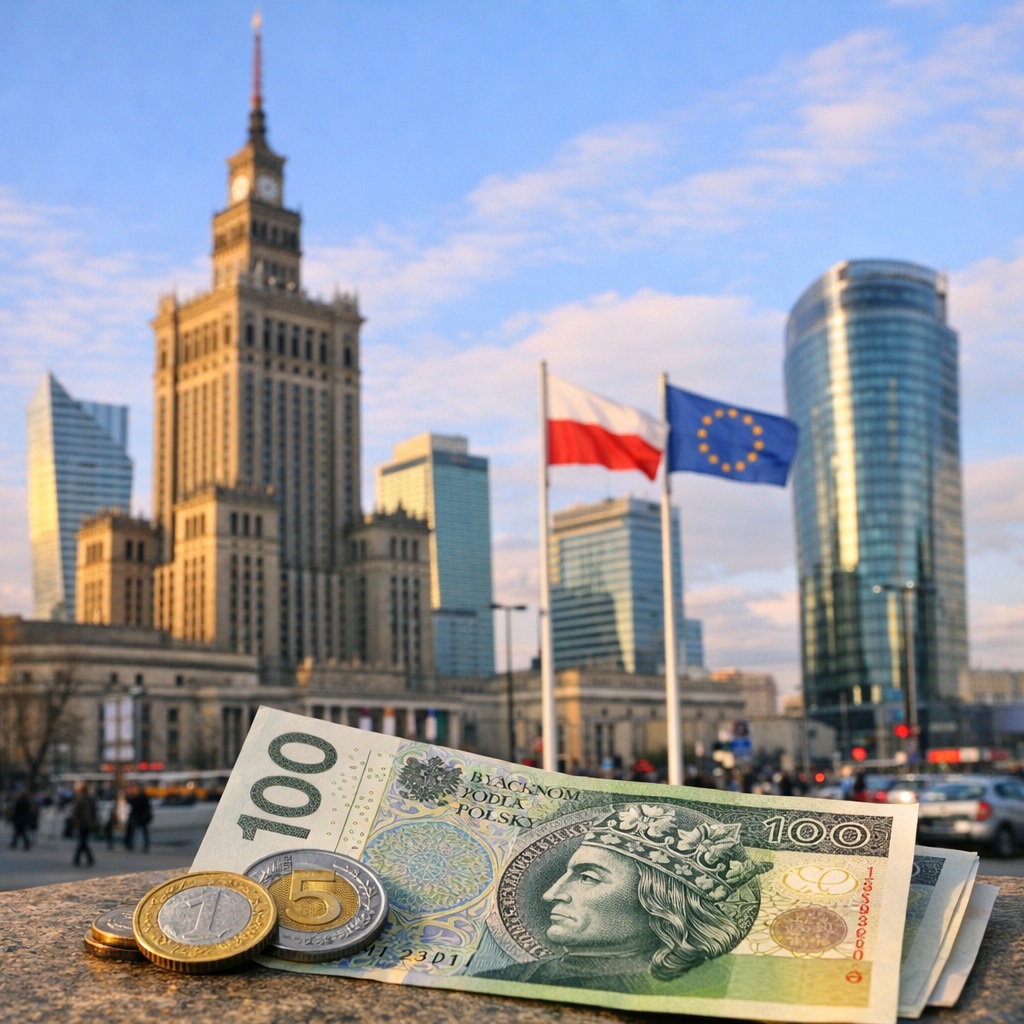
Buoyed by robust expansion and political pragmatism, Warsaw signals it will take its time before embracing the single currency
In a Europe still navigating the aftershocks of inflation, energy shocks, and geopolitical uncertainty, Poland has emerged as a quiet outlier. Its economy has regained momentum with a resilience that contrasts with the hesitations seen in parts of the eurozone. Against this backdrop, Polish leaders have made it clear that adopting the euro is no longer an urgent priority, reframing what was once presented as a natural next step of European integration into a distant and conditional objective.
The message coming from Warsaw is measured rather than defiant. Officials insist that eurozone membership remains a formal commitment embedded in Poland’s long-term European trajectory. Yet the tone has shifted decisively. The country’s renewed growth, improving domestic demand, and relatively flexible monetary framework have strengthened the case for retaining the złoty for the foreseeable future. In political terms, the argument is simple: why rush into a club whose constraints may outweigh its benefits at a moment when the national economy is performing well on its own terms?
Poland’s recent economic performance has reinforced this confidence. After weathering successive external shocks, the economy has rebounded with strong investment, a revitalized labor market, and expanding consumption. Public finances, while still under pressure from social spending and defense commitments, are perceived as more manageable than in previous cycles. For policymakers, this recovery has undercut the traditional rationale for euro adoption as a stabilizing anchor.
The central bank’s role is central to this recalibration. Retaining an independent monetary policy has allowed Poland to respond swiftly to domestic conditions, adjusting interest rates and liquidity tools without waiting for consensus among eurozone members with divergent priorities. Supporters of the złoty argue that this flexibility has cushioned the economy during turbulent periods and preserved competitiveness for exporters, particularly in manufacturing and services closely tied to regional supply chains.
Political calculations also loom large. Public support for the euro remains lukewarm, shaped by memories of price increases in other countries following adoption and by a broader skepticism toward surrendering economic sovereignty. Even among pro-European voters, enthusiasm is tempered by the perception that the eurozone is still evolving and that its governance structures favor larger economies. For governing coalitions, pushing aggressively for euro adoption risks opening an unnecessary front in an already polarized political environment.
At the same time, Poland’s stance reflects a more nuanced view of the eurozone itself. While the single currency has proven durable, it continues to wrestle with structural challenges, from uneven growth to debates over fiscal coordination and burden-sharing. Recent reforms have strengthened common tools, but they have also highlighted the obligations that come with membership, including tighter fiscal oversight and reduced room for national discretion. From Warsaw’s perspective, waiting allows Poland to enter on clearer terms, or not at all if the balance of costs and benefits remains unfavorable.
Business leaders are divided. Large exporters and multinational firms often favor euro adoption, citing lower transaction costs and reduced currency risk. Smaller companies, however, value the protective buffer of an adjustable exchange rate, especially in an era of unpredictable global demand. This split mirrors a broader societal debate: integration versus autonomy, efficiency versus control.
European partners have reacted calmly. Brussels has avoided pressuring Poland, aware that euro adoption is ultimately a sovereign decision and that forcing the issue could prove counterproductive. Privately, some officials acknowledge that Poland’s caution reflects lessons learned from earlier enlargements, when economic convergence proved more uneven than expected. A stronger, more self-assured Poland may, in time, become a more stable eurozone member—if and when it chooses to join.
For now, Poland is content to sit at the threshold. It participates fully in the single market, aligns with EU regulations, and supports deeper cooperation in areas such as defense and energy security. The euro, once framed as a symbol of arrival, has become a question of timing and leverage. As growth reshapes national priorities, Warsaw is signaling that patience, not speed, will define its path.
In cooling its enthusiasm for the euro, Poland is not turning away from Europe. Rather, it is asserting a confidence born of economic strength and political calculation. In a continent where economic narratives are often shaped by constraint, Poland’s message is one of optionality: the freedom to choose when integration serves national interests best.



 The Tower Post