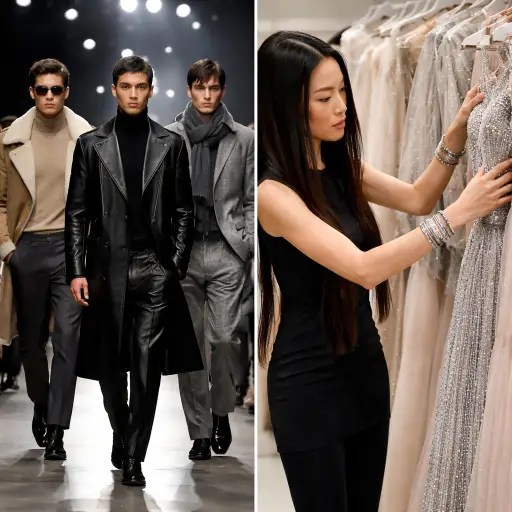
Menswear’s Uneasy Season and Vera Wang’s European Turn
As men’s fashion navigates a cautious, introspective mood, Vera Wang prepares to enter the European ready-to-wear arena, signaling a strategic recalibration rather than a spectacle-driven leap.
The menswear season unfolding at the start of the year feels markedly different from the emphatic confidence that once defined it. Across runways, presentations, and off-calendar conversations, the dominant tone is one of restraint. Designers appear to be asking quieter questions: what does relevance look like now, who is the customer willing to invest, and how can creativity survive in a climate of economic caution and cultural fatigue? The result is a season less about provocation and more about recalibration.
Menswear months have long been laboratories for experimentation, often freer and more agile than their womenswear counterparts. This year, however, the mood is uneasy. The industry is still absorbing the aftershocks of inflated production costs, disrupted supply chains, and a consumer who has become more selective. Buyers speak of edited orders and longer decision cycles, while creative directors talk openly about pressure to deliver collections that can translate immediately to retail without losing identity.
Visually, this tension manifests in collections that emphasize protection and utility. Outerwear dominates, with coats and jackets acting as both literal and symbolic shields. Silhouettes are grounded, often oversized but controlled, suggesting comfort rather than bravado. Fabrics lean toward the tactile and familiar: dense wools, brushed cottons, technical nylons softened by matte finishes. Color palettes frequently orbit around charcoal, olive, navy, and muted earth tones, punctuated sparingly by sharper accents.
Yet to describe the season as pessimistic would be misleading. Beneath the surface caution lies a renewed seriousness about craft. Tailoring has returned not as a nostalgic gesture but as a stabilizing force. Trousers are cut with intention, shoulders are shaped carefully, and details are considered rather than decorative. Many designers appear to be investing their energy in longevity, proposing garments meant to be lived in over several seasons rather than consumed instantly.
This pragmatic turn also reflects a broader cultural shift. Menswear consumers are increasingly skeptical of novelty for novelty’s sake. The appetite for viral moments has not disappeared, but it now coexists with a desire for authenticity and durability. Brands that once relied heavily on streetwear codes are reassessing their vocabularies, integrating them into more structured wardrobes or moving away from them entirely.
Against this backdrop of cautious evolution, the announcement of Vera Wang’s forthcoming ready-to-wear expansion into European markets lands with particular resonance. Known globally for redefining bridalwear and for a distinct aesthetic that blends romance with modern severity, Wang’s move into a broader European retail presence is being read less as a dramatic reinvention and more as a strategic extension.
For years, Vera Wang’s ready-to-wear has occupied a nuanced position, admired for its fluid tailoring, restrained sensuality, and architectural use of fabric. The decision to strengthen its footprint in Europe comes at a moment when consumers and buyers alike are showing renewed interest in designers with clear, enduring identities. Rather than chasing trends, the brand appears poised to offer continuity.
Industry observers note that Europe, with its deep appreciation for craftsmanship and its mature luxury clientele, presents both an opportunity and a challenge. Entering this market requires sensitivity to local tastes while maintaining a recognizable voice. Early indications suggest that the collection will emphasize versatility: pieces that can move between formal and informal contexts, echoing the broader industry’s focus on adaptability.
There is also a symbolic dimension to this launch. At a time when many fashion houses are scaling back ambitions or consolidating lines, Vera Wang’s European push suggests confidence in a slower, more deliberate growth model. It aligns with the current menswear mood, where expansion is measured and creativity is anchored in purpose.
The convergence of these two narratives — the introspective menswear season and Vera Wang’s strategic entry — highlights a fashion industry in transition. Spectacle has not vanished, but it has been tempered by realism. Designers are no longer designing in a vacuum; they are responding to an audience that values clarity, honesty, and emotional connection.
As the season continues, the success of this approach will depend on balance. Menswear must retain its capacity to surprise while acknowledging the constraints of the moment. Vera Wang’s European ready-to-wear debut, meanwhile, will test whether a brand rooted in a strong, singular vision can resonate within a complex, competitive landscape.
What unites these developments is a shared understanding that fashion’s next chapter will not be written in extremes. Instead, it will be shaped by thoughtful adjustments, by respect for craft, and by a willingness to engage with uncertainty rather than deny it. In this sense, the uneasy mood of the season is not a weakness but a sign of an industry learning to move forward with intention.



 The Tower Post