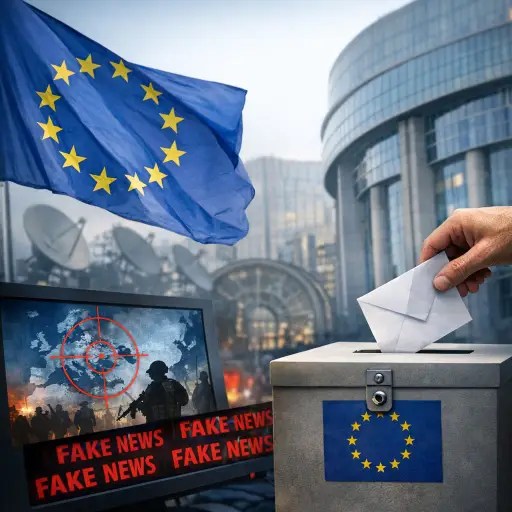
A new Eurobarometer report warns that foreign influence campaigns are reshaping public debate across Europe, placing elections and democratic trust under mounting pressure.
Across the European Union, concern about the health of democracy is increasingly shaped not only by economic uncertainty or geopolitical instability, but by the integrity of information itself. A recent Eurobarometer survey has identified foreign information manipulation as one of the most serious threats facing EU democracies, underscoring growing anxiety about how public opinion is influenced, distorted, and mobilised.
The findings reflect a shifting landscape in which democratic debate is no longer confined to parliaments, town halls, or traditional media. Instead, it is increasingly conducted on digital platforms where narratives travel fast, accountability is uneven, and hostile actors can operate at scale. According to the survey, citizens across the bloc are becoming more aware that manipulation of information is not an abstract risk, but a daily reality that affects political choices, social cohesion, and trust in institutions.
At the heart of these concerns lies the role of foreign actors seeking to influence European societies from the outside. These efforts, often described by EU officials as foreign information manipulation and interference, are designed to exploit existing divisions, amplify polarising narratives, and weaken confidence in democratic processes. Elections, in particular, are seen as vulnerable moments, when misleading or false content can shape perceptions at critical junctures.
The Eurobarometer report suggests that public awareness of these tactics has grown markedly. Many respondents report encountering misleading or deliberately false information online, especially on social media platforms. Rather than isolated incidents, these experiences are increasingly perceived as part of coordinated campaigns that blur the line between legitimate political debate and strategic manipulation.
This growing awareness comes against a backdrop of heightened geopolitical tension. The EU has repeatedly warned that global rivalries now extend into the information space, where influence is exercised not through tanks or tariffs, but through narratives, memes, and targeted messaging. In this environment, democratic societies are challenged to remain open and pluralistic while defending themselves against actors who do not share the same values or rules.
European institutions have responded by placing information integrity higher on the political agenda. Over recent years, the EU has invested in monitoring capabilities, strategic communication units, and cooperation mechanisms among member states. The aim is not only to detect and expose manipulation, but also to build resilience among citizens by strengthening media literacy and critical thinking.
Yet the survey findings indicate that public concern is outpacing confidence in existing safeguards. Many Europeans fear that the speed and sophistication of manipulation campaigns are overwhelming traditional defenses. Algorithms that prioritise engagement can inadvertently amplify sensational or divisive content, while the sheer volume of information makes it difficult for users to distinguish credible sources from deceptive ones.
The pressure on public discourse is particularly evident during election periods. Campaigns are no longer limited to national audiences or domestic actors. Instead, they unfold in a transnational digital space where narratives can be injected from outside and spread rapidly across borders. The Eurobarometer report highlights widespread concern that such dynamics undermine the fairness of elections and erode trust in their outcomes.
Democracy, the survey suggests, is not only threatened by false information itself, but by the cynicism it can generate. When citizens feel that they can no longer trust what they read or hear, disengagement becomes a risk. Voter apathy, political radicalisation, and declining trust in institutions are seen as potential consequences of a polluted information environment.
Experts note that information manipulation rarely relies on outright falsehoods alone. More often, it involves selective framing, emotional language, and the strategic amplification of real grievances. By exploiting social and economic anxieties, foreign campaigns can make their messages more credible and harder to counter without appearing dismissive of legitimate concerns.
The Eurobarometer findings also point to generational and regional differences in perception. Younger Europeans, while often more digitally savvy, report higher exposure to online misinformation. Older citizens, meanwhile, tend to express greater concern about the impact of manipulation on social cohesion and democratic stability. Across regions, countries with recent experience of disinformation campaigns appear particularly alert to the threat.
For policymakers, the challenge is to respond without undermining fundamental freedoms. The EU has consistently emphasised that countering manipulation must not come at the expense of free expression or a vibrant public debate. Instead, the focus is on transparency, accountability, and empowering citizens to make informed judgments.
Technology companies are increasingly drawn into this debate. Platforms are under pressure to address how their systems can be exploited for manipulation, while avoiding accusations of political bias or censorship. The Eurobarometer report suggests that many citizens expect stronger action from both regulators and the private sector to protect the integrity of the information space.
As Europe looks ahead, the survey serves as a reminder that democracy depends not only on institutions and laws, but on shared facts and informed citizens. In an age of information abundance, safeguarding democracy may require as much attention to how narratives are formed and spread as to how votes are cast and counted.
The message emerging from the Eurobarometer is clear: information manipulation is no longer a marginal issue, but a central challenge for European democracies. Addressing it will require sustained cooperation among governments, civil society, media, and citizens themselves. The resilience of Europe’s democratic model, the survey suggests, will be tested not only at the ballot box, but in the digital spaces where public opinion is increasingly shaped.



 The Tower Post