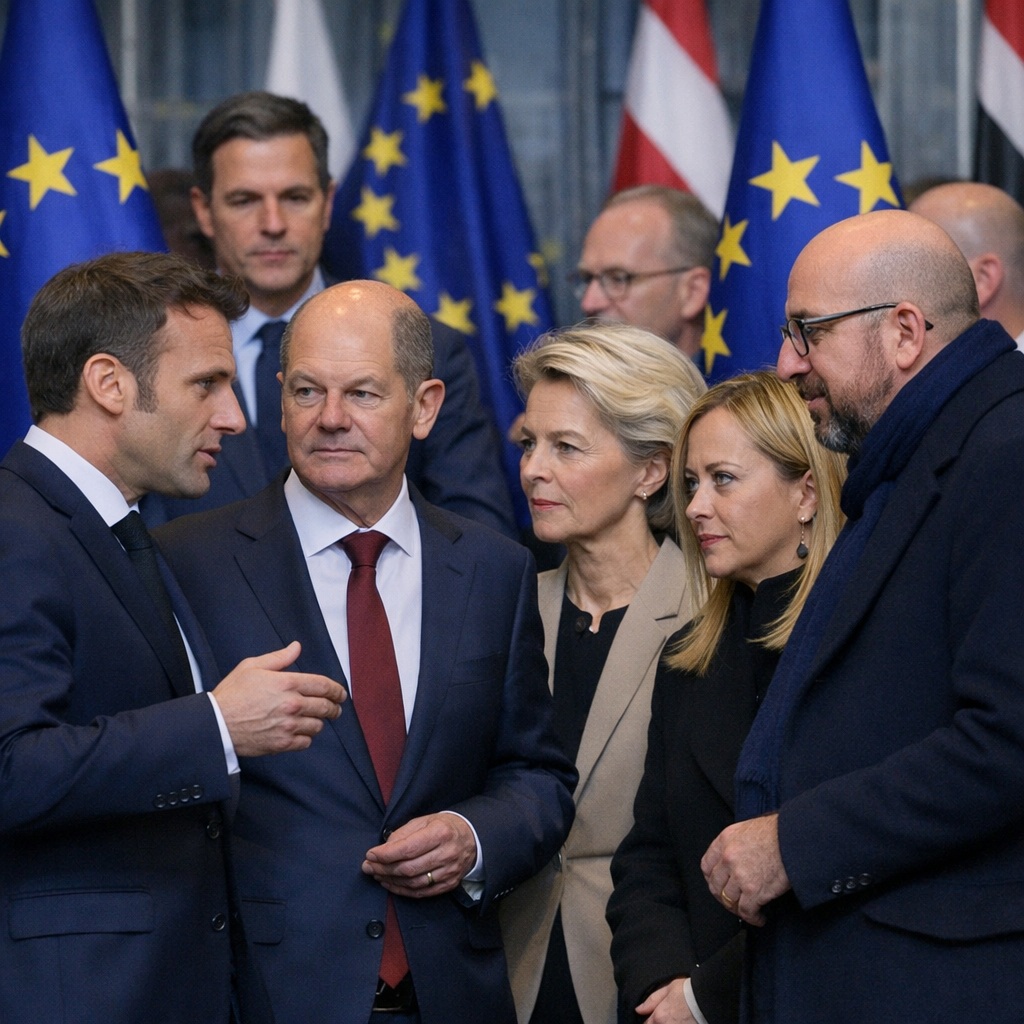
From trade and security to climate and multilateralism, European capitals are coordinating more closely to counter Washington’s unilateral turn and assert strategic autonomy.
Europe’s leaders are speaking with a sharper, more unified tone as they respond to the foreign policy direction of U.S. President Donald Trump. Across Brussels, Paris, Berlin, Rome, Madrid and beyond, a pattern has emerged: coordination first, confrontation only when necessary, and a renewed emphasis on Europe’s capacity to act together on the global stage.
This convergence has not happened overnight, nor is it rooted in reflexive anti-Americanism. European officials are careful to stress the enduring importance of the transatlantic relationship. Yet they are equally clear that recent U.S. positions on trade, security guarantees, climate policy and relations with global institutions have compelled Europe to organize itself more tightly. The result is a continental diplomatic choreography that looks more deliberate than reactive.
At the heart of this shift is a growing belief that unpredictability in Washington can no longer be treated as a temporary disruption. European leaders increasingly describe the current U.S. posture as a structural challenge—one that demands a coordinated response rather than fragmented national reactions. This assessment has translated into frequent consultations among heads of government, intensified use of EU foreign policy mechanisms, and a noticeable effort to align public messaging.
Trade has been one of the clearest rallying points. Faced with threats of tariffs and an openly transactional approach to commerce from the White House, EU leaders have emphasized collective leverage. Instead of bilateral concessions, Brussels has positioned itself as the primary interlocutor, reinforcing the idea that market access to Europe’s vast economy comes with common rules and shared standards. Senior officials argue that unity is not only a negotiating tactic, but a defensive necessity.
Security and defense present a more complex picture. Trump’s repeated questioning of long-standing security commitments has revived debates in Europe that once seemed theoretical. Calls for greater European responsibility in defense are no longer framed solely as burden-sharing, but as insurance against political volatility across the Atlantic. Initiatives aimed at strengthening joint procurement, operational coordination and industrial capacity have gained political momentum, even among traditionally cautious capitals.
France has pushed hard for the concept of European strategic autonomy, while Germany has moved closer to endorsing it in practice, if not always in rhetoric. Smaller member states, initially wary of being sidelined, have sought assurances that deeper defense cooperation will remain inclusive and anchored within existing alliances. The common thread is a recognition that Europe must be better prepared to act, with or without American leadership.
Climate policy has further sharpened the contrast between Washington and Brussels. As the U.S. administration has stepped back from international climate commitments, European leaders have doubled down on presenting the EU as a standard-setter. Coordinated statements, diplomatic outreach to emerging economies, and alignment on green trade measures signal an effort to fill the leadership vacuum.
Multilateral institutions have become another arena of quiet resistance. While the Trump administration has often expressed skepticism toward international bodies, European leaders have portrayed them as essential stabilizers in an increasingly fragmented world. By acting together within these forums, EU states aim to preserve rules-based cooperation and prevent further erosion of global governance.
This emerging unity has been reinforced by internal discipline. Public disagreements among European leaders over U.S. policy have become less frequent, replaced by coordinated messaging agreed behind closed doors. Diplomats describe a conscious effort to avoid giving Washington opportunities to exploit divisions.
Still, unity has its limits. Divergent historical ties to the United States, varying levels of economic exposure, and domestic political pressures continue to shape national positions. The challenge for EU leaders is balancing these perspectives without diluting the collective stance.
What distinguishes the current moment is not uniformity of opinion, but coordination of action. Europe’s response to Trump’s policies has matured from ad hoc reactions into a more structured approach.
For Washington, this presents a different counterpart than in previous years. A more cohesive Europe is harder to pressure through bilateral tactics, yet potentially more capable of partnership on equal terms.
For now, the message from Europe’s capitals is unmistakable: faced with uncertainty across the Atlantic, unity has become Europe’s most valuable diplomatic asset.


 The Tower Post