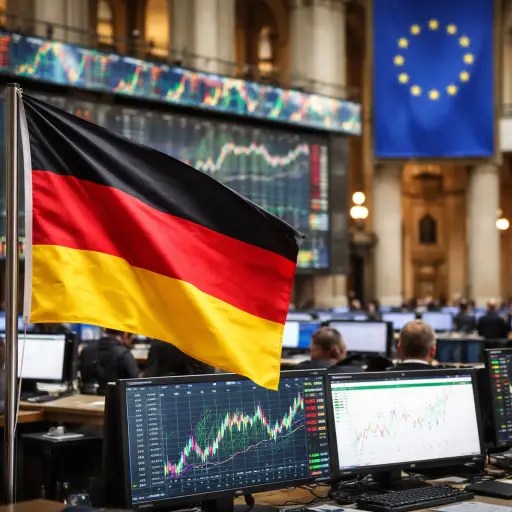
Stabilisation in select sectors offsets lingering caution as investors weigh geopolitics, policy, and growth prospects
European financial markets are entering the heart of winter with a cautious but no longer uniformly defensive tone. Across Germany and the wider European Union, early trading patterns point to a landscape shaped less by panic and more by selective positioning. Investors appear to be reassessing risk after weeks of geopolitical uncertainty, with some sectors showing signs of stabilisation while others remain under pressure from structural and policy-related concerns.
Germany, as Europe’s largest economy and a bellwether for industrial performance, sits at the centre of this mixed picture. Equity markets have oscillated between modest recoveries and abrupt pullbacks, reflecting uncertainty about external demand, energy security, and the pace of global growth. Export-oriented companies have struggled to generate sustained momentum, yet recent sessions suggest that selling pressure has eased compared with earlier volatility. Market participants describe this phase not as a rally, but as a pause in which valuations are being tested rather than rewritten.
Across the broader EU, the tone is similarly uneven. Financial indicators suggest that investors are differentiating more clearly between sectors and business models, rewarding balance-sheet resilience and pricing power while remaining sceptical of firms heavily exposed to global trade disruptions. This selective approach marks a shift from the broad-based risk aversion that followed recent geopolitical jitters, when uncertainty pushed capital into perceived safe havens and away from cyclical assets.
Banking and financial services have been among the sectors showing relative stability. Expectations that monetary policy will remain restrictive but predictable have helped reduce uncertainty around margins and capital adequacy. While concerns persist about credit quality in a slowing economy, investors appear more confident that major European banks are better insulated than in past cycles. This has translated into steadier performance compared with more volatile segments of the market.
Industrial and manufacturing stocks, particularly in Germany, present a more complex picture. On one hand, ongoing adjustments in supply chains and subdued global demand continue to weigh on sentiment. On the other, signs that inventories are being worked down and that energy costs are less erratic than before have provided a measure of relief. Analysts note that the market is increasingly focused on medium-term competitiveness rather than short-term earnings fluctuations, a perspective that has helped cap downside risks.
Energy and utilities have also played a role in shaping the current market mood. After months dominated by fears of supply shocks and price spikes, trading has become more measured. Companies with diversified energy sources and strong regulatory frameworks are attracting renewed interest, while those exposed to political intervention or volatile input costs remain under scrutiny. This divergence underscores how policy and geopolitics continue to influence valuations across the continent.
Technology and growth-oriented sectors, by contrast, remain sensitive to global sentiment. Even as European markets show signs of stabilisation, these segments react quickly to shifts in expectations around international demand and financing conditions. Investors appear reluctant to make bold bets, preferring instead to wait for clearer signals on growth trajectories beyond Europe’s borders.
Bond markets add another layer to the mixed signals. Sovereign yields across the euro area have moved within relatively narrow ranges, suggesting that fears of acute stress have eased but not disappeared. For Germany, government bonds continue to serve as a reference point for stability, while spreads in other parts of the EU reflect ongoing debates about fiscal discipline and investment priorities. The overall message from fixed income markets is one of vigilance rather than alarm.
Currency movements mirror this cautious balance. The euro has traded without a decisive trend, reflecting competing forces of external uncertainty and internal resilience. For exporters, this relative stability offers some predictability, though it does little to offset broader concerns about demand. Currency traders note that the absence of sharp moves itself signals a market searching for direction rather than reacting to crisis.
Behind these market dynamics lies a broader question about Europe’s economic path. Policymakers face the challenge of supporting growth while maintaining credibility on inflation and fiscal rules. For investors, this translates into a careful reading of policy signals and a reluctance to extrapolate short-term improvements into long-term optimism. The current environment rewards patience and discrimination, qualities that have become essential in navigating Europe’s complex landscape.
As markets move through late January, the prevailing sentiment is neither outright pessimism nor confident recovery. Instead, German and EU markets are sending mixed early signals that reflect an ongoing process of adjustment. Stabilisation in some sectors suggests that the worst of recent jitters may have passed, but the absence of a clear upward trend highlights unresolved risks. For now, Europe’s financial markets appear to be marking time, waiting for clearer confirmation that stability can evolve into sustained momentum.




 The Tower Post