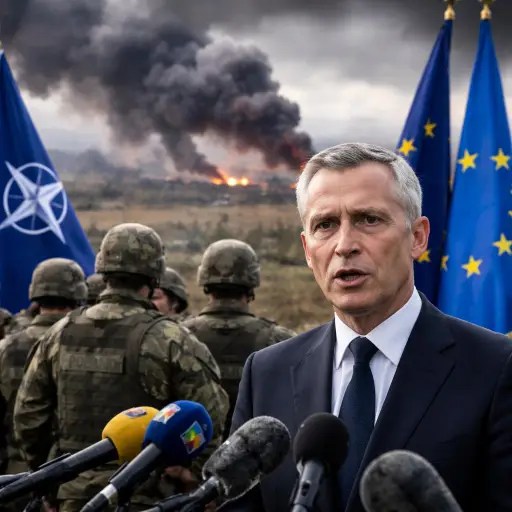
Alliance leaders warn Europe faces a de‑facto war while divisions emerge over cost, strategy, and resolve
As fighting intensifies along multiple fronts in Ukraine, a senior NATO leader has delivered one of the starkest warnings yet to European governments, arguing that the continent is already living through a de‑facto war with Russia. The message, delivered amid renewed Russian offensives and growing pressure on Ukrainian defenses, reflects a widening sense of urgency inside the Alliance that time, resources, and political unity are all under strain.
According to NATO officials, Russia has escalated the tempo of its military operations, combining sustained ground assaults with missile and drone strikes aimed at exhausting Ukraine’s air defenses and industrial capacity. While the front lines continue to shift incrementally, the broader concern in Brussels and allied capitals is strategic: Moscow appears prepared for a long confrontation that extends well beyond Ukraine’s borders and directly tests Europe’s security architecture.
The NATO leader’s warning was not framed as speculation but as a diagnosis. Europe, the official argued, is already involved through intelligence sharing, weapons deliveries, training missions, cyber defense, and economic warfare. The difference between this reality and open conflict, they suggested, is increasingly one of semantics rather than substance. The implication was clear: Europeans must prepare psychologically, economically, and politically for a prolonged period of confrontation.
This sense of alarm comes as Russia continues to adapt its wartime economy. Western officials say Moscow has retooled industrial production to sustain high levels of ammunition output, while leaning on partnerships outside Europe to blunt the impact of sanctions. The result is a grinding conflict in which Ukraine’s need for air defense systems, artillery shells, and financial support remains acute, even as donor fatigue grows in some capitals.
Within NATO, the warning has reignited debate over burden-sharing and strategic priorities. Several frontline states have pushed for faster deliveries of advanced systems and a clearer long-term commitment to Ukraine’s defense. Others emphasize the need to balance support for Kyiv with domestic economic pressures and the risk of escalation. The Alliance remains united in principle, officials insist, but unity in practice has become harder to sustain as the war drags on.
Nowhere are these tensions more visible than in the political rhetoric emerging from parts of Central Europe. Hungary’s prime minister has again stirred controversy by questioning the economic cost of continued military support for Ukraine and criticizing what he described as a strategy lacking a clear endgame. His remarks, delivered to a domestic audience but heard across Europe, underscored a growing divide between governments that see the conflict as an existential security threat and those that prioritize economic stability and national sovereignty.
Critics of Budapest’s position argue that such statements risk undermining collective deterrence at a critical moment. They contend that signaling doubt or fatigue only strengthens Moscow’s belief that Western unity will eventually fracture. Supporters of the Hungarian leader, however, say he is voicing concerns shared quietly by other governments facing inflation, budget constraints, and political pressure at home.
The NATO leadership has responded by sharpening its language. Officials now speak more openly about the consequences of a Russian victory in Ukraine, warning that it would embolden further aggression and force Europe to spend far more on defense in the long run. The argument is increasingly framed as a choice between sustained support now or a much higher price later, both financially and in terms of security.
Military planners inside the Alliance are also adjusting their assumptions. Exercises, force posture, and procurement plans are being recalibrated to reflect a more dangerous and less predictable security environment. Eastern member states are fortifying borders and expanding troop presence, while discussions continue over air defense integration and industrial cooperation to replenish depleted stockpiles.
At the same time, diplomatic channels remain active. NATO officials stress that deterrence and defense do not preclude dialogue, but they insist that any meaningful переговоры must be grounded in strength. For now, they see little evidence that Moscow is prepared to compromise on its core objectives, reinforcing the view that the conflict has entered a decisive and potentially protracted phase.
Public opinion across Europe remains mixed. While polls show continued sympathy for Ukraine, concerns about energy prices, public spending, and social cohesion are rising. The NATO warning appears aimed as much at voters as at policymakers: a call to recognize that the war’s outcomes will shape Europe’s security order for a generation.
As winter conditions ease and military operations intensify, the Alliance faces a narrow window to align strategy with rhetoric. The de‑facto war described by NATO’s leadership may not be declared, but its consequences are already being felt. Whether Europe can muster the unity and endurance required to meet this challenge remains the central question hanging over the continent.


 The Tower Post