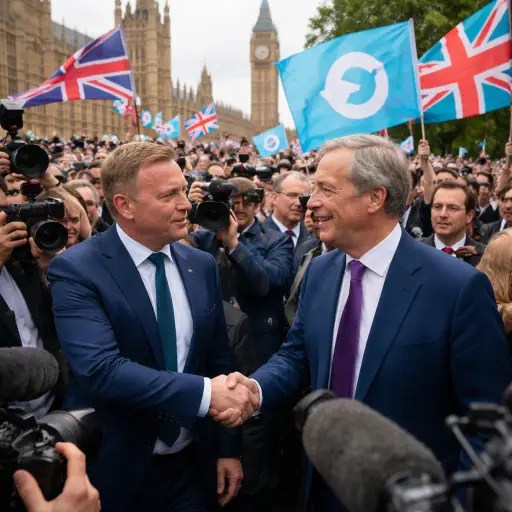
A high-profile break with Reform UK reopens ideological fault lines on the British right and reverberates across Europe’s populist movements.
Westminster awoke this week to a political aftershock that few inside the governing Conservative Party had expected to feel so sharply. A sitting Conservative lawmaker, long associated with the party’s populist wing, announced a defection to Reform UK, delivering a symbolic blow to Conservative unity and injecting fresh volatility into Britain’s already fragmented political landscape.
The move is more than a change of party affiliation. It is a public rupture that exposes the unresolved tensions within the Conservatives over identity, sovereignty, and the direction of post-Brexit Britain. For Reform UK, a party that has steadily positioned itself as the unapologetic voice of anti-establishment conservatism, the defection represents validation and momentum. For the Conservatives, it is a reminder that the struggle to hold together a broad electoral coalition on the right remains far from settled.
Inside Conservative circles, the reaction has oscillated between frustration and concern. Party strategists privately concede that while a single defection will not immediately alter parliamentary arithmetic, it sharpens a narrative problem: the perception that the Conservatives are losing their grip on voters drawn to more radical, populist rhetoric. Publicly, senior figures have sought to downplay the significance, framing the departure as an isolated act driven by personal ambition rather than ideological conviction.
Yet the context tells a more complicated story. Over recent months, the Conservative Party has been caught between competing pressures. On one side are moderate voters, particularly in urban and suburban areas, uneasy with confrontational politics and yearning for stability. On the other is a vocal segment of the base that feels the promises of Brexit have been diluted, that immigration remains too high, and that political elites are unresponsive. Reform UK has targeted this discontent with disciplined messaging and a combative style that thrives on cultural flashpoints.
The defector, in a carefully staged announcement, framed the decision as a matter of principle. Accusing the Conservatives of drifting away from their core promises, the lawmaker argued that Reform UK now represents the only credible vehicle for “real change.” The language was familiar, echoing populist critiques heard across Europe: a people betrayed by institutions, national sovereignty constrained by bureaucracy, and a political class out of touch with everyday concerns.
Reform UK’s leadership wasted little time in capitalizing on the moment. Welcoming the new arrival, party figures described the defection as evidence that the political realignment on the right is accelerating. They presented themselves as a growing force, no longer confined to protest politics but capable of attracting experienced parliamentarians and shaping national debate.
Beyond Westminster, the implications ripple outward. Across Europe, populist and radical-right parties are watching Britain closely. From Italy to the Netherlands, movements that challenge traditional conservative parties have grown by portraying themselves as more authentic, more willing to confront cultural and economic anxieties head-on. The British defection feeds into this broader narrative: that established center-right parties are vulnerable to challengers who promise clarity and confrontation over compromise.
Analysts caution against overstating the immediate impact. Britain’s electoral system remains unforgiving to smaller parties, and Reform UK faces structural hurdles in translating momentum into seats. Still, symbolism matters in politics. A defection of this kind legitimizes Reform UK in the eyes of wavering voters and donors, while forcing the Conservatives to confront uncomfortable questions about their ideological coherence.
Within the Conservative Party, the episode has reignited debate about strategy. Should the party attempt to reclaim populist voters with tougher rhetoric and policy shifts, or double down on a more pragmatic, centrist approach aimed at stability and competence? The risk, as some insiders acknowledge, is that chasing Reform UK’s agenda could alienate moderate supporters without fully winning back those already inclined toward populist alternatives.
For voters, the defection underscores a sense of political flux. Traditional loyalties are weakening, and the boundaries between parties on the right are increasingly porous. What once appeared to be a settled post-Brexit order now looks more like a contested terrain, with multiple actors vying to define what conservatism means in contemporary Britain.
As the political conversation unfolds, one thing is clear: the shockwaves from this single defection extend far beyond one individual’s career. It has reopened ideological battles within the Conservative Party, strengthened the hand of Reform UK, and added a British chapter to Europe’s ongoing populist story. In a climate of uncertainty and shifting alliances, the British right is once again being forced to redefine itself in public view.




 The Tower Post