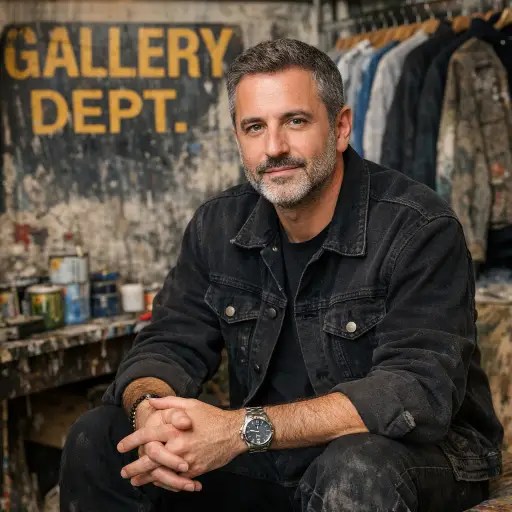
The former Off-White and Humanrace CEO steps into the Los Angeles label with a mandate to scale globally while protecting its artistic core.
In a fashion industry increasingly driven by narrative, community, and cultural credibility, Gallery Dept. has made a move that signals both ambition and intent. The Los Angeles–based brand, known for its raw, art-infused garments and anti-establishment ethos, has appointed Andrea Grilli as its new Chief Executive Officer, entrusting him with the task of guiding the label into its next phase of global growth.
The appointment comes at a moment when fashion brands are being forced to reassess their relationship with consumers. As traditional luxury models strain under shifting tastes and economic uncertainty, labels with strong identities and direct connections to their audiences are gaining ground. Gallery Dept., founded on the idea of clothing as a living canvas, sits squarely within this cultural moment.
Grilli arrives with a résumé that reflects both scale and sensibility. His tenure as CEO of Off-White placed him at the center of one of the most influential fashion narratives of the past decade, where street culture, luxury, and social commentary collided. More recently, at Humanrace, he helped shape a purpose-driven brand rooted in wellness, community, and authenticity. These experiences have positioned him as an executive fluent in translating creative vision into sustainable global business.
Industry observers see Grilli’s appointment as a calculated step for Gallery Dept., which has grown organically through cultural relevance rather than traditional marketing. The brand’s distressed denim, reworked vintage pieces, and painterly details have become visual shorthand for a certain Los Angeles attitude — one that resists polish in favor of process. Scaling such a vision without diluting it is a challenge few brands manage successfully.
Grilli’s stated focus is on international expansion, strengthening direct-to-consumer channels, and reinforcing the brand’s cultural positioning. Rather than chasing wholesale saturation, the strategy emphasizes deeper relationships with consumers, controlled distribution, and storytelling that reflects the brand’s artistic roots. In an era where consumers increasingly demand transparency and meaning, this approach aligns with broader shifts across the industry.
Los Angeles remains central to Gallery Dept.’s identity, and Grilli has been careful to frame growth as an extension of that cultural DNA rather than a departure from it. The city’s role as a creative incubator — spanning art, music, film, and fashion — continues to inform the brand’s output. Protecting that ecosystem while introducing the label to new global audiences will be a defining test of Grilli’s leadership.
The fashion landscape Grilli steps into is markedly different from the one that fueled the rise of streetwear in the previous decade. Today’s consumer is more discerning, less loyal to logos, and more attuned to values, craftsmanship, and narrative coherence. Brands that succeed are those that operate less like seasonal product machines and more like cultural platforms.
For Gallery Dept., the challenge is not visibility but longevity. Its aesthetic has already proven influential, but influence alone does not guarantee endurance. With Grilli at the helm, the brand appears poised to professionalize its operations while preserving the creative tension that made it relevant in the first place.
As the industry watches closely, Grilli’s move to Gallery Dept. underscores a broader recalibration within fashion leadership. Executives are no longer judged solely on revenue growth, but on their ability to steward culture, protect creative integrity, and build communities that extend beyond the product itself.
In that sense, this appointment is less about a change in management and more about a statement of intent. Gallery Dept. is signaling that it plans to grow — deliberately, globally, and on its own terms.




 The Tower Post