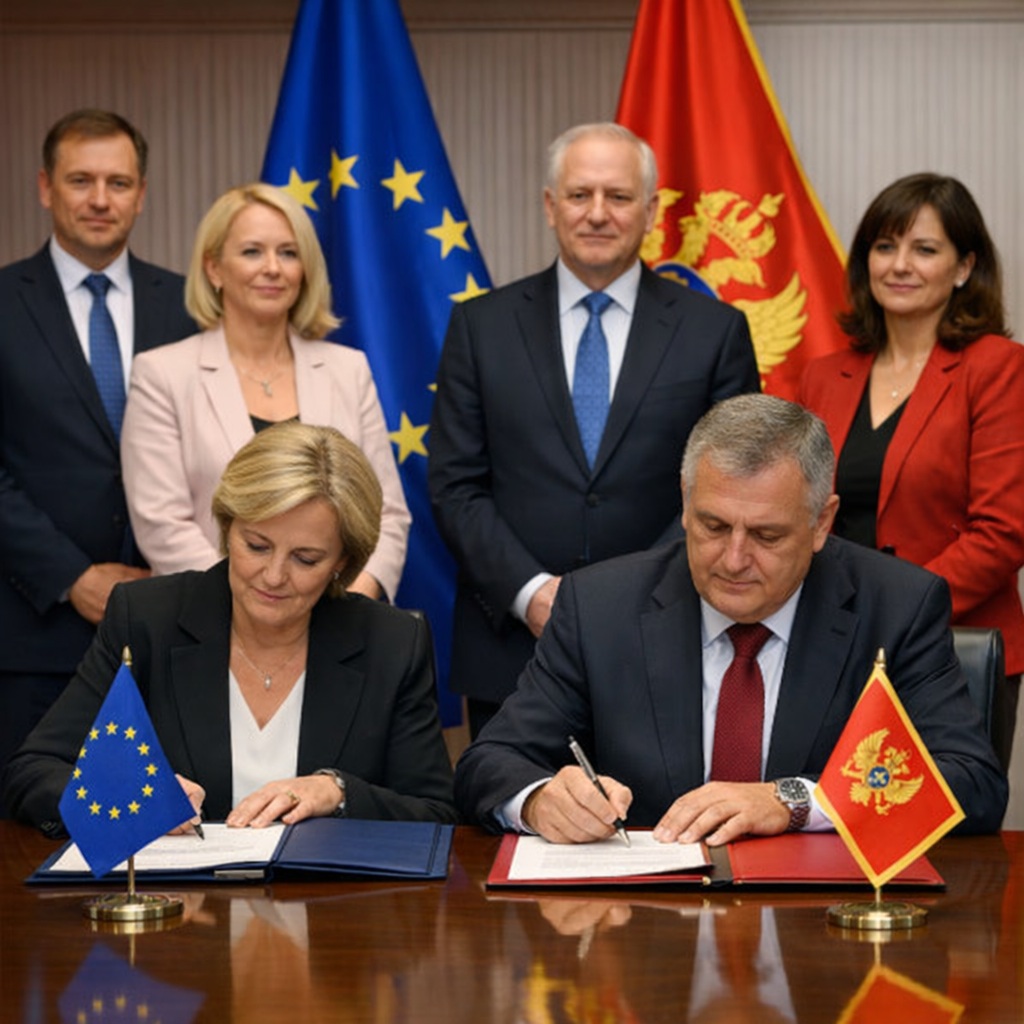
Provisional agreement on financial oversight marks a technical but politically significant step in Montenegro’s long path toward European Union membership
EU and Montenegro have provisionally wrapped up negotiations on the financial control chapter of the country’s EU accession process, a move that officials on both sides describe as a quiet yet meaningful signal of progress at a time when enlargement remains politically sensitive across the bloc.
The chapter, which focuses on public internal financial control, external audit, and the protection of the EU’s financial interests, is one of the more technical areas of the accession talks. Yet it is also among the most consequential. Strong financial control systems are seen in Brussels as a foundation for trust: trust that EU funds will be spent as intended, that public money will be tracked transparently, and that institutions can detect and correct misuse before it becomes systemic.
For Montenegro, the provisional closure of this chapter underscores years of incremental reforms aimed at aligning national rules with EU standards. For the European Union, it represents another test case for a revised enlargement approach that places credibility, rule of law, and institutional resilience ahead of speed.
A technical chapter with political weight
The financial control chapter sits at the intersection of governance and accountability. It requires candidate countries to establish effective internal audit systems across public administrations, ensure the independence and capacity of supreme audit institutions, and adopt robust mechanisms to fight fraud affecting both national and EU budgets.
EU officials familiar with the talks note that Montenegro has gradually strengthened its legislative framework and administrative capacity, particularly in internal financial control and coordination between audit bodies. While challenges remain in implementation, the overall trajectory was deemed sufficient to allow the chapter to be provisionally closed, meaning it will not be reopened unless serious backsliding occurs.
“This is not about ticking boxes,” said one EU diplomat involved in enlargement discussions. “It’s about whether the systems work in practice, and whether there is political ownership of financial accountability.”
Montenegrin authorities have repeatedly framed financial control reforms as part of a broader effort to modernize the state, rather than as obligations imposed from Brussels. Officials in Podgorica argue that stronger audit and control mechanisms are essential to restoring public trust in institutions, particularly in a country where concerns over corruption and state capture have shaped political debate for years.
Part of a broader accession puzzle
Montenegro is widely regarded as one of the most advanced candidates among the Western Balkan countries seeking EU membership. It has opened all negotiating chapters and has been working to close them provisionally as benchmarks are met. Progress, however, has been uneven, with the rule of law chapters remaining the most demanding and politically sensitive.
Against this backdrop, the provisional closure of the financial control chapter sends a signal of steady, if cautious, momentum. It also reflects the EU’s current enlargement philosophy, which emphasizes tangible reforms and track records over formal milestones.
European officials stress that provisional closure does not equate to final approval. All chapters will be reassessed at the end of the process, and sustained compliance is expected. In practice, this means Montenegro will need to demonstrate that audit findings lead to corrective action, that financial irregularities are effectively investigated, and that institutions remain insulated from political pressure.
EU funds and the question of trust
Financial control has taken on added importance as the EU channels increasing amounts of pre-accession assistance to candidate countries. These funds are intended to support reforms, infrastructure, and economic convergence, but they also expose the EU to financial risk if oversight is weak.
By moving forward on this chapter, Brussels signals a degree of confidence in Montenegro’s ability to safeguard EU financial interests. At the same time, EU officials are careful to underline that monitoring will continue, particularly as the country gains greater access to EU programs.
Analysts note that financial control reforms often have spillover effects, improving budget planning, procurement practices, and public sector efficiency. In this sense, the chapter is not only about EU money, but about how the state manages its own resources.
Domestic implications in Montenegro
At home, the development is likely to be welcomed by pro-European actors as evidence that the accession process, often criticized as slow and abstract, can deliver concrete results. Successive governments have faced pressure to demonstrate progress amid reform fatigue and shifting political coalitions.
Civil society groups, while generally supportive, caution that legal alignment must translate into real-world impact. They point to the need for follow-up on audit recommendations and greater transparency in how public institutions respond to identified weaknesses.
“The laws are largely in place,” said a representative of a Montenegrin watchdog organization. “The real test is whether findings lead to accountability.”
Enlargement in a cautious EU
The timing of the provisional closure is also notable from the EU’s perspective. Enlargement has returned to the political agenda, driven by geopolitical considerations and a renewed focus on stability in the EU’s neighborhood. At the same time, skepticism persists among some member states, which insist on strict conditionality and credible reforms.
In this context, Montenegro’s progress on technical chapters such as financial control is often cited as evidence that the accession process can still function when there is sustained commitment on both sides.
Looking ahead, the challenge for Montenegro will be to maintain reform momentum while navigating domestic political complexities. For the EU, the task will be to balance encouragement with scrutiny, ensuring that progress on paper is matched by performance in practice.
As negotiations continue, the provisional closure of the financial control chapter stands as a reminder that enlargement is built as much on accounting rules and audit trails as on grand political declarations. In the meticulous work of financial oversight, both sides are testing whether promises of integration can be grounded in durable institutions.




 The Tower Post