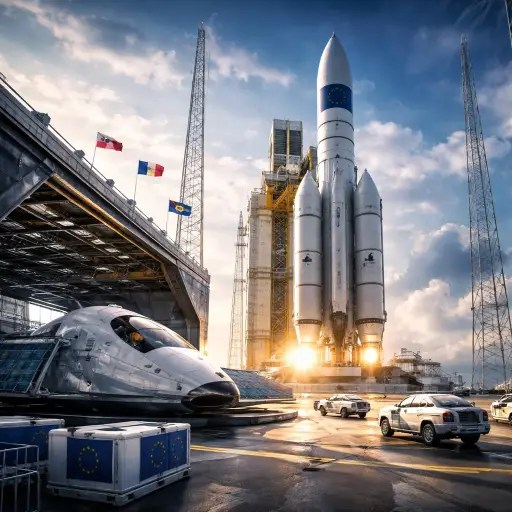
New trade figures highlight Europe’s growing strength in high‑technology space systems and services
In a signal moment for Europe’s high‑technology economy, new trade statistics released this week show that European Union exports linked to spacecraft, launch systems, and space‑related transport services have surpassed the €2 billion threshold. The figures underscore the EU’s rising weight in a sector that has become strategically vital, economically lucrative, and geopolitically sensitive.
The space economy has long been dominated by a small number of global players, but Europe’s position is no longer defined solely by institutional programs or scientific prestige. Instead, it is increasingly shaped by export performance, commercial contracts, and the ability of European firms to compete in global supply chains. The latest data suggest that EU‑based manufacturers and service providers are translating decades of public investment into tangible trade results.
At the heart of this growth is a diversified industrial base spread across several member states. European companies export satellites for telecommunications, Earth observation, and navigation, as well as key components such as propulsion systems, avionics, structures, and ground‑segment equipment. Space transport services, including launch‑related activities and technical support, also form a growing share of the export total, reflecting demand beyond Europe’s borders.
Industry analysts note that the export milestone comes at a time when global demand for space infrastructure is accelerating. Governments are expanding Earth‑observation capabilities for climate monitoring and security purposes, while commercial operators are investing heavily in connectivity and data services. European suppliers, known for high reliability and regulatory compliance, have benefited from this trend, particularly in markets seeking alternatives to single‑supplier dependence.
EU officials view the figures as confirmation of the bloc’s technological competitiveness. Space technologies sit at the intersection of advanced manufacturing, digital systems, and strategic autonomy. Export strength in this domain is therefore seen not only as an economic success, but also as a marker of Europe’s capacity to remain a credible actor in critical technologies.
Public programs continue to play a central role. Flagship initiatives in navigation and Earth observation provide stable demand and technological spillovers that feed into commercial exports. At the same time, procurement rules and industrial policy aim to ensure that European firms can scale up production and compete internationally without eroding security or sustainability standards.
The private sector has also been undergoing a quiet transformation. While Europe does not mirror the venture‑capital‑driven model seen elsewhere, a growing number of startups and mid‑sized firms are entering niche markets, from small satellite platforms to in‑orbit services. Their integration into export supply chains has contributed to the overall trade figures, even as they rely on established primes for market access.
Trade partners for EU space exports are increasingly diverse. Contracts span advanced economies seeking high‑end systems and emerging space nations building capabilities for the first time. This geographic spread helps buffer the industry against cyclical downturns in any single market, while reinforcing Europe’s reputation as a long‑term, reliable supplier.
However, the export milestone also brings challenges. Competition is intensifying, with pricing pressure from new entrants and state‑backed rivals. Supply‑chain resilience remains a concern, particularly for critical components with limited sources. In addition, regulatory complexity and export‑control requirements can slow deal‑making, even when demand is strong.
Environmental considerations are another factor shaping the sector’s future. As orbital congestion and sustainability rise on the international agenda, European exporters are increasingly expected to demonstrate responsible design and end‑of‑life solutions. For some buyers, these standards have become a selling point rather than a constraint, aligning commercial success with policy goals.
Looking ahead, policymakers and industry leaders agree that maintaining momentum will require continued investment in research, skills, and infrastructure. Launch capacity, in particular, is seen as essential to preserving Europe’s autonomy and export credibility. At the same time, closer coordination between civilian, commercial, and security stakeholders is expected to strengthen the overall ecosystem.
As Europe approaches the end of the decade, the crossing of the €2 billion export mark stands as more than a statistical achievement. It reflects a maturing space economy that is increasingly outward‑looking, commercially grounded, and strategically aware. For the EU, space is no longer just a symbol of scientific ambition; it is a growing pillar of trade, technology, and global influence.



 The Tower Post