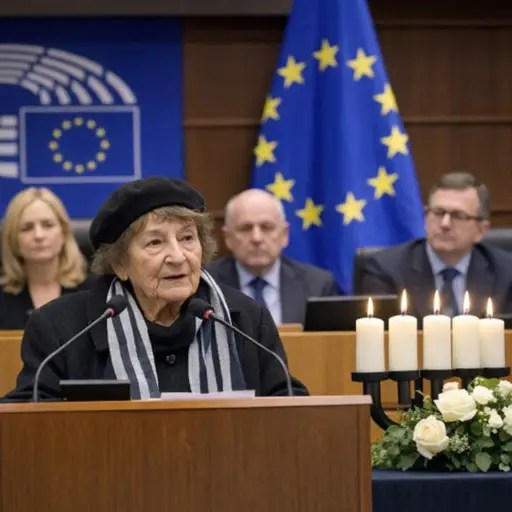
A solemn plenary session underscores the urgency of remembrance, responsibility, and vigilance in a changing Europe.
The European Parliament gathered this week in a solemn atmosphere to mark International Holocaust Remembrance Day, reaffirming a collective commitment to memory at a moment when the last generation of survivors is steadily passing from public life. The commemoration, held in the hemicycle in Strasbourg, placed human testimony at its center, reminding lawmakers that history is not an abstraction but a lived experience carried by voices that still resonate across generations.
Members of the European Parliament listened in silence as a Holocaust survivor addressed the chamber, recounting a life shaped by persecution, loss, and survival. The testimony did not dwell on chronology or statistics, but on moments of fear, resilience, and the enduring weight of memory. For many present, it was a rare and deeply personal encounter with history, one that cut through political divisions and procedural routine.
The President of the Parliament opened the session by stressing that remembrance is not only about honoring the victims, but about recognizing the responsibility of democratic institutions to confront hatred in all its forms. The Holocaust, she said, remains a stark warning of where dehumanization and indifference can lead when societies fail to defend the dignity of every individual.
Across the chamber, political group leaders echoed this message. They spoke of a Europe founded on the ashes of catastrophe, built to ensure that such crimes would never be repeated. Several speakers warned that antisemitism has not vanished, but has adapted, sometimes appearing openly, sometimes hidden behind coded language and online disinformation. In this context, remembrance was framed not as a ritual, but as an active duty.
The survivor’s words brought these concerns into sharp focus. Speaking calmly but firmly, the witness described how ordinary prejudices, left unchallenged, escalated into systematic persecution. The loss of family, the rupture of childhood, and the long journey toward rebuilding a life were described without bitterness, yet with an unmistakable appeal to conscience. The message was clear: memory must translate into action.
MEPs rose for a standing ovation at the conclusion of the testimony, a gesture that carried both respect and urgency. Several lawmakers later reflected that hearing directly from a survivor reinforced the moral foundation of their legislative work, particularly in areas related to fundamental rights, education, and the fight against hate speech.
Education emerged as a recurring theme throughout the commemoration. Speakers emphasized the importance of teaching younger generations about the Holocaust in a way that is factual, empathetic, and resistant to distortion. As time creates distance from the events, the risk of denial, trivialization, or fatigue grows. The Parliament called on member states to strengthen educational programs and support cultural initiatives that keep memory alive.
The ceremony also acknowledged the broader context of rising polarization within and beyond Europe. Lawmakers noted that economic uncertainty, geopolitical tensions, and rapid technological change can create fertile ground for scapegoating and conspiracy theories. In such an environment, the lessons of the Holocaust are not confined to the past, but serve as a guide for navigating the present.
Closing the session, the Parliament reaffirmed its commitment to combating antisemitism, racism, and all forms of discrimination through legislation, dialogue, and international cooperation. The commemoration ended quietly, without spectacle, leaving behind a shared sense that remembrance is not a conclusion, but an ongoing responsibility.
As Europe reflects on its history in these days of remembrance, the voices heard in the Parliament serve as a reminder that democracy requires memory, and that vigilance is the price of freedom.



 The Tower Post