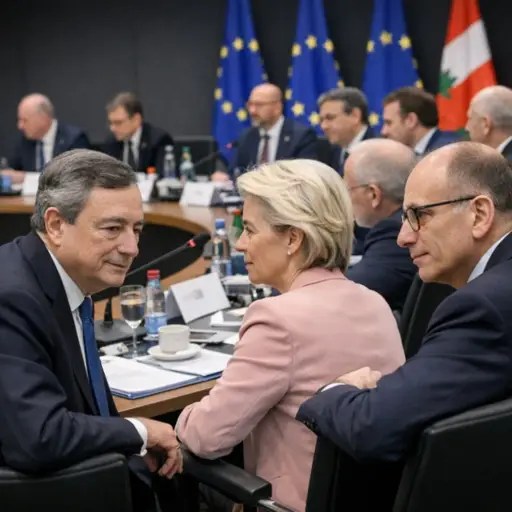
With Mario Draghi and Enrico Letta in attendance, EU leaders gather informally to confront slowing growth, strategic dependence, and the race to remain globally relevant.
In a secluded setting far from the cameras and communiqués of Brussels, European Union leaders have gathered for an informal retreat with a single, pressing question on the table: how can Europe regain its competitive edge in a rapidly changing global economy? The presence of two seasoned Italian figures—former prime minister and ex-European Central Bank president Mario Draghi, and former Italian premier and Democratic Party leader Enrico Letta—has lent both gravity and urgency to the discussions.
The meeting comes at a moment of introspection for the European project. After years marked by overlapping crises—from pandemic recovery and energy shocks to geopolitical tensions and technological disruption—EU leaders increasingly acknowledge that the bloc’s economic model is under strain. Growth has lagged behind global peers, productivity gaps have widened, and Europe’s dependence on external powers for critical technologies and resources has become a political as well as economic vulnerability.
Against this backdrop, the retreat has been framed less as a formal summit and more as a strategic pause. There are no binding conclusions expected, no legislative texts to negotiate line by line. Instead, leaders are using the space to reflect on long-term priorities, guided by voices that have shaped Europe’s economic thinking over the past decade.
Mario Draghi’s role is particularly emblematic. Revered in Brussels for his decisive stewardship of the European Central Bank during the eurozone debt crisis, Draghi has recently emerged as one of the most influential advocates for a bolder European economic strategy. His warnings have been stark: without coordinated investment, deeper capital markets, and a more assertive industrial policy, Europe risks gradual marginalization in a world dominated by the United States and China.
Enrico Letta, for his part, brings a political and institutional perspective rooted in the functioning of the single market. Having led a comprehensive report on the future of that market, Letta has consistently argued that Europe’s fragmentation—across capital markets, energy systems, and digital regulation—undermines its capacity to compete. His message to leaders has been that integration, long seen as a completed chapter, must be renewed and adapted to new realities.
At the heart of the retreat’s discussions lies a shared diagnosis: Europe’s strengths remain formidable, but they are not being fully leveraged. The single market is vast, yet companies still face regulatory hurdles when scaling across borders. The workforce is highly educated, yet skills shortages persist in key sectors such as digital technologies and green industries. Ambitious climate goals have positioned Europe as a regulatory pioneer, but they also risk burdening firms if not matched with investment and innovation support.
Competitiveness, in this context, is no longer framed as a narrow question of costs or deregulation. Leaders are increasingly speaking of “strategic competitiveness,” a concept that blends economic performance with resilience, sustainability, and security. This means ensuring access to critical raw materials, securing supply chains, and fostering homegrown technological champions, while remaining open to trade and cooperation.
Draghi has pressed the case for a step change in investment. According to his analysis, Europe’s traditional reliance on national budgets and cautious fiscal coordination is ill-suited to the scale of transformation required. From artificial intelligence and semiconductors to energy infrastructure and defense-related industries, the investment needs are vast and cross-border by nature. Without new financial instruments and a deeper capital markets union, he has warned, Europe will struggle to mobilize the necessary resources.
Letta has echoed these concerns, emphasizing that competitiveness cannot be built through isolated national initiatives. He has pointed to the risk of internal divergence, where wealthier member states can subsidize their industries more aggressively than others, potentially distorting competition within the single market. A coordinated European approach, he argues, is essential to avoid fragmentation and to ensure that all regions benefit from the green and digital transitions.
The informal nature of the retreat has allowed leaders to speak more candidly than in formal council meetings. Several have acknowledged that Europe’s regulatory zeal, while often rooted in legitimate social and environmental objectives, can sometimes stifle innovation. Others have stressed the need to rebuild public support for economic reform, particularly at a time when voters are wary of globalization and skeptical of elites.
There is also a political dimension to the competitiveness debate. As the European Union looks ahead to a new institutional cycle, leaders are acutely aware that economic performance will shape the bloc’s credibility at home and abroad. A Europe perceived as slow-growing and inward-looking will struggle to project influence on the global stage.
Yet the mood at the retreat has not been one of resignation. On the contrary, the participation of figures like Draghi and Letta has underscored a belief that Europe still has choices—and time—to change course. The challenge, as several leaders have noted, is to translate diagnosis into action, and reflection into political will.
As discussions draw to a close, no grand declarations are expected. Instead, the retreat is likely to feed into upcoming policy debates in Brussels, shaping priorities for investment, regulation, and integration.
For now, the message from the retreat is clear: competitiveness has returned to the top of Europe’s agenda, not as an abstract economic concept, but as a central pillar of the Union’s future. With experienced hands like Draghi and Letta helping to frame the debate, EU leaders are signaling that the question is no longer whether Europe must act, but how boldly it is prepared to do so.


 The Tower Post