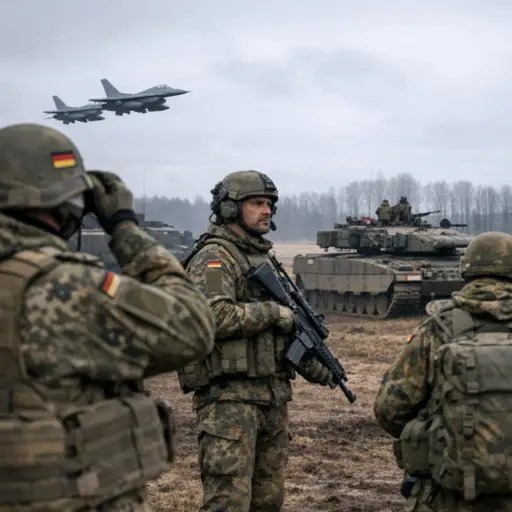
With security officials warning that Russia could test NATO’s resolve within a short strategic window, Berlin is accelerating military planning and reshaping Europe’s defence posture.
Germany is quietly but decisively preparing for a future that many in Europe once hoped would never return. After decades of strategic restraint, the country’s military and political leadership are planning for a scenario in which NATO territory could come under direct threat, forcing the alliance to respond at speed and scale.
Recent assessments circulating within German defence circles suggest that Russia may be capable of challenging NATO’s eastern flank within a relatively short time horizon. While no imminent attack is expected, the warning has been sufficient to trigger an intensification of planning, procurement, and coordination across the alliance. For Germany, Europe’s largest economy and a logistical hub for NATO, the implications are profound.
At the heart of Berlin’s concerns lies a changing security environment shaped by prolonged conflict in Eastern Europe, increased militarisation along NATO’s borders, and the erosion of arms control frameworks that once stabilised relations between East and West. German military planners argue that Russia’s armed forces, despite losses and economic pressure, are adapting quickly, learning from battlefield experience, and restructuring for potential confrontation with NATO.
This assessment has pushed Germany to accelerate its long-debated shift away from a post–Cold War defence model. The Bundeswehr, long criticised for underinvestment and limited readiness, is undergoing structural reform aimed at restoring its ability to deter and, if necessary, defend. Senior officers speak increasingly openly about preparedness, resilience, and the need to think in terms of large-scale collective defence rather than crisis management abroad.
Germany’s role is central not because it sits on the front line, but because it underpins NATO’s ability to operate. In any major alliance operation, German territory would serve as a transit corridor for troops, equipment, and supplies moving eastward. This has placed renewed emphasis on infrastructure protection, military mobility, and civil defence planning, areas that received little attention in recent decades.
Rail networks, highways, ports, and digital systems are now being assessed through a security lens. Defence planners are working with civilian authorities to ensure that transportation and energy networks could function under stress, including cyber disruption or sabotage. The concept of “total defence,” once considered outdated, is re-emerging in policy discussions as governments recognise that modern conflict blurs the line between military and civilian domains.
The warning from German military analysts has also reverberated beyond Berlin. Across Europe, NATO members are reassessing their own preparedness and force contributions. Countries on the alliance’s eastern flank have long argued that deterrence requires visible, credible capabilities. Germany’s renewed focus on defence planning is therefore seen by allies as both overdue and essential.
At the political level, the shift is delicate. Germany’s post-war identity has been built on military restraint, multilateralism, and a strong preference for diplomacy. While public opinion has evolved in response to recent crises, any move toward sustained defence expansion remains sensitive. Government officials have sought to frame the preparations not as a march toward war, but as a necessary insurance policy designed to prevent it.
Deterrence, in this view, is about convincing potential adversaries that any attack would fail or come at an unacceptable cost. German officials stress that planning for worst-case scenarios does not signal aggressive intent. Instead, they argue, it reflects a sober reading of strategic realities and a commitment to alliance solidarity.
Russia, for its part, continues to deny any intention to attack NATO, accusing the alliance of provoking instability through expansion and military deployments. Yet the mutual distrust that now defines relations has reduced the space for reassurance. With communication channels strained and arms control agreements weakened, military planners on both sides are preparing for uncertainty.
Germany’s preparations are also influencing debates about defence spending and industrial capacity. Meeting alliance commitments requires not only money, but the ability to produce and maintain modern equipment at scale. The defence industry is being asked to expand output, shorten delivery times, and invest in long-term capacity, reversing decades of contraction.
Critics warn of the risks of a security-driven spiral, in which threat perceptions feed militarisation on all sides. Supporters counter that failing to prepare would be far more dangerous, inviting miscalculation and coercion. For Germany, the lesson drawn from recent history is that peace cannot be taken for granted, even in Europe.
As NATO adapts to a more contested security environment, Germany’s transformation is emblematic of a broader shift. The alliance is moving from reassurance to readiness, from assumption to planning. The aim is not to predict the future with certainty, but to ensure that, should deterrence fail, Europe is not caught unprepared.
For now, the preparations remain largely out of public view, embedded in planning documents, exercises, and budget lines. Yet their significance is unmistakable. Germany is preparing not because it expects war, but because it believes that credible preparedness is the strongest argument against it.



 The Tower Post