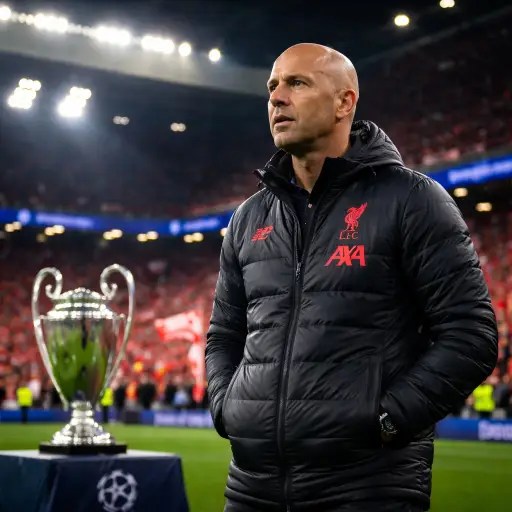
With domestic consistency elusive, the Reds’ manager frames the Champions League as a proving ground rather than an escape
Liverpool’s winter has been defined by contrast. On European nights, the stadium still hums with belief and ritual, the kind forged by decades of continental drama. In the Premier League, however, that certainty has frayed. As January draws to a close, Liverpool manager Arne Slot has chosen his words carefully, urging his squad and supporters to narrow their focus to the Champions League, even as domestic form continues to provoke uncomfortable questions.
Slot’s message is not one of denial, but of prioritisation. The Dutch coach, still in the early phase of his tenure at Anfield, has acknowledged that league performances have fallen short of expectations. Results have been uneven, momentum difficult to sustain, and familiar authority within matches has too often slipped away. Yet rather than allow frustration to spread across competitions, Slot has framed Europe as a stage where clarity of purpose can be restored.
“Europe demands a different kind of attention,” has become the underlying theme of his recent briefings. In the Champions League, there is little room for drifting intensity or half-measures. Slot believes that this sharpness can act as a corrective, reminding players of standards that have recently wavered on domestic fronts.
The contrast in Liverpool’s performances has been stark. In the league, the side has struggled to control games that once felt routine. Midfields have been bypassed too easily, defensive lines stretched, and attacking patterns disrupted by a lack of rhythm. Injuries and rotation have played their part, but so too has a broader sense of transition, as players adapt to Slot’s methods and positional demands.
Europe, by comparison, has offered structure. Tactical plans have been executed with greater discipline, pressing triggers more coherent, and game management more assured. For Slot, this is not coincidence. He has suggested that the psychological framing of a Champions League tie — the clarity of opposition, the immediacy of consequence — brings out a decisiveness that has been missing at times in the league.
Critics, however, see danger in such a narrative. Focusing too heavily on Europe risks the perception that domestic shortcomings are being quietly accepted. The Premier League remains the club’s primary measure of consistency, and Liverpool’s standards have been set high by recent history. Slot has been quick to counter the idea that his European emphasis signals surrender elsewhere. Instead, he presents it as a recalibration: using Europe to reset habits, not to excuse failures.
Inside the dressing room, the message is said to be direct. Senior players are being asked to lead emotionally as much as tactically, particularly in moments when league matches turn tense. Slot’s approach leans heavily on collective responsibility, with less tolerance for the passive spells that have undermined recent performances. He has stressed that intensity cannot be scheduled; it must become instinctive again.
The Champions League also offers something else Liverpool have been missing: narrative momentum. A strong European run has historically acted as a catalyst at Anfield, lifting belief and sharpening focus across competitions. Slot is clearly aware of this tradition, even if he avoids referencing it explicitly. His public tone remains pragmatic, grounded in preparation rather than romance.
For supporters, the balancing act is delicate. There is pride in Europe and impatience at home. Many recognise the need for patience under a new manager, yet expectations have not softened. Slot’s calm, analytical demeanour contrasts with the volatility of results, creating a tension that defines this phase of his reign.
As January fades, Liverpool stand at a crossroads that feels familiar but unresolved. The Champions League offers an immediate test, one that Slot believes can reinforce identity and restore conviction. Whether that focus can translate into domestic recovery remains uncertain. What is clear is that, for now, Europe has become the lens through which Liverpool are being asked to rediscover themselves.




 The Tower Post