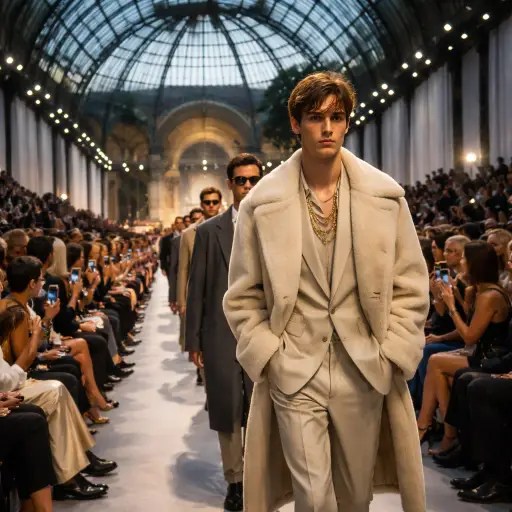
As menswear takes center stage, historic houses balance transition and tradition, setting the tone for a season defined by confidence and reinvention.
Paris Fashion Week has opened with a palpable sense of momentum, as the city once again becomes the focal point of the global fashion conversation. This season’s opening days have been marked by renewed creative energy, visible both on the runways and behind the scenes, where several storied houses are navigating moments of transition while reaffirming their identities. Menswear, long a laboratory for experimentation in Paris, is at the heart of this dialogue, offering a blend of heritage craftsmanship and contemporary urgency.
From the first shows, the atmosphere has felt purposeful rather than nostalgic. Designers are clearly aware of fashion’s shifting terrain: economic uncertainty, changing consumer habits, and a growing demand for authenticity have all sharpened the stakes. Yet instead of retreating into caution, Paris has responded with collections that emphasize clarity of vision. The message is consistent across houses both large and small: legacy is not a constraint, but a foundation from which to move forward.
Transitions at major maisons have been one of the defining undercurrents of the week. Creative handovers, whether recently completed or still unfolding, are being closely watched by buyers and critics alike. Rather than dramatic breaks with the past, many designers are opting for a quieter recalibration. Familiar codes—precise tailoring, artisanal finishes, and signature silhouettes—are being reinterpreted with lighter touches, updated proportions, and a more relaxed attitude. The result is menswear that feels grounded yet unmistakably current.
At several heritage labels, the opening looks set the tone immediately. Sharp coats and structured jackets appeared alongside fluid trousers and softened layers, suggesting a shift away from rigid formality. Color palettes favored depth and nuance over spectacle: charcoal, ink, olive, and warm neutrals dominated, punctuated by occasional flashes of saturated color. These choices spoke to confidence rather than caution, signaling designers who trust their audience to appreciate subtle evolution.
Younger designers, meanwhile, have used the opening days to assert Paris’s role as a platform for new voices. Their collections often blur the boundaries between streetwear and tailoring, drawing on personal narratives and cultural references without falling into pastiche. There is a noticeable emphasis on wearability, but not at the expense of imagination. Experimental cuts, unconventional fabric pairings, and playful layering suggest a generation intent on redefining what luxury means in everyday life.
Craft remains a central theme throughout the week. In workshops across Paris, traditional techniques continue to inform modern design, and this season they are being highlighted with renewed pride. Hand-finished seams, intricate embroidery, and innovative textile treatments are presented not as relics of the past, but as markers of value in an era of mass production. Several houses have made a point of drawing attention to the human labor behind their garments, reinforcing fashion’s connection to time, skill, and patience.
The influence of heritage is also evident in the way designers are revisiting archival ideas. Rather than reproducing iconic pieces, many are extracting underlying principles—proportion, movement, or attitude—and translating them into contemporary forms. This approach allows collections to resonate with long-standing clients while remaining accessible to younger audiences discovering these brands for the first time. It is a balancing act that Paris, with its deep fashion history, is uniquely equipped to perform.
Sustainability, while less overtly foregrounded in some presentations, continues to shape decision-making behind the scenes. Material choices, production volumes, and show formats reflect an industry increasingly aware of its responsibilities. The mood is pragmatic rather than preachy, with designers integrating more responsible practices into their work without turning them into marketing slogans. This quiet integration may signal a maturation of the conversation, where action speaks louder than declarations.
As the week unfolds, buyers are paying close attention to pieces that feel adaptable and enduring. Outerwear, in particular, has emerged as a strong category, with coats and jackets designed to bridge seasons and settings. Accessories, too, are being treated with seriousness, reinforcing the idea that menswear wardrobes are built over time, not replaced each season. The commercial undercurrent is unmistakable, but it does not overwhelm the creative one.
Ultimately, the opening of Paris Fashion Week suggests a city comfortable with its role as fashion’s anchor. There is little need for provocation for its own sake; instead, the strength lies in thoughtful progression. By embracing both energy and legacy, Paris is signaling that the future of menswear will be shaped not by abrupt disruption, but by confident, informed evolution.
As editors, buyers, and audiences move between shows in the winter light, the prevailing impression is one of continuity with purpose. Paris is not looking backward, nor is it chasing novelty. It is, as ever, refining its language—one collection at a time—and reminding the industry why its voice still carries such weight.


 The Tower Post