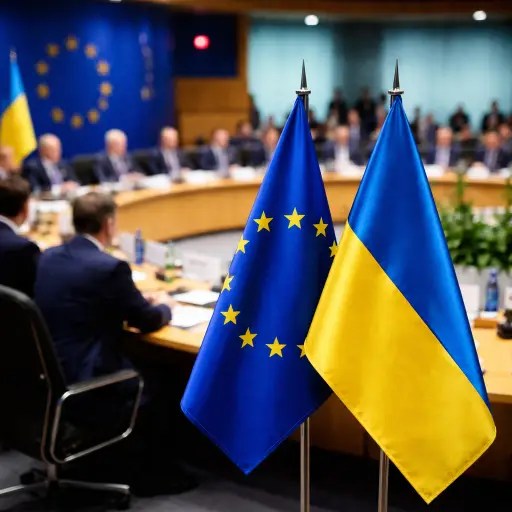
Brussels talks see cautious assessments on membership timelines even as bloc condemns “state terror” and boosts humanitarian assistance.
European Union foreign ministers met in Brussels in late January for a high-stakes discussion on Ukraine’s future, amid intensifying Russian attacks and deepening divisions within the bloc over the pace of Kyiv’s accession to the EU.
At the core of the debate was Ukraine’s aspiration to join the European Union by a target year proposed by Kyiv — a goal welcomed by many capitals but explicitly questioned by Luxembourg’s foreign minister, who stressed that accession in that timeframe is unlikely without full compliance with the bloc’s stringent criteria. The Copenhagen criteria — a set of political, economic and legal benchmarks — remain a non-negotiable benchmark for membership, he reiterated, underscoring that no candidate can be advanced without meeting established rules.
Ministers gathered against a backdrop of daily reports from Ukraine highlighting the devastating toll of Russian bombardments on civilian infrastructure, particularly energy networks. EU officials attending the council described the strikes not simply as military operations but as tactics tantamount to “state terror,” aimed at forcing Ukrainian capitulation through winter hardships.
In a coordinated response, the European Commission pledged €145 million in additional humanitarian aid to support shelter, food, health services, cash assistance and psychosocial support for civilians displaced or affected by the continued bombardment of energy facilities. Crisis management officials stressed that this funding is designed to provide relief as winter conditions exacerbate suffering across conflict-affected regions.
Despite these gestures of solidarity, the accession debate revealed fault lines. Some member states endorse a more rapid timetable to integrate Ukraine, arguing that closer European ties will enhance stability and security on the bloc’s eastern flank. Others, including Luxembourg, have urged caution, emphasizing that enlargement must uphold EU standards — from rule of law to democratic safeguards — lest credibility be undermined in future accession negotiations.
EU foreign policy leadership amplified these views while also highlighting internal tensions, notably over unanimous consent required for enlargement decisions. The commissioner for enlargement acknowledged broad political support for Kyiv’s aspirations but stopped short of affirming a fixed entry date, signaling that conditions rather than calendars will determine the pace of progress.
Alongside Ukraine’s accession prospects, ministers discussed the worsening humanitarian situation on the ground. EU officials conveyed concern over the deepening humanitarian crisis caused by Russian attacks on civilian infrastructure and the ensuing risk of mass displacement, particularly as colder weather sets in. Calls for enhanced energy support and civil protection measures reflected a shared sense of urgency.
The session also reiterated the EU’s broader strategic posture toward Russia. The bloc has repeatedly condemned the invasion and its associated violence while imposing successive rounds of sanctions targeting Russian political, military and economic actors. These measures, embraced across much of the EU, are part of a broader effort to define Moscow’s actions not merely as conventional warfare but as systematic violations of international law and human rights.
While the summit did not conclude with definitive decisions on a fixed accession timetable, it underscored the dual reality facing European leaders: unwavering support for Ukraine’s European future — including humanitarian and political backing — paired with a firm insistence that EU accession standards must be met before full membership can be granted.
As discussions continue in Brussels and across EU capitals, Kyiv’s European trajectory remains a defining question for the bloc’s future — one shaped as much by principles and institutional thresholds as by geopolitical urgency.

 The Tower Post