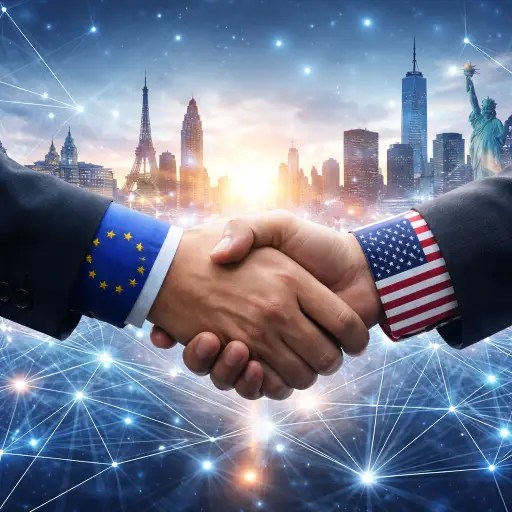
Nokia’s chief executive underscores why transatlantic co-dependence, not rivalry, is shaping the next phase of global technology
As geopolitical tensions, trade realignments, and industrial policy debates continue to reshape the global economy, a clear message has emerged from the leadership of one of Europe’s most emblematic technology companies: the future of innovation remains deeply transatlantic.
Speaking against a backdrop of accelerating digital transformation, Nokia’s chief executive has stressed that Europe and the United States are not competing technology islands, but interlinked pillars of a single, highly integrated ecosystem. From advanced semiconductors and cloud infrastructure to 5G, artificial intelligence, and cybersecurity, modern technology is built through supply chains, standards, and research networks that span both continents.
This reality, Nokia’s leadership argues, is often underestimated in political debates that frame technological sovereignty as separation rather than collaboration. In practice, the digital economy runs on co-dependence.
At the heart of the argument is infrastructure. Networks that carry data across cities, countries, and oceans are rarely confined to one jurisdiction. European telecom operators rely heavily on American-designed chips, software platforms, and cloud services. At the same time, U.S. hyperscalers and enterprises depend on European network equipment, optical systems, and research expertise. Nokia itself operates major research centers and engineering teams on both sides of the Atlantic, reflecting how innovation flows across borders rather than stopping at them.
The same pattern applies to standards. Global connectivity depends on shared technical frameworks, whether for mobile networks, internet protocols, or emerging technologies such as 6G. European and American firms, universities, and regulators collaborate extensively in standard-setting bodies. According to Nokia’s chief executive, this quiet, technical cooperation is one of the most powerful yet least visible forces holding the global digital economy together.
Recent policy shifts have added urgency to this message. Governments in both Europe and the United States are investing heavily in domestic technology capabilities, motivated by supply-chain resilience and national security concerns. While these investments have strengthened local ecosystems, they have also raised fears of fragmentation. Nokia’s leadership has cautioned that resilience should not be confused with isolation.
In the telecom sector, for example, building secure and reliable networks requires scale. Research and development costs are rising sharply as networks become more software-driven and energy-efficient, and as they incorporate artificial intelligence for automation and optimization. No single region, Nokia argues, can sustainably carry these costs alone without sacrificing speed or global competitiveness.
Artificial intelligence offers another clear illustration of co-dependence. The most advanced AI systems depend on a combination of American-designed chips, globally sourced manufacturing, European research talent, and massive data-center infrastructure distributed across regions. Regulatory approaches may differ between Brussels and Washington, but the underlying technology stack remains shared.
Nokia’s chief executive has emphasized that this shared stack creates both opportunity and responsibility. Close cooperation allows Europe and the United States to set global norms on issues such as data protection, network security, and ethical AI. At the same time, divergence risks ceding influence to other regions that are eager to define their own standards.
The company’s perspective carries weight because Nokia sits at the intersection of multiple strategic debates. As a major supplier of mobile and fixed networks, it works with governments, operators, and enterprises worldwide. Its products underpin critical infrastructure, from emergency communications to industrial automation. That vantage point provides a clear view of how deeply intertwined technology ecosystems have become.
Economic data reinforce this view. Transatlantic technology investment remains among the largest and most stable in the world. European firms continue to expand research, manufacturing, and cloud partnerships in the United States, while American companies invest heavily in European data centers, startups, and advanced manufacturing. Talent flows in both directions, with engineers and researchers building careers that span continents.
Yet challenges remain. Regulatory complexity, differing competition rules, and debates over digital taxation and data governance can slow cooperation. Nokia’s leadership has called for more structured dialogue between policymakers and industry to ensure that regulations support innovation without undermining interoperability.
Security concerns also loom large. As networks become more software-defined and cloud-based, they present new vulnerabilities. Here again, Nokia argues that cooperation is essential. Shared threat intelligence, joint research into secure architectures, and aligned certification schemes can strengthen defenses far more effectively than fragmented approaches.
Looking ahead, the transition toward next-generation networks and digital services will test the resilience of the transatlantic relationship. Technologies such as 6G, edge computing, and immersive digital platforms will demand unprecedented coordination across hardware, software, and services. Nokia’s chief executive has framed this not as a choice between Europe and America, but as a collective challenge that requires both.
The broader implication is political as much as technological. In a world increasingly shaped by strategic competition, the Europe–U.S. technology relationship represents a model of managed interdependence. It combines competition with collaboration, national interests with shared values, and local investment with global reach.
As debates over industrial policy and technological sovereignty continue, Nokia’s message is a reminder that modern innovation rarely fits neatly within borders. The cables, code, and standards that power the digital economy form a shared backbone. Protecting and strengthening that backbone, the company argues, depends on recognizing co-dependence not as a weakness, but as a strategic asset.
For Europe and the United States alike, the challenge is to translate that recognition into policies that sustain openness, trust, and collaboration. In doing so, they may not only secure their own technological future, but also shape the global digital order for years to come.



 The Tower Post