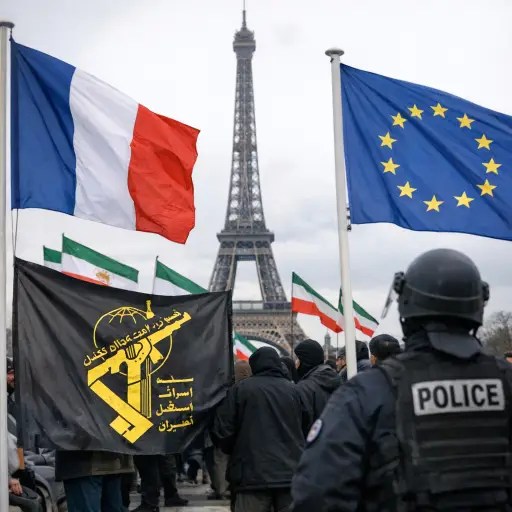
Paris presses for an EU-wide designation of Iran’s Islamic Revolutionary Guard Corps, as Rwanda’s legal action against the UK over migration policy underscores widening global legal tensions
France has moved to open a formal pathway toward labeling Iran’s Islamic Revolutionary Guard Corps (IRGC) as a terrorist organization, a step that would mark one of the most consequential shifts in Europe’s posture toward Tehran in years. The initiative, driven by Paris and gaining cautious traction among several European partners, reflects a hardening mood inside the European Union as diplomacy with Iran remains strained and regional conflicts continue to reverberate across the Middle East.
French officials argue that the IRGC’s activities—ranging from support for armed groups abroad to alleged involvement in plots on European soil—can no longer be treated as a peripheral security concern. Instead, they see the Guards as a central instrument of Iranian state power whose actions directly challenge European security interests and international norms. By pushing for a formal designation, France is seeking to move the debate from political condemnation to legal consequence.
The proposal faces a complex road through Brussels. Under EU law, adding an entity to the terrorist list requires a robust legal basis, typically grounded in court decisions or clear evidence of terrorist acts. Some member states remain wary of the diplomatic fallout, fearing retaliation against European interests or a complete collapse of remaining channels with Tehran. Others, particularly in Eastern and Northern Europe, have signaled openness to France’s argument, framing the issue as one of legal consistency rather than geopolitical escalation.
Within France, the push reflects both domestic and strategic calculations. Security agencies have repeatedly warned of the IRGC’s reach through networks they say operate under diplomatic and commercial cover. Politically, Paris is also positioning itself as a leading voice on European security autonomy, insisting that the EU must be capable of decisive action even when transatlantic partners are divided or cautious.
Tehran has reacted sharply to the French initiative, denouncing it as a hostile act and warning of “serious consequences” for bilateral relations. Iranian officials maintain that the IRGC is a legitimate arm of the state, integral to national defense, and accuse European governments of bowing to external pressure. The standoff adds another layer of tension to an already fragile relationship marked by stalled nuclear talks, sanctions disputes, and mutual distrust.
The debate over the IRGC designation is unfolding against a broader backdrop of legal and political confrontation on the global stage. In a separate but symbolically resonant case, Rwanda has launched legal action against the United Kingdom over its controversial migrant transfer arrangements. Kigali argues that the agreements, which seek to relocate asylum seekers to Rwandan territory, violate international obligations and undermine sovereign consent as framed in the evolving legal structure of the deals.
The Rwandan case, now moving through judicial channels, has drawn attention far beyond the specifics of UK migration policy. Legal experts see it as part of a growing trend in which states, particularly from the Global South, are increasingly willing to challenge major powers in court rather than solely through diplomatic protest. The case raises questions about responsibility, jurisdiction, and the limits of bilateral agreements when they intersect with international refugee law.
Together, the French push on Iran and Rwanda’s lawsuit against the UK illustrate a world in which legal instruments are becoming as central as military or economic power. Governments are turning to courts, designations, and formal rulings to advance strategic objectives or defend national interests. This legal turn does not necessarily reduce tensions; in some cases, it institutionalizes them, locking disputes into prolonged and highly visible processes.
For the European Union, the IRGC debate is a test of unity and resolve. A successful designation would signal that the bloc is prepared to absorb diplomatic costs in the name of security and legal principle. Failure to act, after months of discussion, could reinforce perceptions of indecision and internal division. Either outcome will shape how Europe is viewed by allies and adversaries alike.
As January draws to a close, policymakers in Paris, Brussels, London, and Kigali are all navigating a landscape where law and politics are tightly intertwined. Whether through terrorist listings or courtroom challenges, states are increasingly defining their power not just by what they can enforce, but by what they can argue—and win—under the rules they collectively claim to uphold.


 The Tower Post