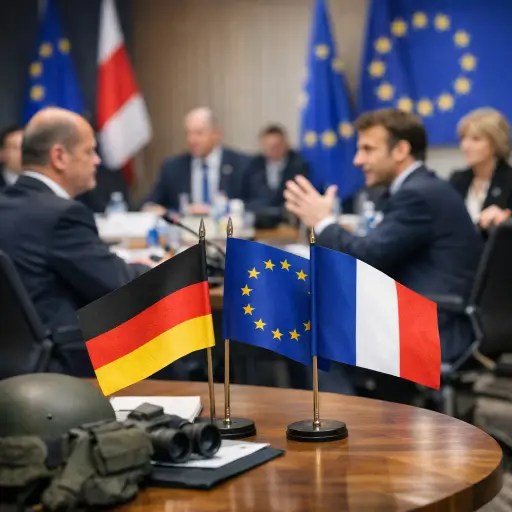
Berlin and Paris argue that differentiated integration could unblock defense and industrial policy, while critics warn of a fragmented Union.
By early 2026, the idea that the European Union should move at different speeds is no longer confined to academic debate. It has returned to the political foreground, pushed most forcefully by Germany and France as a response to mounting security pressures, economic competition, and persistent policy deadlock among the EU’s twenty-seven member states.
At the heart of the proposal is a familiar but controversial concept: a “two-speed” Europe. Under this model, a core group of countries willing and able to deepen cooperation would move ahead in areas such as defense, industrial policy, and strategic autonomy, while others could opt in later or remain outside those arrangements. Berlin and Paris argue that the approach reflects political reality and offers a pragmatic way forward at a moment when unanimity has become increasingly elusive.
The renewed push comes against a backdrop of heightened geopolitical uncertainty. The war on the EU’s eastern flank, instability in the Middle East and Africa, and intensifying rivalry between the United States and China have all underscored Europe’s dependence on external powers for security and critical technologies. For German and French leaders, these pressures have exposed the limits of the EU’s current decision-making framework.
In recent months, officials in both capitals have made the case that the Union’s requirement for broad consensus, particularly in foreign and defense policy, has slowed responses to crises and diluted ambitions. Defense procurement projects, joint military capabilities, and coordinated industrial strategies have repeatedly been stalled by divergent national priorities. The result, they argue, is an EU that speaks of strategic autonomy but struggles to deliver it.
Germany’s position reflects a notable evolution. Traditionally cautious about initiatives that might divide the Union, Berlin has grown more open to differentiated integration as its own strategic outlook has shifted. Increased defense spending and a reassessment of security policy have made German policymakers more receptive to closer military cooperation with a smaller group of partners, provided it strengthens European capabilities rather than duplicating existing alliances.
France, by contrast, has long championed the idea of a more sovereign Europe led by a vanguard of committed states. Paris sees a two-speed model as a logical extension of existing arrangements, pointing to the eurozone and the Schengen area as precedents where not all members participate on equal terms. From the French perspective, deeper integration among a core group would reinforce Europe’s ability to act independently on the global stage.
Supporters of the proposal stress that it is not about exclusion but flexibility. They argue that the EU is already operating at multiple speeds in practice, and that formalizing this reality could reduce frustration on all sides. Countries that wish to move faster would no longer be held back, while those with domestic constraints or different priorities would avoid being pushed into commitments they are not ready to make.
Yet the initiative has sparked unease across the bloc, particularly among smaller and newer member states. In Central and Eastern Europe, some governments fear that a two-speed EU could entrench divisions between a powerful inner circle and a peripheral outer ring. They worry that decisions taken by a core group on defense and industrial policy could shape the Union’s future without their full participation or influence.
There are also concerns that differentiated integration might weaken the EU’s cohesion at a time when unity is widely seen as essential. Critics argue that creating formal tiers of membership risks undermining solidarity and could fuel Euroscepticism in countries that feel left behind. For them, the answer to gridlock lies in reforming decision-making rules, not in accepting fragmentation as inevitable.
Legal and institutional questions further complicate the debate. Expanding two-speed arrangements in sensitive areas such as defense would require careful navigation of EU treaties and national constitutional constraints. While existing mechanisms allow for enhanced cooperation among subsets of member states, scaling these up into a coherent strategic framework would be a complex task.
Despite the controversy, the discussion has gained momentum in Brussels. EU officials acknowledge that the Union’s ambitions in defense and industrial policy have outpaced its ability to act collectively. The challenge, they say, is to strike a balance between effectiveness and inclusiveness, ensuring that deeper cooperation among some does not come at the expense of the Union as a whole.
For Germany and France, the stakes are high. Both see the two-speed model as a test of the EU’s capacity to adapt to a harsher international environment. Failure to find workable solutions, they warn, could leave Europe increasingly vulnerable and dependent, with strategic decisions made elsewhere.
As the debate unfolds, it is clear that the question is not merely technical but deeply political. It touches on competing visions of what the European Union should be: a tightly integrated bloc moving forward together, or a more flexible structure that accommodates diversity at the cost of uniformity. In January 2026, that choice remains unresolved, but the push from Berlin and Paris has ensured it can no longer be postponed.

 The Tower Post