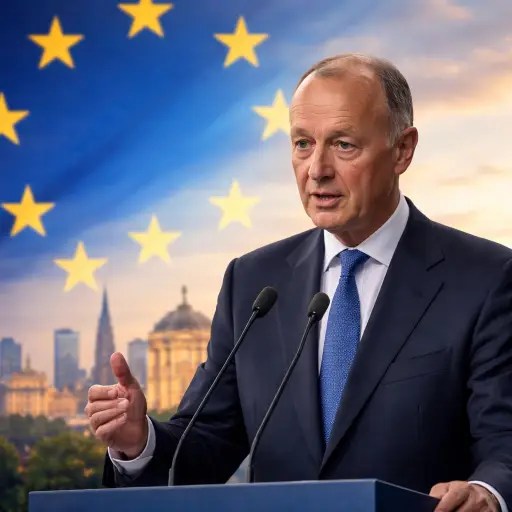
Merz frames European unity as an alternative to imperial power politics, underscores NATO’s role, and calls for balanced transatlantic ties and trade cohesion.
Germany’s chancellor used a prominent European stage this week to argue that the European Union represents a modern alternative to imperialism, casting the bloc as a democratic answer to an era increasingly defined by coercion, spheres of influence, and raw power politics. In a speech calibrated for both European partners and global allies, Chancellor Friedrich Merz presented the EU not as a rival empire, but as a voluntary union grounded in law, shared sovereignty, and civic consent.
At a time when authoritarian models are gaining visibility and confidence, Merz described the EU as proof that influence does not have to be enforced by domination. “Europe’s strength,” he said, lies in the ability of free societies to bind themselves together without erasing national identity, replacing imperial ambition with negotiated cooperation. The message was clear: the EU’s power is normative and democratic, not territorial or coercive.
The chancellor’s remarks come amid renewed geopolitical tension, with wars on Europe’s periphery, strategic competition between major powers, and an unsettled global economy reshaping alliances. Against that backdrop, Merz warned that the language of empire — whether expressed through military pressure, economic leverage, or political intimidation — is re-entering international discourse. Europe, he argued, must respond not by mimicking those methods, but by reinforcing its own model.
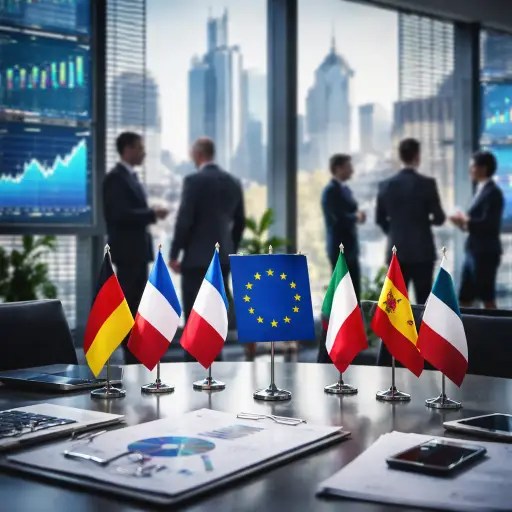
Central to that model is unity. Merz stressed that the EU’s credibility depends on its ability to act together, particularly on trade and economic policy. Fragmentation, he cautioned, weakens Europe’s voice and leaves individual member states vulnerable to external pressure. Coordinated trade policy, fair competition rules, and investment in strategic industries were presented as essential tools for maintaining autonomy without sliding into protectionism.
While emphasizing European agency, the chancellor was careful to reaffirm Germany’s commitment to NATO. He described the alliance as “indispensable” for European security, especially in light of ongoing instability to the east. NATO, in Merz’s telling, remains the cornerstone of collective defense and deterrence, providing a security umbrella that allows European democracies to thrive.
At the same time, Merz called for a more balanced transatlantic relationship. Without questioning the depth of ties with the United States, he suggested that Europe must be capable of acting independently when its interests require it. Strategic maturity, he argued, means being a reliable ally without being dependent, a partner that contributes to shared security rather than outsourcing responsibility.
This balance extends beyond defense. On trade, Merz urged closer coordination between Europe and its transatlantic partners to avoid damaging disputes and unilateral measures. He warned that trade conflicts among allies only benefit authoritarian competitors who exploit divisions. A united approach, he said, would strengthen democratic economies and set global standards rooted in transparency and fairness.
The speech also carried a domestic dimension. By framing the EU as an alternative to imperialism, Merz implicitly addressed skepticism within Germany and elsewhere about Brussels’ role. He rejected the idea of the EU as an overreaching bureaucracy, portraying it instead as a platform through which nations amplify their democratic choices. Sovereignty, in this view, is not surrendered but pooled.
European officials attending the address welcomed the emphasis on unity, noting that Germany’s tone reflects a broader shift toward a more assertive but values-driven Europe. Diplomats said the chancellor’s language resonated with partners concerned about the erosion of international norms and the temptation, even among democracies, to retreat into narrow national interest.
Critics, however, cautioned that rhetoric must be matched by policy. Calls for unity on trade and defense have echoed through European halls for years, often colliding with domestic politics and divergent economic priorities. Whether Berlin can translate its vision into sustained compromise remains an open question.
Still, the timing of Merz’s intervention was widely seen as deliberate. With global alliances under strain and democratic cohesion being tested, the chancellor positioned Germany as a champion of a European project that rejects imperial nostalgia and embraces cooperative power. The EU, in his telling, is not a relic of a postwar order but a living response to contemporary challenges.
As Europe navigates an uncertain international landscape, Merz’s message was both a warning and an invitation: a warning against the return of imperial thinking, and an invitation to strengthen a union built on choice rather than force. Whether that vision can hold amid mounting pressures may define Europe’s role in the world in the period ahead.


 The Tower Post