
Analysts warn that Moscow’s blend of disinformation, sabotage, and low-level incursions is testing Europe’s cohesion and security resilience.
By late January, European security officials say the pressure is unmistakable. Russia’s hybrid campaign against Europe—long described as a shadow conflict operating below the threshold of open war—has not abated. Instead, it has evolved, adapting to tighter sanctions, stronger defenses, and a more alert public. According to analysts and security experts, Moscow continues to probe Europe’s political, digital, and physical infrastructure with a mix of deniable actions designed to confuse, exhaust, and divide.
Hybrid warfare, as defined by Western strategists, combines military and non-military tools: cyber operations, disinformation, economic coercion, sabotage, and the use of proxies. What makes it effective is not any single attack, experts say, but the cumulative effect. “The goal is strategic erosion,” said one senior analyst at a European security think tank. “Russia is trying to stretch European institutions thin, forcing governments to respond to constant, ambiguous pressure.”
Disinformation remains a central pillar of this approach. Across social media platforms and fringe news sites, narratives questioning democratic legitimacy, inflaming migration fears, or amplifying social divisions continue to circulate. Analysts note that these campaigns are often localized, tailored to national debates in different European countries. The intent is less about persuading outright and more about amplifying distrust—toward governments, toward allies, and toward shared European policies.
Alongside the information war, officials point to a rise in suspicious incidents affecting infrastructure and logistics. Investigations in several countries have focused on acts of sabotage or attempted interference with transport networks, energy facilities, and communications cables. While attribution is often difficult, intelligence agencies argue that the pattern fits a broader strategy: create uncertainty about the safety and reliability of everyday systems that modern societies depend on.
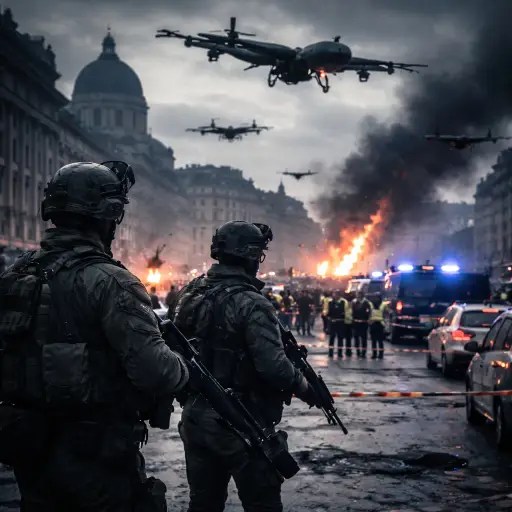
Unmanned aerial vehicles have become another symbol of this gray-zone conflict. Drone incursions near sensitive sites and borders, sometimes dismissed as accidents or civilian errors, have drawn growing attention from defense planners. Even when no direct damage occurs, experts say such incidents force costly responses and keep security services on edge. “Each event may seem minor,” one defense official noted, “but together they impose a constant tax on attention and resources.”
The cumulative pressure is testing European cohesion. Responses to hybrid threats require close coordination—between governments, intelligence services, technology companies, and the public. Yet political divisions and uneven capabilities across the continent complicate that effort. Some countries have invested heavily in counter-disinformation units and cyber defenses, while others lag behind, creating vulnerabilities that can be exploited across borders.
European institutions have moved to strengthen collective defenses, emphasizing resilience rather than retaliation. This includes improving the protection of critical infrastructure, sharing intelligence more rapidly, and educating citizens about manipulation tactics. Still, experts caution that resilience is a long-term project. “Hybrid war is not about quick victories,” said a former NATO official. “It’s about endurance. Russia is betting that democracies will tire before it does.”
As Europe looks ahead, analysts argue that acknowledging the persistence of the threat is essential. Hybrid attacks thrive in ambiguity and denial; they are most effective when societies argue over whether an attack has even occurred. For security experts, the message is clear: the conflict is ongoing, even if it rarely makes headlines in dramatic fashion. And in this quiet struggle, vigilance—political, institutional, and societal—remains Europe’s most critical line of defense.




 The Tower Post