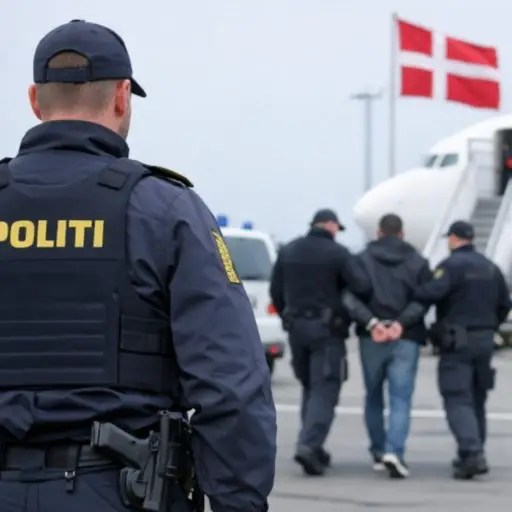
Copenhagen’s proposed deportation overhaul tests Europe’s human-rights consensus as nationalist pressure reshapes migration policy.
Denmark is preparing to redraw the legal boundaries of who can stay and who must leave. In the opening days of February, the government unveiled a sweeping proposal to toughen deportation laws, granting authorities broader powers to expel non-citizens and to subject some of them to electronic monitoring. Framed as a necessary response to security concerns and public unease over migration, the plan has immediately reignited debate across Europe about the limits of national sovereignty and the durability of shared human-rights standards.
At the heart of the proposal is an expansion of deportation eligibility. Under the new framework, foreign nationals convicted of certain crimes, or deemed to pose a threat to public order, could be expelled more swiftly and with fewer procedural safeguards than before. In parallel, the government wants courts to make wider use of electronic ankle bracelets for non-citizens who are awaiting deportation but cannot be removed immediately. Officials argue that monitoring offers a humane alternative to prolonged detention while still ensuring compliance with removal orders.
The initiative is not emerging in a vacuum. Denmark has, for years, pursued one of Europe’s most restrictive migration regimes, often with the support of a broad parliamentary consensus. Successive governments, including those led by center-left coalitions, have embraced hardline measures once associated primarily with the far right. This political convergence reflects a domestic landscape in which immigration remains a potent electoral issue, amplified by nationalist parties that have steadily normalized tougher rhetoric and policy demands.
Government ministers insist the latest proposal strikes a careful balance. They emphasize that deportation decisions would still be subject to judicial oversight and that electronic monitoring would be used selectively. “This is about protecting society while respecting the rule of law,” one senior official said, describing the reforms as both firm and fair. Supporters also point to public opinion surveys suggesting strong backing for stricter controls on foreign offenders.
Yet legal experts and human-rights organizations warn that the measures could push Denmark into conflict with European norms. The expansion of expulsion powers raises questions about proportionality, particularly in cases involving long-term residents with family ties in the country. Critics argue that automatic or near-automatic deportation risks undermining the right to private and family life, a cornerstone of European human-rights jurisprudence.
Electronic monitoring, too, has become a flashpoint. While less restrictive than detention, ankle bracelets carry their own stigma and intrusions into daily life. Civil-liberties advocates caution that normalizing surveillance for a specific group—non-citizens—creates a two-tier justice system. “You end up with punishment not just for what someone has done, but for who they are,” said one rights lawyer, warning of a slippery slope toward discriminatory enforcement.
Beyond Denmark’s borders, the proposed legislation is being watched closely. The country has often served as a policy laboratory, testing measures that later inspire or embolden other governments. In recent years, several European states have explored expanded deportation powers, offshore asylum processing, and stricter residency requirements. Denmark’s latest move may further legitimize a trend toward securitizing migration, even as the European Union struggles to present a unified approach.
The timing is significant. Across the continent, nationalist and populist movements continue to shape political agendas, pressing mainstream parties to adopt tougher stances on identity and borders. In this climate, human-rights obligations are increasingly portrayed as constraints rather than shared values. Denmark’s proposal encapsulates this tension: a small state asserting control while operating within a web of international commitments.
If adopted, the law could face legal challenges at home and abroad. Danish courts would be tasked with interpreting the new provisions in light of constitutional principles, while European bodies could scrutinize their compatibility with international conventions. Past experience suggests that even when rulings go against Copenhagen, political appetite for confrontation with supranational institutions may remain strong.
For migrants and minority communities within Denmark, the debate is deeply personal. Many fear that broader deportation powers will foster insecurity and mistrust, particularly among those who have lived in the country for years without citizenship. Community leaders warn that the perception of being perpetually conditional residents can erode social cohesion, undermining the very stability the government seeks to protect.
As the proposal moves through parliament, it is likely to be refined, contested, and possibly hardened further. What is already clear is that Denmark is once again at the forefront of Europe’s migration debate, challenging long-held assumptions about the balance between national control and human rights. Whether the rest of Europe follows, resists, or recalibrates in response may help define the continent’s political direction in the months ahead.




 The Tower Post